




- ABOUT ASEAN
The Association of Southeast Asian Nations, or ASEAN, was established on 8 August 1967 in Bangkok, Thailand, with the signing of the ASEAN Declaration (Bangkok Declaration) by the Founding Fathers of ASEAN: Indonesia, Malaysia, Philippines, Singapore and Thailand. Brunei Darussalam joined ASEAN on 7 January 1984, followed by Viet Nam on 28 July 1995, Lao PDR and Myanmar on 23 July 1997, Cambodia on 30 April 1999, and Timor-Leste on 26 October 2025 making up what is today the eleven Member States of ASEAN.
Menu - WHAT WE DO
ASEAN organs always strive to achieve ASEAN’s goals and objectives, the Secretary-General of ASEAN and the ASEAN Secretariat shall be functioned as coordinating Secretariat to help facilitate effective decision-making withing and amongst ASEAN bodies. In addition, each Member State shall appoint a Permanent Representative to liaise with Secretary-General of ASEAN and the ASEAN Secretariat
Menu - WHO WE WORK WITH
ASEAN shall develop friendly relations and mutually beneficial dialogues, cooperation and partnerships with countries and sub-regional, regional and international organisations and institutions. This includes external partners, ASEAN entities, human rights bodies, non-ASEAN Member States Ambassadors to ASEAN, ASEAN committees in third countries and international organisations, as well as international / regional organisations.
Menu - OUR COMMUNITIES
The rodmap for an ASEAN Community (2009-2015) was declared by the leaders in 2009. The ASEAN Community, anchored on three community pillars: Political-Security Community, Economic Community, Socio-Cultural Community was launched in 2015. The ASEAN 2025: Forging Ahead Together was introduced in 2015 as a Post-2015 Vision. It comprises the ASEAN Community Vision 2025, the ASEAN Political-Security Community Blueprint 2025, the ASEAN Economic Community Blueprint 2025 and the ASEAN Socio-Cultural Community Blueprint 2025
Menu - SITEMAP
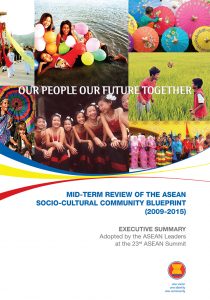
Executive Summary Mid-Term Review of the ASEAN Socio-Cultural Community Blueprint (2009-2015)
Author:

Abstract
1. The Cha-Am Hua Hin Declaration on the ASEAN Roadmap for an ASEAN Community 2009-2015 of 1 March 2009 established that the three Community Blueprints – Economic, Political-Security, and SocioCultural – and the 2nd IAI Work Plan constitute the ASEAN Roadmap. The ASEAN Socio-Cultural Community (ASCC) Blueprint’s primary goal is “to contribute to realising a peoplecentred and socially responsible ASEAN Community by forging a common identity and building a caring and sharing society.” The ASCC Blueprint is a framework for action and is structured into 6 Characteristics1 or strategiclevel development and cooperation outcomes and impacts toward ASEAN Community building. Underlying each Characteristic are Elements or inter-woven cross-pillar, thematic, sectoral and cross-sectoral outcomes. Each Element is in turn buttressed by Action Lines of which there are 339 specific results or activities to be achieved or undertaken through programmes, projects or special activities. The Blueprint contains an implementation arrangement laying out a schedule of key milestones and a coordination mechanism or governance structure delegating roles to the ASCC Council, Sectoral Ministerial Bodies, Senior Officials Meetings and other ASEAN-affiliated bodies and associated entities. In carrying out the Blueprint, ASCC is required to identify and address resource requirements, and to enumerate a communications plan that helps to enhance awareness, broaden and raise funds.
More Details
| Author | |
| Barcode | <000000010437> |
| Edition | |
| Place | |
| Publisher | |
| Year | |
| Classification | Socio-Cultural – Senior Officials’ Committee for ASCC Council (SOCA) |
| Call Number | |
| ISBN | |
| Language | English |
| Content Type | Text Book |
| Media Type | Cartographic Material |
| Number of copies |