



- ABOUT ASEAN
The Association of Southeast Asian Nations, or ASEAN, was established on 8 August 1967 in Bangkok, Thailand, with the signing of the ASEAN Declaration (Bangkok Declaration) by the Founding Fathers of ASEAN: Indonesia, Malaysia, Philippines, Singapore and Thailand. Brunei Darussalam joined ASEAN on 7 January 1984, followed by Viet Nam on 28 July 1995, Lao PDR and Myanmar on 23 July 1997, Cambodia on 30 April 1999, and Timor-Leste on 26 October 2025 making up what is today the eleven Member States of ASEAN.
Menu - WHAT WE DO
ASEAN organs always strive to achieve ASEAN’s goals and objectives, the Secretary-General of ASEAN and the ASEAN Secretariat shall be functioned as coordinating Secretariat to help facilitate effective decision-making withing and amongst ASEAN bodies. In addition, each Member State shall appoint a Permanent Representative to liaise with Secretary-General of ASEAN and the ASEAN Secretariat
Menu - WHO WE WORK WITH
ASEAN shall develop friendly relations and mutually beneficial dialogues, cooperation and partnerships with countries and sub-regional, regional and international organisations and institutions. This includes external partners, ASEAN entities, human rights bodies, non-ASEAN Member States Ambassadors to ASEAN, ASEAN committees in third countries and international organisations, as well as international / regional organisations.
Menu - OUR COMMUNITIES
The rodmap for an ASEAN Community (2009-2015) was declared by the leaders in 2009. The ASEAN Community, anchored on three community pillars: Political-Security Community, Economic Community, Socio-Cultural Community was launched in 2015. The ASEAN 2025: Forging Ahead Together was introduced in 2015 as a Post-2015 Vision. It comprises the ASEAN Community Vision 2025, the ASEAN Political-Security Community Blueprint 2025, the ASEAN Economic Community Blueprint 2025 and the ASEAN Socio-Cultural Community Blueprint 2025
Menu - SITEMAP
ASEAN Guidelines for Addressing Child and Forced Marriage within the Context of Trafficking in Persons
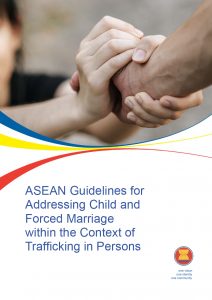
Author:ASEAN Secretariat

Abstract
The development of the ASEAN Guidelines for Addressing Child and Forced Marriage within the Context of Trafficking in Persons builds on the challenges identified during a series of regional forums hosted by the ASEAN Commission on the Promotion and Protection of the Rights of Women and Children (ACWC). These forums were supported by key UN agencies, including the United Nations Children's Fund (UNICEF) and the United Nations Population Fund (UNFPA), as well as Plan International, focusing on Child, Early, and Forced Marriage (CEFM). The first South-East Asia forum in 2019 established a foundation for regional discussions on this critical issue. The second forum, conducted in the aftermath of the COVID-19 pandemic, examined the connections between child and forced marriage and adolescent pregnancy, highlighting the necessity for a comprehensive approach that involves governments, civil society, local leaders, families, and children. The third forum, co-organised by Plan International and ACWC Indonesia, empowered adolescent girls and proposed recommendations for a regional framework to support ASEAN's commitment to ending violence against children, particularly concerning child marriage.
In light of this, ACWC has sought support from the Australian Government through the ASEAN-Australia Counter-Trafficking program (ASEAN-ACT), under the Joint Multi-Year Project led by ACWC Indonesia, launched in June 2021. Among its key objectives, this collaboration aims to develop the ASEAN Guidelines for Preventing and Addressing Child and Forced Marriages within the Context of Trafficking in Persons, providing a vital framework to combat these interconnected issues effectively.
More Details
| Author | ASEAN Secretariat |
| Barcode | <000000019741> |
| Edition | |
| Place | Jakarta |
| Publisher | ASEAN Secretariat |
| Year | 2025 |
| Classification | Socio-Cultural – Senior Officials’ Committee for ASCC Council (SOCA) 305 - Social Welfare and Development - AMMSWD, SOMSWD, Population, Social Security 305.2 - Gender, Rights of Women and Children - ASEAN Committee on Women (ACW) |
| Call Number | 305.2 ASE a |
| ISBN | 9786235429687 |
| Language | English |
| Content Type | Text Book |
| Media Type | |
| Number of copies |