





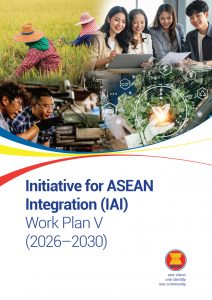
Initiative for ASEAN Integration (IAI) Work Plan V (2026–2030)
Abstract
The Initiative for ASEAN Integration (IAI) was launched by the ASEAN Heads of State/Government at the Fourth ASEAN Informal Summit in 2000, to narrow the development gap and strengthen ASEAN’s competitiveness as a region. Its implementation strategy was further articulated in the 2001 Ha Noi Declaration on Narrowing the Development Gap for closer ASEAN Integration. Since then, the IAI has served as a key framework for advancing regional integration and cooperation by facilitating infrastructure development, technical assistance and capacity-building support to the newer ASEAN Member States, namely: Cambodia, Lao PDR, Myanmar and Viet Nam (CLMV) countries with the support of ASEAN Member States and ASEAN Partners.
A significant milestone shaping the development of the IAI Work Plan V is the accession of Timor-Leste as ASEAN’s 11th Member State and its inclusion as the newest IAI beneficiary. The IAI Work Plan V (2026-2030) was adopted at the 47th ASEAN Summit in October 2025. It has six Strategic Areas, namely: (i) food and agriculture, (ii) micro enterprises and informal sector, (iii) education and skills, (iv) public health, (v) local community empowerment and resilience, and (vi) inclusive growth and sustainable economic development. Through these Strategic Areas, IAI Work Plan V aims to promote equitable development among AMS, strengthen institutional capacity of its beneficiaries, and support deeper regional integration across ASEAN.
ASEAN welcomes collaboration with development partners, the private sector, academic and research institutions, and other stakeholders to jointly implement projects under IAI Work Plan V. Interested organisations are encouraged to explore partnership opportunities and may contact us at iai@asean.org for further information.
More Details
| Author | ASEAN Secretariat |
| Barcode | <000000020687> <000000021001> <000000021002> |
| Edition | |
| Place | Jakarta |
| Publisher | ASEAN Secretariat |
| Year | 2026 |
| Call Number | 402 ASE i |
| ISBN | N/A |
| Language | English |
| Content Type | Text Book |
| Media Type | |
| Number of copies | 2 |

