




- ABOUT ASEAN
The Association of Southeast Asian Nations, or ASEAN, was established on 8 August 1967 in Bangkok, Thailand, with the signing of the ASEAN Declaration (Bangkok Declaration) by the Founding Fathers of ASEAN: Indonesia, Malaysia, Philippines, Singapore and Thailand. Brunei Darussalam joined ASEAN on 7 January 1984, followed by Viet Nam on 28 July 1995, Lao PDR and Myanmar on 23 July 1997, Cambodia on 30 April 1999, and Timor-Leste on 26 October 2025 making up what is today the eleven Member States of ASEAN.
Menu - WHAT WE DO
ASEAN organs always strive to achieve ASEAN’s goals and objectives, the Secretary-General of ASEAN and the ASEAN Secretariat shall be functioned as coordinating Secretariat to help facilitate effective decision-making withing and amongst ASEAN bodies. In addition, each Member State shall appoint a Permanent Representative to liaise with Secretary-General of ASEAN and the ASEAN Secretariat
Menu - WHO WE WORK WITH
ASEAN shall develop friendly relations and mutually beneficial dialogues, cooperation and partnerships with countries and sub-regional, regional and international organisations and institutions. This includes external partners, ASEAN entities, human rights bodies, non-ASEAN Member States Ambassadors to ASEAN, ASEAN committees in third countries and international organisations, as well as international / regional organisations.
Menu - OUR COMMUNITIES
The rodmap for an ASEAN Community (2009-2015) was declared by the leaders in 2009. The ASEAN Community, anchored on three community pillars: Political-Security Community, Economic Community, Socio-Cultural Community was launched in 2015. The ASEAN 2025: Forging Ahead Together was introduced in 2015 as a Post-2015 Vision. It comprises the ASEAN Community Vision 2025, the ASEAN Political-Security Community Blueprint 2025, the ASEAN Economic Community Blueprint 2025 and the ASEAN Socio-Cultural Community Blueprint 2025
Menu - SITEMAP
ASEAN Socio-Cultural Community Policy Brief – Culture, Development and Society in ASEAN: Balancing Economic Development with the Preservation and Promotion of Cultural Heritage
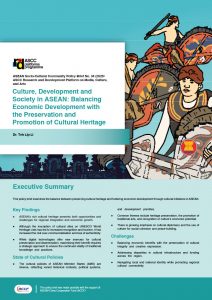
AMS cultures are rich and diverse, comprising many traditions, languages, and forms of artistic expressions. This diversity offers strengths and challenges for ASEAN policymakers seeking to preserve cultural heritage while simultaneously leveraging it for social cohesion and economic development. This brief addresses several questions facing ASEAN in developing cultural policies:
- What are the impacts and implications for AMS from inscribing their tangible and intangible cultural heritage on UNESCO World Heritage Lists? How does commercialisation, overcrowding, physical degradation, and loss of original significance affect local community culture?
- What lessons can ASEAN learn from nations with sites previously included on the World Heritage List as it considers developing its own cultural heritage list?
- How can culture promote tolerance, greater understanding, and harmony in ASEAN?
- How might ASEAN and its stakeholders enhance the role of culture to promote peace, tolerance, understanding, and harmony in the region and globally?
More Details
| Headline | Culture, Development and Society in ASEAN: Balancing Economic Development with the Preservation and Promotion of Cultural Heritage |
| Volume | 2026 |
| Number | 34 |
| Start date | |
| End date | |
| Barcode number | <000000021541> |
| Call Number | |
| Number of copies |