




- ABOUT ASEAN
The Association of Southeast Asian Nations, or ASEAN, was established on 8 August 1967 in Bangkok, Thailand, with the signing of the ASEAN Declaration (Bangkok Declaration) by the Founding Fathers of ASEAN: Indonesia, Malaysia, Philippines, Singapore and Thailand. Brunei Darussalam joined ASEAN on 7 January 1984, followed by Viet Nam on 28 July 1995, Lao PDR and Myanmar on 23 July 1997, Cambodia on 30 April 1999, and Timor-Leste on 26 October 2025 making up what is today the eleven Member States of ASEAN.
Menu - WHAT WE DO
ASEAN organs always strive to achieve ASEAN’s goals and objectives, the Secretary-General of ASEAN and the ASEAN Secretariat shall be functioned as coordinating Secretariat to help facilitate effective decision-making withing and amongst ASEAN bodies. In addition, each Member State shall appoint a Permanent Representative to liaise with Secretary-General of ASEAN and the ASEAN Secretariat
Menu - WHO WE WORK WITH
ASEAN shall develop friendly relations and mutually beneficial dialogues, cooperation and partnerships with countries and sub-regional, regional and international organisations and institutions. This includes external partners, ASEAN entities, human rights bodies, non-ASEAN Member States Ambassadors to ASEAN, ASEAN committees in third countries and international organisations, as well as international / regional organisations.
Menu - OUR COMMUNITIES
The rodmap for an ASEAN Community (2009-2015) was declared by the leaders in 2009. The ASEAN Community, anchored on three community pillars: Political-Security Community, Economic Community, Socio-Cultural Community was launched in 2015. The ASEAN 2025: Forging Ahead Together was introduced in 2015 as a Post-2015 Vision. It comprises the ASEAN Community Vision 2025, the ASEAN Political-Security Community Blueprint 2025, the ASEAN Economic Community Blueprint 2025 and the ASEAN Socio-Cultural Community Blueprint 2025
Menu - SITEMAP
ASEAN-ROK Partnership in the Indo-Pacific Era: consolidation and expansion
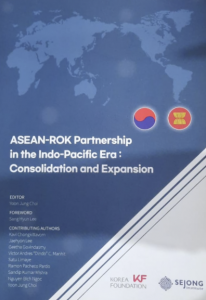
Author:Yoon Jung Choi (editor)

Abstract
In 2021, actors in the Indo-Pacific including ASEAN member countries and the Republic of Korea (ROK, hereafter referred to as Korea) have experienced changes and continuitities with the inauguration of the Biden administration. At the same time, continuing Sino-US rivalry and intensifying waves of COVID-19 infection globaly presented new challenges to the region's economy and threatened to erode multilateralism and rule-based order. In the long term, however, the region's seeing disintegration may also provide novel opportunities to forge new and innovative forms of cooperation and partnership in the Indo-Pacific. The book comprises contributions from nine distinguished experts who participated in the seminar, and H.E. Ambassador Ong Keng Yong and Ambassador Cho Byung-jae who have made great congtributions to ASEAN and ROK's progress honored this initiative by chairing Sessions 1 and 2. Chapter I of the book reviews strategies of ASEAN and ROK and their current bilateral partnership in cultural, economic, and political domains. Suggestions to strengthen the ties between ASEAN member countries and ROK are made based on the convergences in their respective Indo-Pacific strategies. Chapter II then turns to the broaded Indo-Pacific and focuses on ways to develop partnerships with other key stakeholders in the region such as the US, EU, and India. In this regrards, Chapter III emphasizes the ASEAN-ROK partnership central in these multilateral approaches to fostering cooperation and ensuring peace and prosperity in the Indo-Pacific.
More Details
| Author | Yoon Jung Choi (editor) |
| Barcode | <000000021736> |
| Edition | |
| Place | |
| Publisher | Sejong Institute & Korea Foundation |
| Year | |
| Classification | Political-Security 113 – External Relations 113.8 – Republic of Korea |
| Call Number | 113.8 CHO a |
| ISBN | |
| Language | English |
| Content Type | Text Book |
| Media Type | |
| Number of copies | 1 |