



- ABOUT ASEAN
The Association of Southeast Asian Nations, or ASEAN, was established on 8 August 1967 in Bangkok, Thailand, with the signing of the ASEAN Declaration (Bangkok Declaration) by the Founding Fathers of ASEAN: Indonesia, Malaysia, Philippines, Singapore and Thailand. Brunei Darussalam joined ASEAN on 7 January 1984, followed by Viet Nam on 28 July 1995, Lao PDR and Myanmar on 23 July 1997, Cambodia on 30 April 1999, and Timor-Leste on 26 October 2025 making up what is today the eleven Member States of ASEAN.
Menu - WHAT WE DO
ASEAN organs always strive to achieve ASEAN’s goals and objectives, the Secretary-General of ASEAN and the ASEAN Secretariat shall be functioned as coordinating Secretariat to help facilitate effective decision-making withing and amongst ASEAN bodies. In addition, each Member State shall appoint a Permanent Representative to liaise with Secretary-General of ASEAN and the ASEAN Secretariat
Menu - WHO WE WORK WITH
ASEAN shall develop friendly relations and mutually beneficial dialogues, cooperation and partnerships with countries and sub-regional, regional and international organisations and institutions. This includes external partners, ASEAN entities, human rights bodies, non-ASEAN Member States Ambassadors to ASEAN, ASEAN committees in third countries and international organisations, as well as international / regional organisations.
Menu - OUR COMMUNITIES
The rodmap for an ASEAN Community (2009-2015) was declared by the leaders in 2009. The ASEAN Community, anchored on three community pillars: Political-Security Community, Economic Community, Socio-Cultural Community was launched in 2015. The ASEAN 2025: Forging Ahead Together was introduced in 2015 as a Post-2015 Vision. It comprises the ASEAN Community Vision 2025, the ASEAN Political-Security Community Blueprint 2025, the ASEAN Economic Community Blueprint 2025 and the ASEAN Socio-Cultural Community Blueprint 2025
Menu - SITEMAP
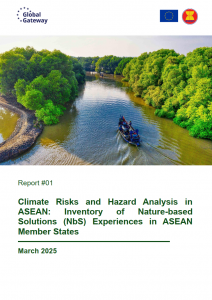
Climate Risks and Hazard Analysis in ASEAN: Inventory of Nature-based Solutions (NbS) Experiences in ASEAN Member States
Author:

Abstract
This publication presents a regional framework for scalable NbS, analysing biophysical conditions, land-use systems, and ecosystem-based approaches to address Southeast Asia’s diverse climate risks and challenges. By identifying opportunities, barriers, and practical strategies for implementation, the study guides policymakers and practitioners in tailoring context-specific, inclusive, and resilient NbS across the region’s landscapes. The key recommendations from the report include:
- Leverage local opportunities with tailored planning.
- Embed NbS into broader policies and frameworks.
- Build capacity and foster transparent governance.
- Engage communities and monitor progress
- Scale successful pilots with sustained investment.
More Details
| Author | |
| Barcode | <000000022093> |
| Edition | Report 1 |
| Place | |
| Publisher | |
| Year | |
| Classification | Socio-Cultural – Senior Officials’ Committee for ASCC Council (SOCA) |
| Call Number | |
| ISBN | |
| Language | English |
| Content Type | Text Book |
| Media Type | |
| Number of copies |