




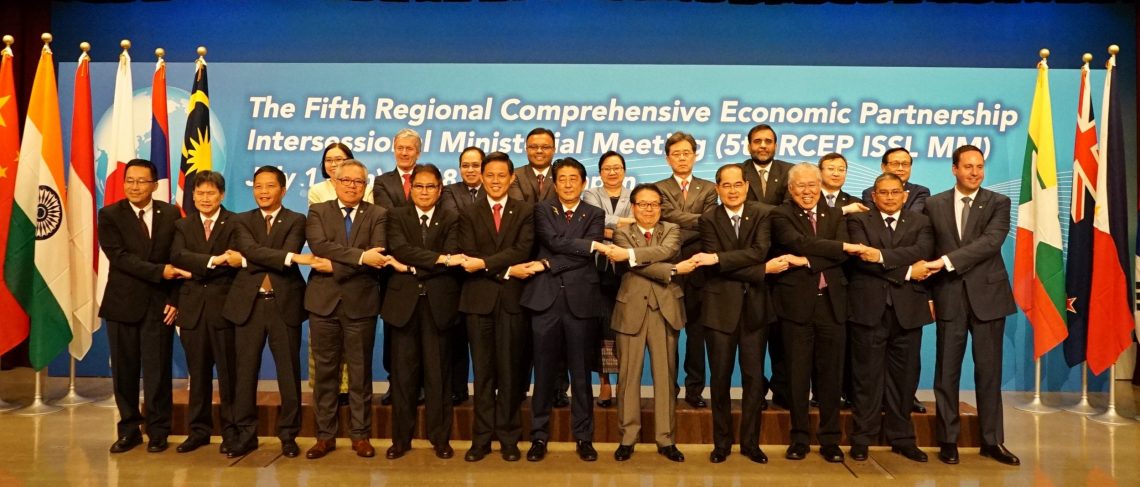
1. The Ministers from the 16 RCEP Participating Countries (RPCs) attended the 5th RCEP Intersessional Ministerial Meeting held on 1 July 2018 in Tokyo, Japan. The Ministers discussed the developments since the 4th RCEP Intersessional Ministerial Meeting on 3 March 2018 in Singapore, including the outcomes of the 22nd round of negotiations held on 28 April-8 May 2018 also in Singapore; the intersessional meetings of selected working groups and sub-working groups; as well as the 4th RCEP Intersessional TNC and Related Meetings held on 25-29 June 2018 in Tokyo, Japan, which were also participated by the Working Group on Electronic Commerce(e-Commerce), the Working Group on Intellectual Property (IP), and the Sub-Working Group on Customs Procedures and Trade Facilitation (CPTF) and intensification of market access bilateral negotiations.
2. The Ministers recognised the importance of swiftly and successfully concluding the RCEP negotiations consistent with the Guiding Principles and Objectives for Negotiating the RCEP, particularly in view of the current global trade environment which faces serious risks from unilateral trade actions and reactions, as well as their debilitating implications on the multilateral trading system. To this end, the Ministers reaffirmed their resolve to work together and see through the RCEP negotiations towards conclusion, and to achieve an agreement that would allow economies of different levels of development to actively participate in and benefit from an open and inclusive regional economic integration.
Download the full statement here
- ABOUT ASEAN
The Association of Southeast Asian Nations, or ASEAN, was established on 8 August 1967 in Bangkok, Thailand, with the signing of the ASEAN Declaration (Bangkok Declaration) by the Founding Fathers of ASEAN: Indonesia, Malaysia, Philippines, Singapore and Thailand. Brunei Darussalam joined ASEAN on 7 January 1984, followed by Viet Nam on 28 July 1995, Lao PDR and Myanmar on 23 July 1997, Cambodia on 30 April 1999, and Timor-Leste on 26 October 2025 making up what is today the eleven Member States of ASEAN.
Menu - WHAT WE DO
ASEAN organs always strive to achieve ASEAN’s goals and objectives, the Secretary-General of ASEAN and the ASEAN Secretariat shall be functioned as coordinating Secretariat to help facilitate effective decision-making withing and amongst ASEAN bodies. In addition, each Member State shall appoint a Permanent Representative to liaise with Secretary-General of ASEAN and the ASEAN Secretariat
Menu - WHO WE WORK WITH
ASEAN shall develop friendly relations and mutually beneficial dialogues, cooperation and partnerships with countries and sub-regional, regional and international organisations and institutions. This includes external partners, ASEAN entities, human rights bodies, non-ASEAN Member States Ambassadors to ASEAN, ASEAN committees in third countries and international organisations, as well as international / regional organisations.
Menu - OUR COMMUNITIES
The rodmap for an ASEAN Community (2009-2015) was declared by the leaders in 2009. The ASEAN Community, anchored on three community pillars: Political-Security Community, Economic Community, Socio-Cultural Community was launched in 2015. The ASEAN 2025: Forging Ahead Together was introduced in 2015 as a Post-2015 Vision. It comprises the ASEAN Community Vision 2025, the ASEAN Political-Security Community Blueprint 2025, the ASEAN Economic Community Blueprint 2025 and the ASEAN Socio-Cultural Community Blueprint 2025
Menu - SITEMAP