






The signing of the ASEAN Declaration in Bangkok on 8 August 1967 by five Foreign Ministers, marking the establishment of the Association of Southeast Asian Nations (ASEAN).
In recognising the necessity for a fund to
finance joint projects, an Agreement for the
Establishment of a Fund for the ASEAN was
approved by the Foreign Ministers of ASEAN in
Cameron Highlands, Malaysia on 7 December
1969.
Declaration on the Zone of Peace, Freedom and Neutrality (ZOPFAN) was adopted by the Foreign Ministers at the Special ASEAN Foreign
Ministers Meeting in Kuala Lumpur on 27 November 1971.
Australia became ASEAN’s first Dialogue Partner in 1974 and since then the relations has evolved to cover a wide range of cooperation across the three ASEAN
Community pillars.

The First ASEAN Summit meeting was held in Bali. At this summit, ASEAN expressed its readiness to develop fruitful relations and mutually beneficial co-operation with other countries of the region.
The Foreign Ministers signed the Agreement on the Establishment of the ASEAN Secretariat and the Heads of Government took note of the nomination of Mr. Hartono Rekso Dharsono as the first Secretary-General of the ASEAN Secretariat
The Heads of Government reviewed the development and progress of ASEAN in its first ten years and, in particular, they examined the progress in the implementation of the programme of action adopted at their First Summit Meeting.
Agreement on ASEAN Food Security Reserve was signed by 5 (five) Foreign Ministers in New
York on 4 October 1979 to strengthen food security in the region.
The ASEAN Secretariat premises move from Pejambon to Kebayoran Baru. It was officiated
on 6 May 1981 by the then President of Indonesia, H.E. Soeharto.
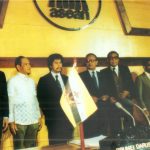
Brunei Darussalam was admitted as the sixth member of ASEAN at the 17 th Ministerial Meeting in Jakarta on 7 January 1984.
ASEAN Agreement on The Conservation of Nature and Natural Resources was signed in recognising the importance of natural resources for present and future generations.
Agreement on ASEAN Energy Cooperation was signed in Manila, ASEAN members agree to cooperate in the efficient development and use of all forms of energy, whether commercial, non- commercial, renewable or non-renewable, in modalities that may be appropriately designed by them for the above purpose.
The objective of AFTA is to increase the ASEAN region’s competitive advantage as a production base geared for the world market. A vital step in this direction is the liberalization of trade through the elimination of tariffs and non-tariff barriers among the ASEAN members. This activity has begun to serve as a catalyst for greater efficiency in production and long-term competitiveness.
The Declaration committed to explore the possibility of cooperation in the South China Sea relating to the safety of maritime navigation and communication, protection against pollution of the marine environment, coordination of search and rescue operations, efforts towards combating piracy
and armed robbery as well as collaboration in the campaign against illicit trafficking in drug.
The Protocol re-designated the Secretary- General of ASEAN Secretariat as the Secretary-General of ASEAN, accorded the Secretary-General with Ministerial status and with an enlarged mandate to initiate, advise, coordinate
and implement ASEAN activities.
ASEAN expressed the common desire to see the smooth and swift implementation of AFTA to further promote economic cooperation within ASEAN and to facilitate investments in ASEAN by third countries.
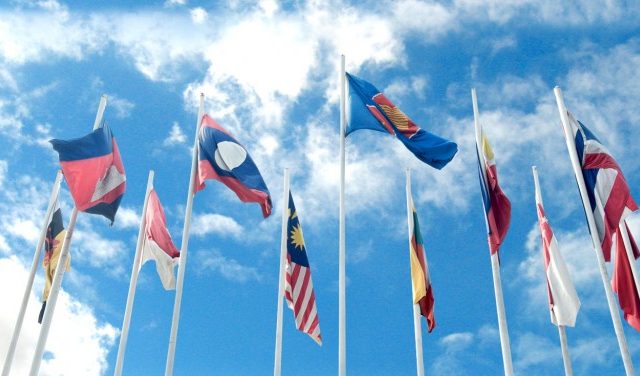
The Foreign Ministers adopted the ASEAN Flag as a symbol of ASEAN cooperation and solidarity in promoting the common aspirations of Member Countries for peace and prosperity in the region
The 26th ASEAN Ministerial Meeting and Post Ministerial Conference, which were held in Singapore on 23-25 July 1993, agreed to establish the ASEAN Regional Forum (ARF). The inaugural meeting of the ARF was held in 22-23 July 1994 Bangkok on 25 July 1994.
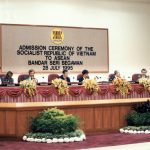
Viet Nam was admitted as the seventh member of ASEAN at the 28th ASEAN Foreign Ministers’
Meeting (AMM) in Bandar Seri Begawan on 28 July 1995.
The parties to the SEANWFZ comprise the current 10 ASEAN members, with aims to refrain from developing, acquiring, or possessing nuclear weapons.
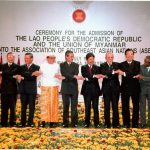
Lao PDR and Myanmar were admitted as the eighth and ninth member of ASEAN at the 30 th
ASEAN Ministerial Meeting in Subang Jaya, Malaysia on 23 July 1997.
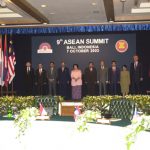
The framework to achieve a dynamic, cohesive, resilient and Integrated ASEAN Community
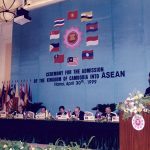
Ceremony for the Admission of the Kingdom of Cambodia into ASEAN, 30 April 1999, Ha Noi, Vietnam
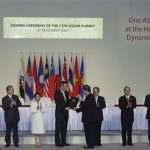
The Signing of ASEAN Charter

The establishment of ASEAN Community
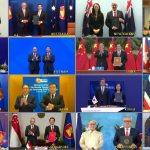
The Signing of the Regional Comprehensive Economic
Partnership (RCEP) Agreement

Timor-Leste admission to ASEAN on the 25 October 2025 making up what is today the eleven Member States of ASEAN.
