





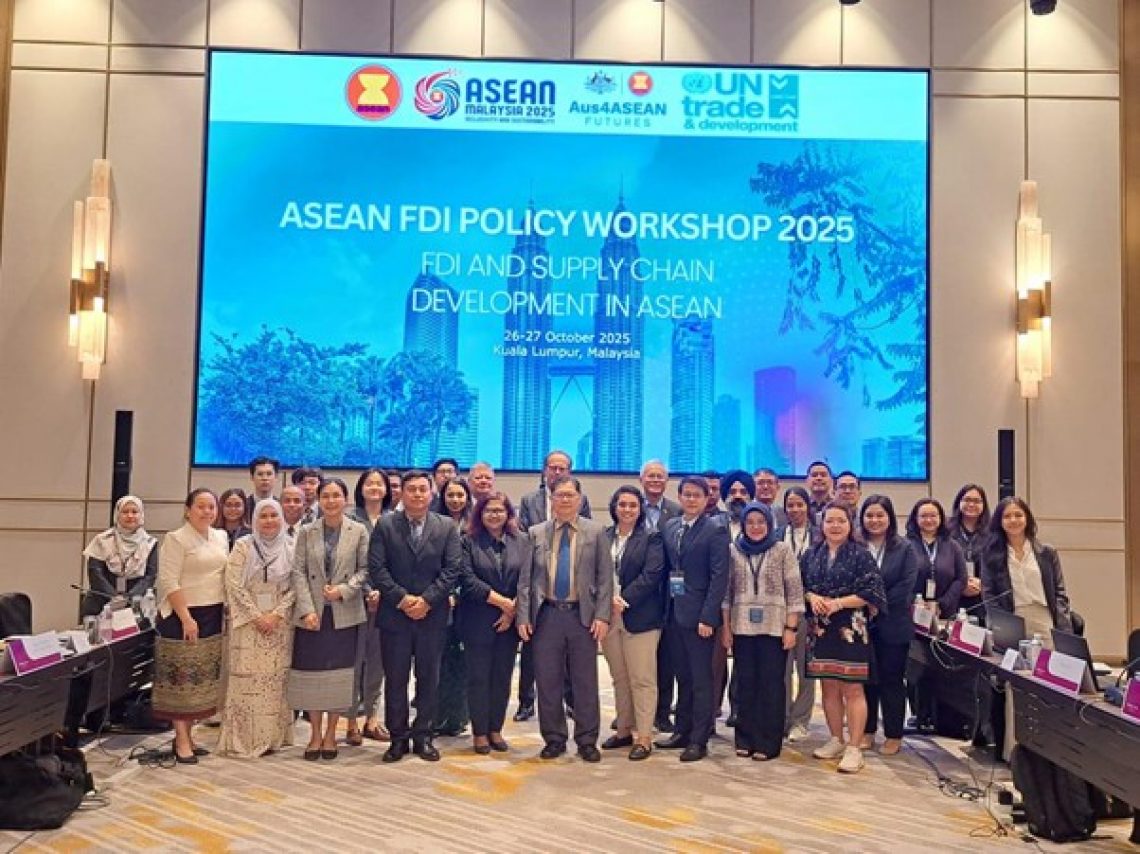
KUALA LUMPUR, 27 October 2025 – The ASEAN Foreign Direct Investment (FDI) Policy Workshop took place at the Crowne Plaza KLCC in Kuala Lumpur, Malaysia, bringing together government officials from ASEAN Member States (AMS), industry leaders, and global organisations to discuss strategies to boost foreign investments and improve supply chain systems across the region, taking into account the newly launched ASEAN Investment Report (AIR) 2025. The workshop was organised by the ASEAN Secretariat in collaboration with the United Nations Trade and Development (UNCTAD) with support from the Australia for ASEAN (Aus4ASEAN) Futures.
The workshop commenced with UNCTAD’s sharing of key findings from the AIR 2025, which highlighted ASEAN’s remarkable growth in attracting foreign investments despite global economic challenges. While global FDI inflows dropped by 11% in 2024, ASEAN saw an impressive 8% growth, largely driven by its strong manufacturing sector. The region also witnessed diversification of FDI sources, which helped strengthen ASEAN’s economic resilience. The report further analyses ASEAN’s growing role in global supply chains, contributing 9% of global exports and 14% of global FDI despite representing only 3% of the world’s GDP, and provides recommendations going forward.
Esteemed officials from AMS and prominent speakers from organisations such as the ASEAN-Business Advisory Council, Institute for Democracy and Economic Affairs, EU-ASEAN Business Council, Hitachi Energy-Malaysia, Maersk, Japan External Trade Organisation, and the US-ASEAN Business Council, shared their collective expertise and insights, were instrumental in shaping discussions and driving forward ASEAN’s shared vision of creating a stronger investment ecosystem.
They discussed thematic areas which originated from AIR 2025 recommendations covering Industrial Upgrading and Attracting High-Value Added FDI, Special Economic Zones (SEZs) and Supply Chain Development, Cross-Border Infrastructure and Supply Chain Development, Talent Development and MSMEs Participation, Supply chain Challenges and Resilience in ASEAN, and Developing Efficient and Resilient Supply Chain Ecosystems.
Participants also discussed the challenges and opportunities facing FDI attraction and supply chains development in ASEAN, including global trade tensions, logistic and infrastructure gaps, as well as regulatory gaps. They emphasised the importance of fostering collaboration among Member States to ensure resilience and sustainable economic growth, regional connectivity, and addressing non-tariff barriers. SEZs and Industrial Parks were highlighted as key tools for attracting investments and boosting industrial growth.
The workshop concluded with several key recommendations to help ASEAN strengthen its position as a global investment hub. These included investing in green and digital-ready infrastructure, harmonizing SEZ standards across the region, and creating cross-border SEZ models to enhance economic integration. Participants also stressed the need to develop talent through vocational training, industry-academia partnerships, and regional platforms for skills mobility. Supporting small and medium enterprises (SMEs) was another priority, with suggestions to provide tax benefits, simplify registration processes, and promote digitalisation to help SMEs compete in global markets.
The ASEAN FDI Policy Workshop was a significant step forward in advancing the region’s economic growth and integration. By implementing the recommendations discussed, ASEAN can continue to attract high-value investments, strengthen its supply chains, and build a sustainable and resilient economic future for its Member States.
