





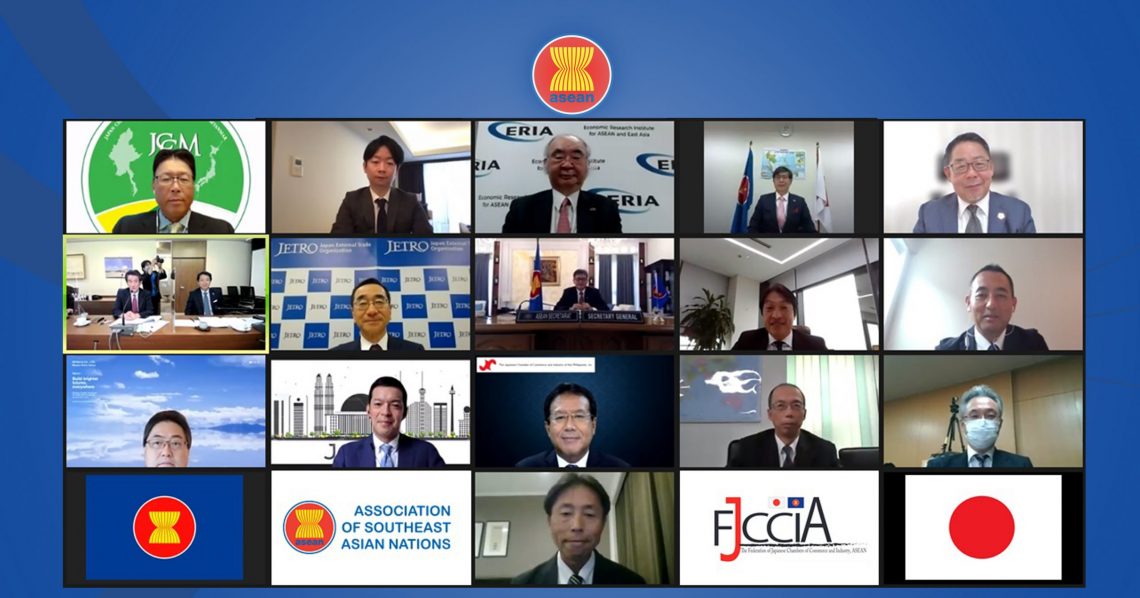
Jakarta, 7 July 2021 – Secretary-General of ASEAN Dato Lim Jock Hoi and the Federation of Japanese Chambers of Commerce and Industry in ASEAN (FJCCIA) attended the 13th Dialogue organised virtually today.
This dialogue, held annually between the Secretary-General of ASEAN and FJCCIA, demonstrated the ASEAN Secretariat’s rigorous efforts in engaging the private sector to support the region’s recovery from the COVID-19 pandemic. It discussed the Japanese businesses’ recommendations to support the implementation of the ASEAN Comprehensive Recovery Framework (ACRF) and its implementation plan, particularly in the area of trade facilitation, digital transformation and sustainable development.
In his remarks, Dato Lim highlighted the importance of collaborating with the private sector to pursue a sustainable recovery from the pandemic. He further emphasised that ASEAN welcomed closer engagement and collaboration with the Japanese industry players to seize opportunities and address challenges brought by digitalization to enhance sustainable investments in green infrastructure and low-carbon emission technologies and practices. It was also underlined that the collaboration would support business continuity in the region by maximising cross-border business and production activities while taking advantage of supply chain relocation and integration to the ASEAN region.
Mr. Soichi Inoue, Chairman of FJCCIA and the Federation of Japanese Chamber of Commerce and Industry in Viet Nam, at the dialogue, expressed his support and proposed several recommendations and initiatives towards the ASEAN’s sustainable and inclusive recovery. In addition, Mr. Nobuhiko Sasaki, Chairman and CEO of the Japan External Trade Organization (JETRO), expressed his commitment to working with the Japanese companies to contribute to ASEAN’s post-pandemic recovery efforts, particularly on digital transformation, green growth and circular economy.
This dialogue was attended by the FJCCIA members and representatives from JETRO, as well as key important figures in ASEAN – Japan cooperation including Ambassador of Japan to ASEAN Akira Chiba and Professor Hidetoshi Nishimura, President of the Economic Research Institute of ASEAN and East Asia (ERIA). The FJCCIA represents more than 7,500 Japanese businesses and investors operating in ASEAN Member States.
ASEAN Sec-Gen highlights role of private sector in COVID-19 recovery
Share This On
Share on facebook
Share on twitter
Share on linkedin
Share on whatsapp
Share on google
