




- ABOUT ASEAN
The Association of Southeast Asian Nations, or ASEAN, was established on 8 August 1967 in Bangkok, Thailand, with the signing of the ASEAN Declaration (Bangkok Declaration) by the Founding Fathers of ASEAN: Indonesia, Malaysia, Philippines, Singapore and Thailand. Brunei Darussalam joined ASEAN on 7 January 1984, followed by Viet Nam on 28 July 1995, Lao PDR and Myanmar on 23 July 1997, Cambodia on 30 April 1999, and Timor-Leste on 26 October 2025 making up what is today the eleven Member States of ASEAN.
Menu - WHAT WE DO
ASEAN organs always strive to achieve ASEAN’s goals and objectives, the Secretary-General of ASEAN and the ASEAN Secretariat shall be functioned as coordinating Secretariat to help facilitate effective decision-making withing and amongst ASEAN bodies. In addition, each Member State shall appoint a Permanent Representative to liaise with Secretary-General of ASEAN and the ASEAN Secretariat
Menu - WHO WE WORK WITH
ASEAN shall develop friendly relations and mutually beneficial dialogues, cooperation and partnerships with countries and sub-regional, regional and international organisations and institutions. This includes external partners, ASEAN entities, human rights bodies, non-ASEAN Member States Ambassadors to ASEAN, ASEAN committees in third countries and international organisations, as well as international / regional organisations.
Menu - OUR COMMUNITIES
The rodmap for an ASEAN Community (2009-2015) was declared by the leaders in 2009. The ASEAN Community, anchored on three community pillars: Political-Security Community, Economic Community, Socio-Cultural Community was launched in 2015. The ASEAN 2025: Forging Ahead Together was introduced in 2015 as a Post-2015 Vision. It comprises the ASEAN Community Vision 2025, the ASEAN Political-Security Community Blueprint 2025, the ASEAN Economic Community Blueprint 2025 and the ASEAN Socio-Cultural Community Blueprint 2025
Menu - SITEMAP
Burma : Military Rule and the Politics of Stagnation
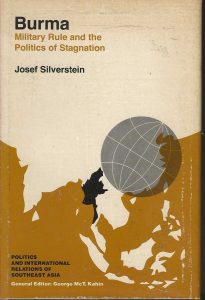
Author:Josef Silverstein

Abstract
This book charts the course of Burma's controlled revolution- a do-it-yourself revolution that, the author contends, has thus far failed. After tracing the roots of Burmese political culture to the precolonial era, Professor Silverstein concentrates on the period of military rule from 1962 to 1974, and the constitutional dictatorship from 1974 to the present. His analysis focuses on the new leadership, ideals, institutions, and political processes that were grafted onto the previous constitutional system. After providing a careful examination of the economy and foreign policy under both democratic and military rule, he concludes with some astute observations on fundamental problems that must be resolved if the nation is to begin realizing its social and economic potential.
More Details
| Author | Josef Silverstein |
| Barcode | <000000020584> |
| Edition | |
| Place | London |
| Publisher | Cornell University Press |
| Year | 1977 |
| Classification | Political-Security |
| Call Number | 100 SIL b |
| ISBN | 801498635 |
| Language | English |
| Content Type | Text Book |
| Media Type | |
| Number of copies | 1 |