




- ABOUT ASEAN
The Association of Southeast Asian Nations, or ASEAN, was established on 8 August 1967 in Bangkok, Thailand, with the signing of the ASEAN Declaration (Bangkok Declaration) by the Founding Fathers of ASEAN: Indonesia, Malaysia, Philippines, Singapore and Thailand. Brunei Darussalam joined ASEAN on 7 January 1984, followed by Viet Nam on 28 July 1995, Lao PDR and Myanmar on 23 July 1997, Cambodia on 30 April 1999, and Timor-Leste on 26 October 2025 making up what is today the eleven Member States of ASEAN.
Menu - WHAT WE DO
ASEAN organs always strive to achieve ASEAN’s goals and objectives, the Secretary-General of ASEAN and the ASEAN Secretariat shall be functioned as coordinating Secretariat to help facilitate effective decision-making withing and amongst ASEAN bodies. In addition, each Member State shall appoint a Permanent Representative to liaise with Secretary-General of ASEAN and the ASEAN Secretariat
Menu - WHO WE WORK WITH
ASEAN shall develop friendly relations and mutually beneficial dialogues, cooperation and partnerships with countries and sub-regional, regional and international organisations and institutions. This includes external partners, ASEAN entities, human rights bodies, non-ASEAN Member States Ambassadors to ASEAN, ASEAN committees in third countries and international organisations, as well as international / regional organisations.
Menu - OUR COMMUNITIES
The rodmap for an ASEAN Community (2009-2015) was declared by the leaders in 2009. The ASEAN Community, anchored on three community pillars: Political-Security Community, Economic Community, Socio-Cultural Community was launched in 2015. The ASEAN 2025: Forging Ahead Together was introduced in 2015 as a Post-2015 Vision. It comprises the ASEAN Community Vision 2025, the ASEAN Political-Security Community Blueprint 2025, the ASEAN Economic Community Blueprint 2025 and the ASEAN Socio-Cultural Community Blueprint 2025
Menu - SITEMAP
Chinese Society in Rural Malaysia: a local history of the Chinese in Titi, Jelebu
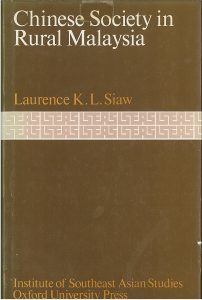
Author:Laurence K. L. Siaw

Abstract
This is a study in depth of a typical pioneering Chinese community which sprang into being on the fringes of the deep jungle in Negeri Sembilan, a traditional Malay state of the Malaysian Peninsula, during the last quarter of the nineteenth century. The author traces succinctly the evolution of this isolated Chinese peasant society through a series of vicissitudes and challenges which many ways represents the history of microcosm of the Chinese in Malaya as a whole. The role of the founding Siow clan and their links with their homeland, the emergence of secret societies and Chinese nationalist politics, the traumatic experiences of the Japanese Occupation and the equally bitter years of the Emergency and finally the emergence of a new Malayan-entered community in the formative years of independence are all vividly portrayed. The study is based on a close research of government and private papers, an on interviews carried out with leading members of Jelebu Chinese society. The result is to present a unique picture of a Malayan Chinese community in transition.
More Details
| Author | Laurence K. L. Siaw |
| Barcode | <000000001370> |
| Edition | |
| Place | Kuala Lumpur |
| Publisher | Oxford University Press |
| Year | 1983 |
| Classification | ASEAN in General 001 - Member States 001.5 - Malaysia |
| Call Number | 001.5 SIA c |
| ISBN | 195825411 |
| Language | English |
| Content Type | Text Book |
| Media Type | |
| Number of copies | 1 |