




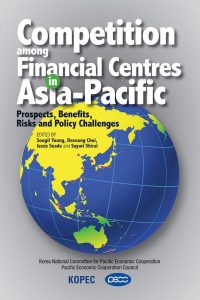
Competition among Financial Centres in Asia-Pacific : Prospects, Benefits, Risks and Policy Challenges
Abstract
Many cities in the Asia-Pacific region serve as financial centres in their respective national jurisdictions or local areas. Noting that most were engaged in efforts to become premier international financial centres (IFCs) in competition with one another, the Korea National Committee for Pacific Economic Cooperation (KOPEC) convened an international conference in Seoul, Korea in October 2007 to examine the prospects for success for seven such financial centres (Hong Kong, Seoul, Shanghai, Singapore, Sydney, Tokyo and Wellington), weigh the costs and benefits of such competition for local economies as well as the region as a whole, and derive implications for cooperation among the regional governments.
The present volume consists of case studies and commentaries presented at the conference as well as the synthesis report, which draws conclusions from those papers and commentaries. One of those conclusions is that, given the power of scale economies as well as the lack of integration of the financial markets in the region, none of the regional financial centres, even Hong Kong, Singapore or Tokyo, considered alone represents a meaningful rival to London or New York, the two existing global financial centres. The synthesis report thus argues for regional cooperation to integrate all those financial centres into an Asia-Pacific IFC network. It further argues that the present global financial crisis presents a major opportunity for regional governments to create such an IFC network that will challenge London and New York in quality as well as quantity of international financial business while helping the latter two overcome the current global crisis. This would open the path towards a stable and resilient Asia-Pacific financial community, with the constituent regional economies no longer vulnerable to the problems of the so-called original sin and double mismatch.
More Details
| Author | Edited by Soogil Young, Dosoung Choi, Jesus Seade, and Sayuri Shirai |
| Barcode | <000000020579> |
| Edition | |
| Place | Singapore |
| Publisher | ISEAS Publishing |
| Year | 2009 |
| Call Number | 206 Com |
| ISBN | 9789812308559 |
| Language | English |
| Content Type | Text Book |
| Media Type | |
| Number of copies | 1 |

