



- ABOUT ASEAN
The Association of Southeast Asian Nations, or ASEAN, was established on 8 August 1967 in Bangkok, Thailand, with the signing of the ASEAN Declaration (Bangkok Declaration) by the Founding Fathers of ASEAN: Indonesia, Malaysia, Philippines, Singapore and Thailand. Brunei Darussalam joined ASEAN on 7 January 1984, followed by Viet Nam on 28 July 1995, Lao PDR and Myanmar on 23 July 1997, Cambodia on 30 April 1999, and Timor-Leste on 26 October 2025 making up what is today the eleven Member States of ASEAN.
Menu - WHAT WE DO
ASEAN organs always strive to achieve ASEAN’s goals and objectives, the Secretary-General of ASEAN and the ASEAN Secretariat shall be functioned as coordinating Secretariat to help facilitate effective decision-making withing and amongst ASEAN bodies. In addition, each Member State shall appoint a Permanent Representative to liaise with Secretary-General of ASEAN and the ASEAN Secretariat
Menu - WHO WE WORK WITH
ASEAN shall develop friendly relations and mutually beneficial dialogues, cooperation and partnerships with countries and sub-regional, regional and international organisations and institutions. This includes external partners, ASEAN entities, human rights bodies, non-ASEAN Member States Ambassadors to ASEAN, ASEAN committees in third countries and international organisations, as well as international / regional organisations.
Menu - OUR COMMUNITIES
The rodmap for an ASEAN Community (2009-2015) was declared by the leaders in 2009. The ASEAN Community, anchored on three community pillars: Political-Security Community, Economic Community, Socio-Cultural Community was launched in 2015. The ASEAN 2025: Forging Ahead Together was introduced in 2015 as a Post-2015 Vision. It comprises the ASEAN Community Vision 2025, the ASEAN Political-Security Community Blueprint 2025, the ASEAN Economic Community Blueprint 2025 and the ASEAN Socio-Cultural Community Blueprint 2025
Menu - SITEMAP

Abstract
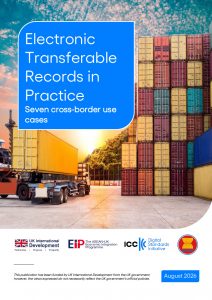
The use of Electronic Transferable Records (ETRs) in trade is poised to move from concept to commercial reality. The obvious driver is that more economies are aligning to the UNCITRAL Model Law on Electronic Transferable Records (MLETR)1: economies accounting for 62.5% of global exports are either aligned to or have committed to do so with visible signs of their progress. Growing awareness around the use of electronic bills of lading (eBL) is also helping, with the share of eBLs amidst the total pool rising to roughly 12% as of December 2025.
Yet questions remain about how and why ETRs could play a catalytic role in digitalising trade, particularly for countries just starting their journeys. ETRs cover only seven of 36 key trade documents, the most notable of which are electronic bills of lading, electronic bills of exchange and promissory notes, and electronic warehouse receipts. These documents sit at the critical junctures of the supply chain, covering the shipment, receipt and financing processes. No supply chain can operate without them, and thus, these records also contain the core data of a given supply chain. A supply chain that can successfully implement ETRs will find it much easier to drive digitalisation of the other parts of the chain.
More Details
| Author | |
| Barcode | <000000022172> |
| Edition | |
| Place | |
| Publisher | |
| Year | |
| Classification | Economic - ASEAN Economic Minister Meeting (AEM) |
| Call Number | |
| ISBN | |
| Language | English |
| Content Type | Text Book |
| Media Type | |
| Number of copies |