



- ABOUT ASEAN
The Association of Southeast Asian Nations, or ASEAN, was established on 8 August 1967 in Bangkok, Thailand, with the signing of the ASEAN Declaration (Bangkok Declaration) by the Founding Fathers of ASEAN: Indonesia, Malaysia, Philippines, Singapore and Thailand. Brunei Darussalam joined ASEAN on 7 January 1984, followed by Viet Nam on 28 July 1995, Lao PDR and Myanmar on 23 July 1997, Cambodia on 30 April 1999, and Timor-Leste on 26 October 2025 making up what is today the eleven Member States of ASEAN.
Menu - WHAT WE DO
ASEAN organs always strive to achieve ASEAN’s goals and objectives, the Secretary-General of ASEAN and the ASEAN Secretariat shall be functioned as coordinating Secretariat to help facilitate effective decision-making withing and amongst ASEAN bodies. In addition, each Member State shall appoint a Permanent Representative to liaise with Secretary-General of ASEAN and the ASEAN Secretariat
Menu - WHO WE WORK WITH
ASEAN shall develop friendly relations and mutually beneficial dialogues, cooperation and partnerships with countries and sub-regional, regional and international organisations and institutions. This includes external partners, ASEAN entities, human rights bodies, non-ASEAN Member States Ambassadors to ASEAN, ASEAN committees in third countries and international organisations, as well as international / regional organisations.
Menu - OUR COMMUNITIES
The rodmap for an ASEAN Community (2009-2015) was declared by the leaders in 2009. The ASEAN Community, anchored on three community pillars: Political-Security Community, Economic Community, Socio-Cultural Community was launched in 2015. The ASEAN 2025: Forging Ahead Together was introduced in 2015 as a Post-2015 Vision. It comprises the ASEAN Community Vision 2025, the ASEAN Political-Security Community Blueprint 2025, the ASEAN Economic Community Blueprint 2025 and the ASEAN Socio-Cultural Community Blueprint 2025
Menu - SITEMAP

Abstract
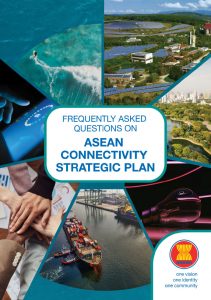
ASEAN Connectivity envisages connecting ASEAN Member States by enhancing physical, institutional and people-to-people linkages.
As a cross-pillar concept, it is fundamental to building a more resilient, innovative, dynamic and people centred region. By enhancing physical infrastructure, digital networks, and institutional cooperation, ASEAN Connectivity expands trade and investment opportunities for ASEAN Member States (AMS), while strengthening the region’s resilience against external shocks and geoeconomic uncertainties. It also contributes to narrowing the development gap in ASEAN by promoting equitable growth and inclusivity. By fostering deeper people-to-people connections, ASEAN Connectivity also seeks to nurture a shared ASEAN identity, which is essential for regional peace and stability, and ultimately, it will enable Southeast Asia to connect more effectively with global supply chains, digital ecosystems, and sustainable infrastructure networks.
ASEAN Connectivity reinforces the region’s role as a central hub in the Indo-Pacific, promoting shared prosperity and deeper collaboration with the global community.
More Details
| Author | ASEAN Secretariat |
| Barcode | <000000020484> |
| Edition | |
| Place | Jakarta |
| Publisher | ASEAN Secretariat |
| Year | 2026 |
| Classification | Cross-Sectoral 401- ASEAN Connectivity - ASEAN Connectivity Coordinating Committee (ACCC) |
| Call Number | 401 ASE f |
| ISBN | N/A |
| Language | English |
| Content Type | Text Book |
| Media Type | |
| Number of copies |