




- ABOUT ASEAN
The Association of Southeast Asian Nations, or ASEAN, was established on 8 August 1967 in Bangkok, Thailand, with the signing of the ASEAN Declaration (Bangkok Declaration) by the Founding Fathers of ASEAN: Indonesia, Malaysia, Philippines, Singapore and Thailand. Brunei Darussalam joined ASEAN on 7 January 1984, followed by Viet Nam on 28 July 1995, Lao PDR and Myanmar on 23 July 1997, Cambodia on 30 April 1999, and Timor-Leste on 26 October 2025 making up what is today the eleven Member States of ASEAN.
Menu - WHAT WE DO
ASEAN organs always strive to achieve ASEAN’s goals and objectives, the Secretary-General of ASEAN and the ASEAN Secretariat shall be functioned as coordinating Secretariat to help facilitate effective decision-making withing and amongst ASEAN bodies. In addition, each Member State shall appoint a Permanent Representative to liaise with Secretary-General of ASEAN and the ASEAN Secretariat
Menu - WHO WE WORK WITH
ASEAN shall develop friendly relations and mutually beneficial dialogues, cooperation and partnerships with countries and sub-regional, regional and international organisations and institutions. This includes external partners, ASEAN entities, human rights bodies, non-ASEAN Member States Ambassadors to ASEAN, ASEAN committees in third countries and international organisations, as well as international / regional organisations.
Menu - OUR COMMUNITIES
The rodmap for an ASEAN Community (2009-2015) was declared by the leaders in 2009. The ASEAN Community, anchored on three community pillars: Political-Security Community, Economic Community, Socio-Cultural Community was launched in 2015. The ASEAN 2025: Forging Ahead Together was introduced in 2015 as a Post-2015 Vision. It comprises the ASEAN Community Vision 2025, the ASEAN Political-Security Community Blueprint 2025, the ASEAN Economic Community Blueprint 2025 and the ASEAN Socio-Cultural Community Blueprint 2025
Menu - SITEMAP
Minimum Standards and Guidelines for the ASEAN School Nutrition Package
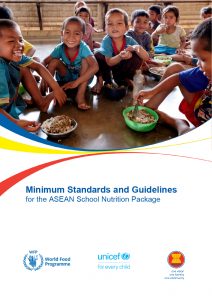
Author:ASEAN Secretariat

Abstract
Taking into considerations risks of malnutrition and opportunity to address the issues amongst school-age children, particularly given the rising double burden of malnutrition, additional investment to prevent undernutrition and overweight amongst this target group is required. Schools can play an important role in delivering health and nutrition interventions and providing a supportive, health-enabling environment, providing an opportunity for catch up growth in school-age children. A comprehensive guideline that provides understanding and direction on package of policy and programmes for healthy school food environment and nutrition education in schools for ASEAN is required. The ASEAN guidelines describe the rationale, framework and thematic areas for a comprehensive School Nutrition Package and set out the minimum standards for implementing, monitoring and enforcing this package. It covers children aged 3–18 years in schools. It brings together recommendations from existing international technical documents to provide harmonized guidelines specific to the ASEAN region. The guidelines include the recommended package of minimum standards, policy, and programmes for nutrition education and healthy school food environment, with scope of actions on thematic areas. This set of guidelines, considered as minimum standards, is streamlined and applicable depend on the country-context for each minimum standard and for use by ASEAN Member States in the development and implementation of school nutrition actions.
More Details
| Author | ASEAN Secretariat |
| Barcode | <000000012247> |
| Edition | |
| Place | Jakarta |
| Publisher | ASEAN Secretariat |
| Year | 2024 |
| Classification | Socio-Cultural – Senior Officials’ Committee for ASCC Council (SOCA) 312 - Health - ASEAN Health Ministers' Meeting (AHMM), ASEAN Senior Officials' Meeting on Health Development (SOMHD) 312.1 - Healthy Lifestyle: tobacco, alcohol, physical inactivity, unhealthy diet, nutrition, malnutrition, mental health, active ageing, preventing injury and hazards at workplace |
| Call Number | 312.1 ASE m |
| ISBN | N/A |
| Language | English |
| Content Type | Text Book |
| Media Type | |
| Number of copies |