

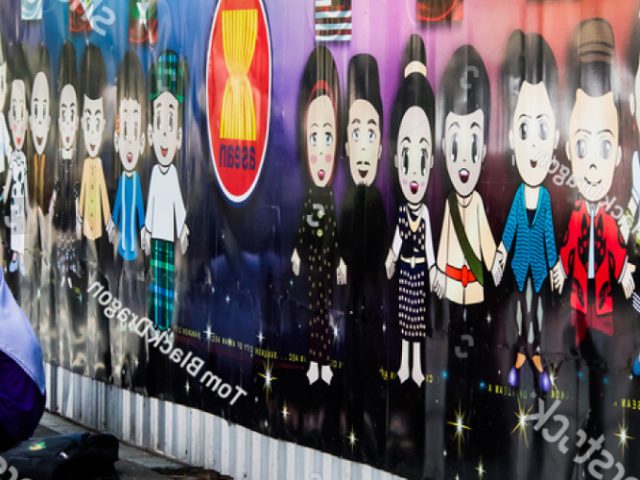
- ABOUT ASEANThe Association of Southeast Asian Nations, or ASEAN, was established on 8 August 1967 in Bangkok, Thailand, with the signing of the ASEAN Declaration (Bangkok Declaration) by the Founding Fathers of ASEAN: Indonesia, Malaysia, Philippines, Singapore and Thailand. Brunei Darussalam joined ASEAN on 7 January 1984, followed by Viet Nam on 28 July 1995, Lao PDR and Myanmar on 23 July 1997, and Cambodia on 30 April 1999, making up what is today the ten Member States of ASEAN.Menu
- WHAT WE DO
ASEAN organs always strive to achieve ASEAN’s goals and objectives, the Secretary-General of ASEAN and the ASEAN Secretariat shall be functioned as coordinating Secretariat to help facilitate effective decision-making withing and amongst ASEAN bodies. In addition, each Member State shall appoint a Permanent Representative to liaise with Secretary-General of ASEAN and the ASEAN Secretariat
Menu - WHO WE WORK WITH
ASEAN shall develop friendly relations and mutually beneficial dialogues, cooperation and partnerships with countries and sub-regional, regional and international organisations and institutions. This includes external partners, ASEAN entities, human rights bodies, non-ASEAN Member States Ambassadors to ASEAN, ASEAN committees in third countries and international organisations, as well as international / regional organisations.
Menu - OUR COMMUNITIES
The rodmap for an ASEAN Community (2009-2015) was declared by the leaders in 2009. The ASEAN Community, anchored on three community pillars: Political-Security Community, Economic Community, Socio-Cultural Community was launched in 2015. The ASEAN 2025: Forging Ahead Together was introduced in 2015 as a Post-2015 Vision. It comprises the ASEAN Community Vision 2025, the ASEAN Political-Security Community Blueprint 2025, the ASEAN Economic Community Blueprint 2025 and the ASEAN Socio-Cultural Community Blueprint 2025
Menu - SITEMAP
Transnational Organized Crime in East Asia and the Pacific: a threat assessment
Author:United Nations Office on Drugs and Crime
Abstract
Human trafficking and smuggling of migrants: Four of the 12 illicit flows reviewed in this report involve human beings. The first two concern movement between the countries of the region, one for general labour and one for sexual exploitation. The third concerns the smuggling of migrants from the region to the rich countries of the West, and the last focuses on migrants smuggled through the region from the poor and conflicted countries of South and Southwest Asia. Drug trafficking: The production and use of opiates has a long history in the region, but the main opiate problem in the 21st century involves the more refined form of the drug: heroin. In addition, methamphetamine has been a threat in parts of East Asia for decades (in the form of yaba tablets), but crystal methamphetamine has recently grown greatly in popularity. Virtually every country in the region has some crystal methamphetamine users, and some populations consume at very high levels.Resources: Resource-related crimes include those related to both extractive industries, such as the illegal harvesting of wildlife and timber, and other crimes that have a negative impact on the environment, such as the dumping of e-waste and the trade in ozone-depleting substances. In all cases, the threat goes beyond borders, jeopardizing the global environmental heritage. These are therefore crimes of inherent international significance, though they are frequently dealt with lightly under local legislation.Counterfeit goods: The trade in counterfeit goods is often perceived as a soft" form of crime
More Details
| Author | United Nations Office on Drugs and Crime |
| Barcode | <000000000440> <000000000874> <000000000875> |
| Edition | - |
| Place | Bangkok |
| Publisher | United Nations Office on Drugs and Crime |
| Year | 2013 |
| Classification | Political-Security 104 – Transnational Crime – Non-traditional Security, ASEAN Ministerial Meeting on Transnational Crime (AMMTC) |
| Call Number | 104 UNO t |
| ISBN | N/A |
| Language | English |
| Content Type | Text Book |
| Media Type | printed |
| Number of copies | 3 |