





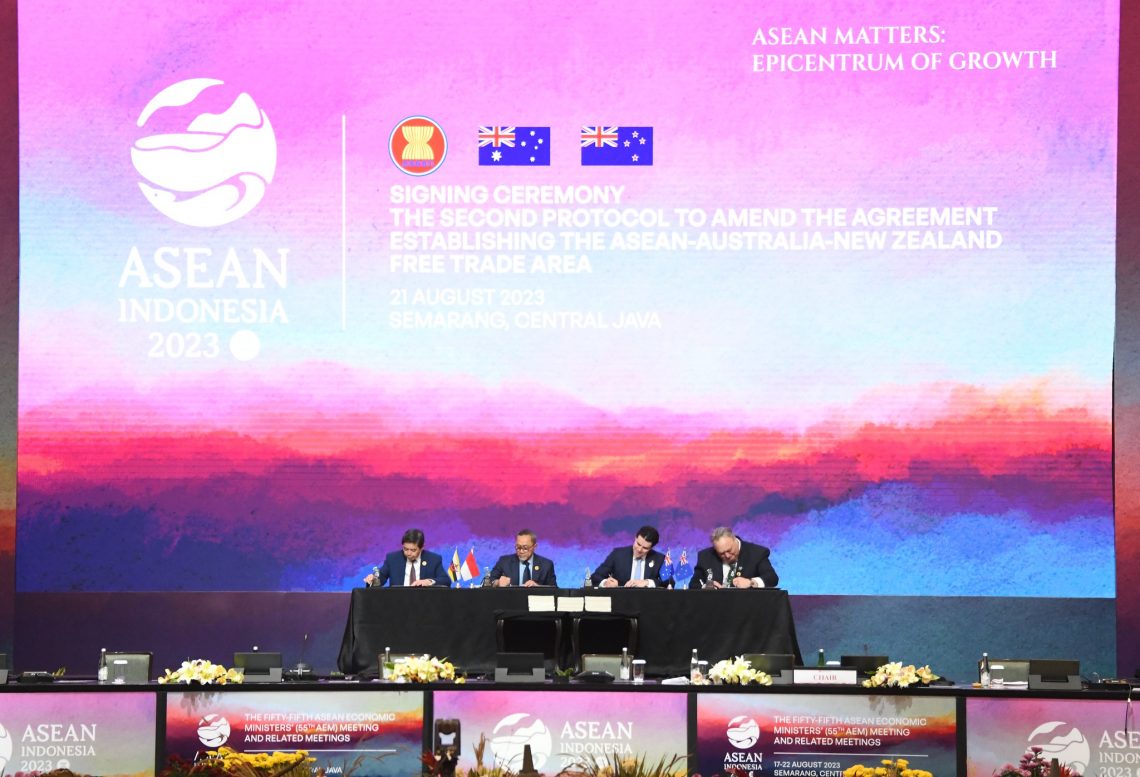
- Economic Ministers from Brunei Darussalam (ASEAN Country Coordinator for AANZFTA) and Indonesia (ASEAN Chair 2023), as well as Australia and New Zealand, gathered at the sidelines of the 28th ASEAN Economic Ministers – Closer Economic Relations (AEM-CER) Consultation in Semarang, Indonesia on 22 August 2023 to sign the Second Protocol to Amend the Agreement Establishing the ASEAN-Australia-New Zealand Free Trade Area (2nd Protocol).
- The signing of the 2nd Protocol is the culmination of three years of negotiations to upgrade the Agreement Establishing the ASEAN-AustraliaNew Zealand Free Trade Area (AANZFTA). It reaffirms AANZFTA Parties’ resolve to accelerate post-pandemic economic recovery efforts, which Leaders conveyed when they announced the substantial conclusion of the upgrade negotiations at the sidelines of the 40th and 41st ASEAN Summits and Related Meetings in Phnom Penh, Cambodia, on 13 November 2022. The Upgrade is a significant milestone towards ensuring that the AANZFTA remains of high-quality, responsive to emerging challenges, takes into account modern trade practices, and remains commercially meaningful to businesses in the region. In addition, the Upgrade was intended to maximise AANZFTA’s synergies and complementarities with other regional trade initiatives for resilient and inclusive growth in the region.
Download the full statement here
Home ❭ Statements ❭ Joint Media Statement on The Signing of The Second Protocol to Amend The Agreement Establishing The ASEAN-Australia-New Zealand Free Trade Area (AANZFTA)
Joint Media Statement on The Signing of The Second Protocol to Amend The Agreement Establishing The ASEAN-Australia-New Zealand Free Trade Area (AANZFTA)
Share This On
Share on facebook
Share on twitter
Share on linkedin
Share on whatsapp
Share on google
