




- ABOUT ASEANThe Association of Southeast Asian Nations, or ASEAN, was established on 8 August 1967 in Bangkok, Thailand, with the signing of the ASEAN Declaration (Bangkok Declaration) by the Founding Fathers of ASEAN: Indonesia, Malaysia, Philippines, Singapore and Thailand. Brunei Darussalam joined ASEAN on 7 January 1984, followed by Viet Nam on 28 July 1995, Lao PDR and Myanmar on 23 July 1997, and Cambodia on 30 April 1999, making up what is today the ten Member States of ASEAN.Menu
- WHAT WE DO
ASEAN organs always strive to achieve ASEAN’s goals and objectives, the Secretary-General of ASEAN and the ASEAN Secretariat shall be functioned as coordinating Secretariat to help facilitate effective decision-making withing and amongst ASEAN bodies. In addition, each Member State shall appoint a Permanent Representative to liaise with Secretary-General of ASEAN and the ASEAN Secretariat
Menu - WHO WE WORK WITH
ASEAN shall develop friendly relations and mutually beneficial dialogues, cooperation and partnerships with countries and sub-regional, regional and international organisations and institutions. This includes external partners, ASEAN entities, human rights bodies, non-ASEAN Member States Ambassadors to ASEAN, ASEAN committees in third countries and international organisations, as well as international / regional organisations.
Menu - OUR COMMUNITIES
The rodmap for an ASEAN Community (2009-2015) was declared by the leaders in 2009. The ASEAN Community, anchored on three community pillars: Political-Security Community, Economic Community, Socio-Cultural Community was launched in 2015. The ASEAN 2025: Forging Ahead Together was introduced in 2015 as a Post-2015 Vision. It comprises the ASEAN Community Vision 2025, the ASEAN Political-Security Community Blueprint 2025, the ASEAN Economic Community Blueprint 2025 and the ASEAN Socio-Cultural Community Blueprint 2025
Menu - SITEMAP
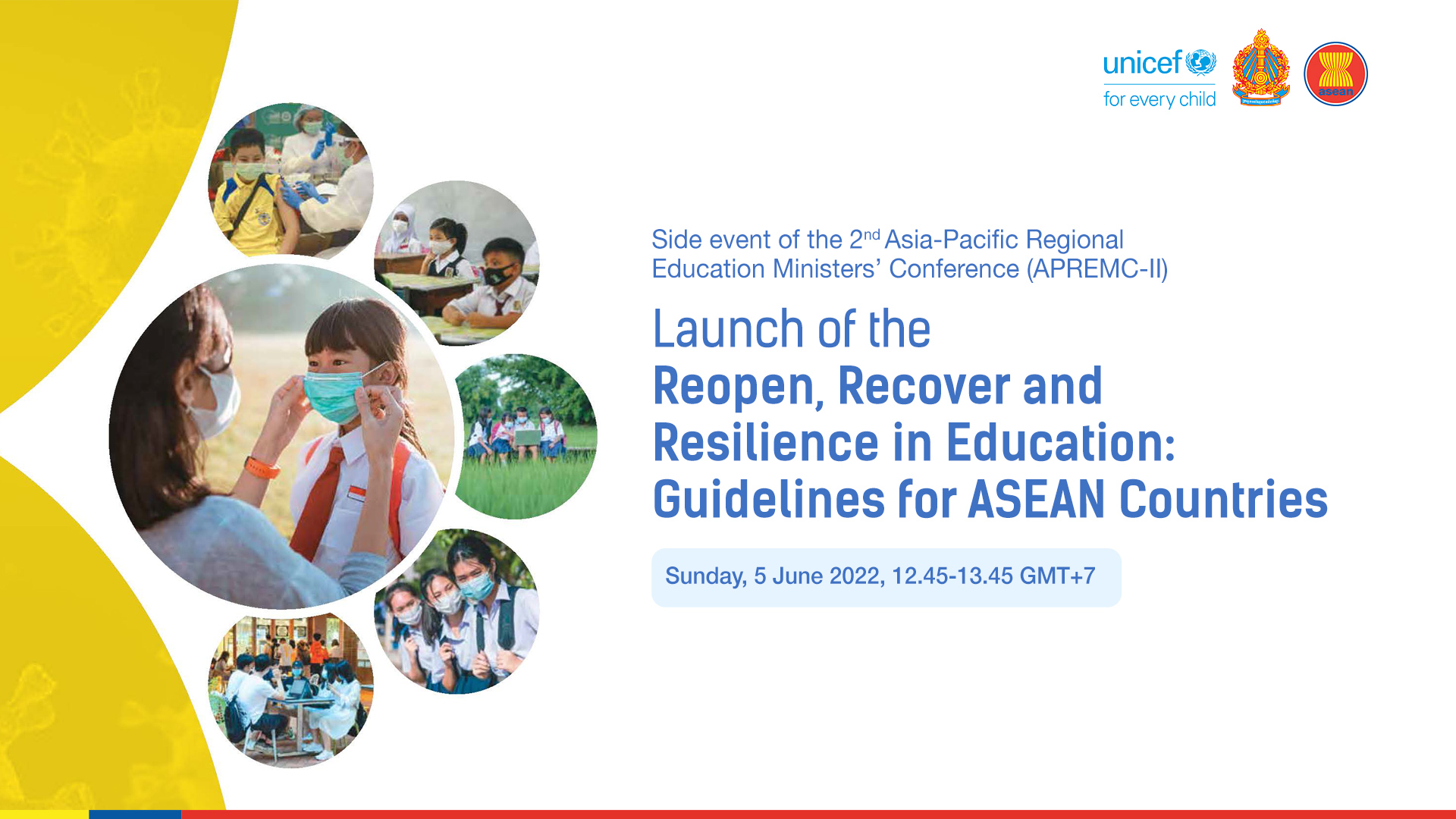
The launch event aims to disseminate the “Reopen, Recover and Resilience in Education: Guidelines for ASEAN Countries” to relevant stakeholders and allow ASEAN Member States to share their national initiatives and challenges on topics such as learning recovery and strengthening education resilience through digital transformation of education system. The “Reopen, Recover and Resilience in Education: Guidelines for ASEAN Countries” was developed by the ASEAN Secretariat in collaboration with the UNICEF East Asia and the Pacific Regional Office (EAPRO), under the leadership of Cambodia. The guidelines, which was developed based on the ASEAN Policy Brief on Safe School Reopening, Learning Recovery and Continuity, is expected to continuously inform the policy decisions in the ASEAN Member States around safe school reopening during health crisis and emergencies in the long term.
Agenda
|
Schedule |
Activity |
|
12:45 – 12:50 PM (5 min) |
Welcome Remarks by H.E Ekkaphab Phanthavong, Deputy Secretary-General of ASEAN for ASEAN Socio-Cultural Community (pre-recorded)
|
|
12:50 – 12:57 PM (7 min) |
Key note speech by H.E Ratana Som, Undersecretary of State, Ministry of Education Youth and Sports Cambodia |
|
12:57 – 1:00 PM (3 min) |
Video presentation on the Guidelines
|
|
1:00 – 1:40 PM (40 mins) |
Topics:
Speakers: 3 ASEAN Member States
Moderator: Mr. Akihiro Fushimi, Regional Education Specialist, UNICEF EAPRO
|
|
1:40 – 1:45 PM (5 mins) |
Ways Forward and Closing by Dr. Roger Yap Chao, Jr, Assistant Director and Head of Education Youth and Sports Division, ASEAN Secretariat
|
The side event will be convened in person in Bangkok. The recording of the event will be uploaded in ASEAN social media channels for watching after the event.