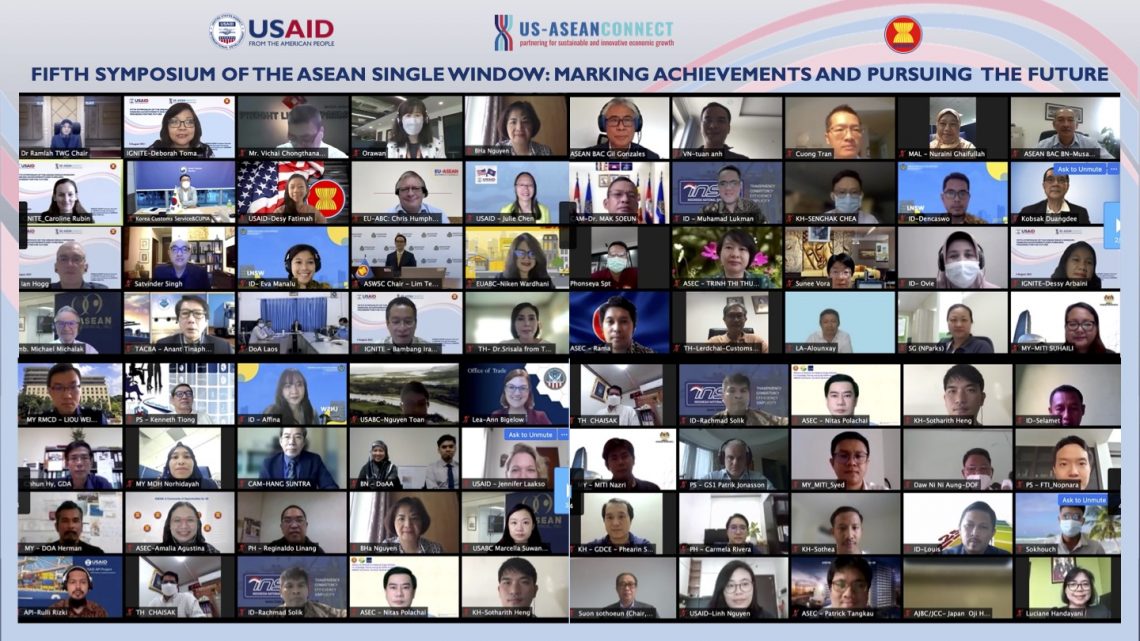




JAKARTA, August 5 2021 –– Today, the Association of Southeast Asian Nations (ASEAN) and the U.S. Agency for International Development (USAID) held the fifth symposium on the ASEAN Single Window (ASW) to plan for greater private sector engagement and facilitate timely, cross-border trade.
Held virtually and facilitated by the ASEAN-USAID Inclusive Growth in ASEAN through the Innovation, Trade and e-Commerce project, the symposium brought together 300 government officials, private sector leaders, and trade community representatives from the ASEAN Member States. Titled ‘Marking Achievements and Pursuing Progress for the Future,’ the half-day forum highlighted ASW achievements and presented updates on 2021 priority actions and plans for 2022.
On progress so far, participants learned that, while using the ASW, all 10 member states have utilised the ATIGA electronic Certificate of Origin (ATIGA e-Form D) to enjoy preferential tariff treatment for goods produced and traded within ASEAN. This means importers can enjoy swift, preferential tariff treatment without waiting for the receipt of a hard copy of certificates of origin from issuing authorities and without being required to send hard copies to customs authorities of the importing countries. In another milestone, five ASEAN Member States have exchanged the ASEAN Customs Declaration Document through the ASW, helping customs authorities of importing countries complete risk management procedures.
“This symposium provides an opportunity to showcase the achievements of the ASW to date and explores options for enhanced private sector engagement and expansion of the ASW services,” according to Deputy Secretary-General of ASEAN for ASEAN Economic Community Satvinder Singh. “This will allow ASEAN Member States to focus on how best to facilitate trade in ways that are most important to the private sector.”
The ASEAN Single Window is a regional electronic platform that promotes ASEAN economic integration by enabling the electronic exchange of border trade-related documents among member states. Traders can exchange customs documentation through the ASW platform, expediting cargo clearance and reducing paperwork. This boosts regional trade efficiency and competitiveness for inclusive economic growth.
“The United States, through USAID, is proud to partner with ASEAN in developing the ASEAN Single Window,” said Melissa A. Brown, Chargé d’Affaires, a.i. of the U.S. Mission to ASEAN. “This groundbreaking trade facilitation platform continues to increase trade transparency and reduce costs associated with cross-border trade, benefits that will extend to countries throughout the Indo-Pacific in the future.”
Symposium discussions focused on expanding ways to reform the ASW to promote the use of exchanged trade documents and strengthen private sector engagement. The event also explored options for connecting the ASW to foreign single windows—an important step that can help simplify Customs procedures and reduce the cost of trading for ASEAN Member States and potentially overseas markets.
For more information about the Symposium, contact USAID/ASEAN Communications Specialist, Samara Sanders at jakartausaidasean@usaid.gov.