






SINGAPORE, 6 September 2018 – More than 160 participants, including senior officials from ASEAN countries, members of the ASEAN Connectivity Coordinating Committee (ACCC), representatives from Dialogue Partners, and other stakeholders involved in the ASEAN Connectivity agenda, attended the 9th ASEAN Connectivity Symposium held today in Singapore. The Symposium continued to serve as an important platform to conduct a two-way conversation between ASEAN and the key stakeholders, including the private sector and multilateral development institutions.
 With the theme “Towards Effective Implementation of the Master Plan on ASEAN Connectivity (MPAC) 2025”, the Symposium focused on the priority MPAC 2025 deliverables for 2018: namely: (i) establishing a priority list of potential ASEAN infrastructure projects; (ii) strategies to advance sustainable urbanisation in ASEAN; and (iii) review of micro, small and medium enterprises’ (MSMEs) participation in the digital economy.
 In his opening remarks, the Chair of the ASEAN Connectivity Coordinating Committee Ambassador Tan Hung Seng reiterated that the fundamental objective of MPAC 2025 is to establish a seamlessly connected ASEAN that will deliver tangible benefits to ASEAN citizens. He also highlighted that MPAC 2025 is designed to ensure better delivery of results by having: (i) focussed targets, and clear governance and ownership; (ii) a robust performance management system; and (iii) proactive stakeholder engagement. Using the analogy of a triathlon, Ambassador Tan highlighted the multi-year, cross-cutting nature of MPAC 2025, and encouraged ASEAN and the stakeholders to adopt a strategic and long-term approach towards ASEAN Connectivity.
The Symposium participants engaged in a rich exchange of views with a line-up of eminent panellists. They exchanged views on current challenges and recommendations to mobilise resources for infrastructure development and cooperation in ASEAN, promote sustainable urbanisation in ASEAN cities, and facilitate MSME participation in the digital economy. Recognising the cross-cutting nature of MPAC 2025, they emphasised the importance of holding more dialogue and fostering greater cooperation between stakeholders in order to deliver concrete actions that benefit the region.
The Ministry of Foreign Affairs of Singapore organised the symposium with the support of ASEAN Secretariat and the Economic Research Institute for ASEAN and East Asia (ERIA).
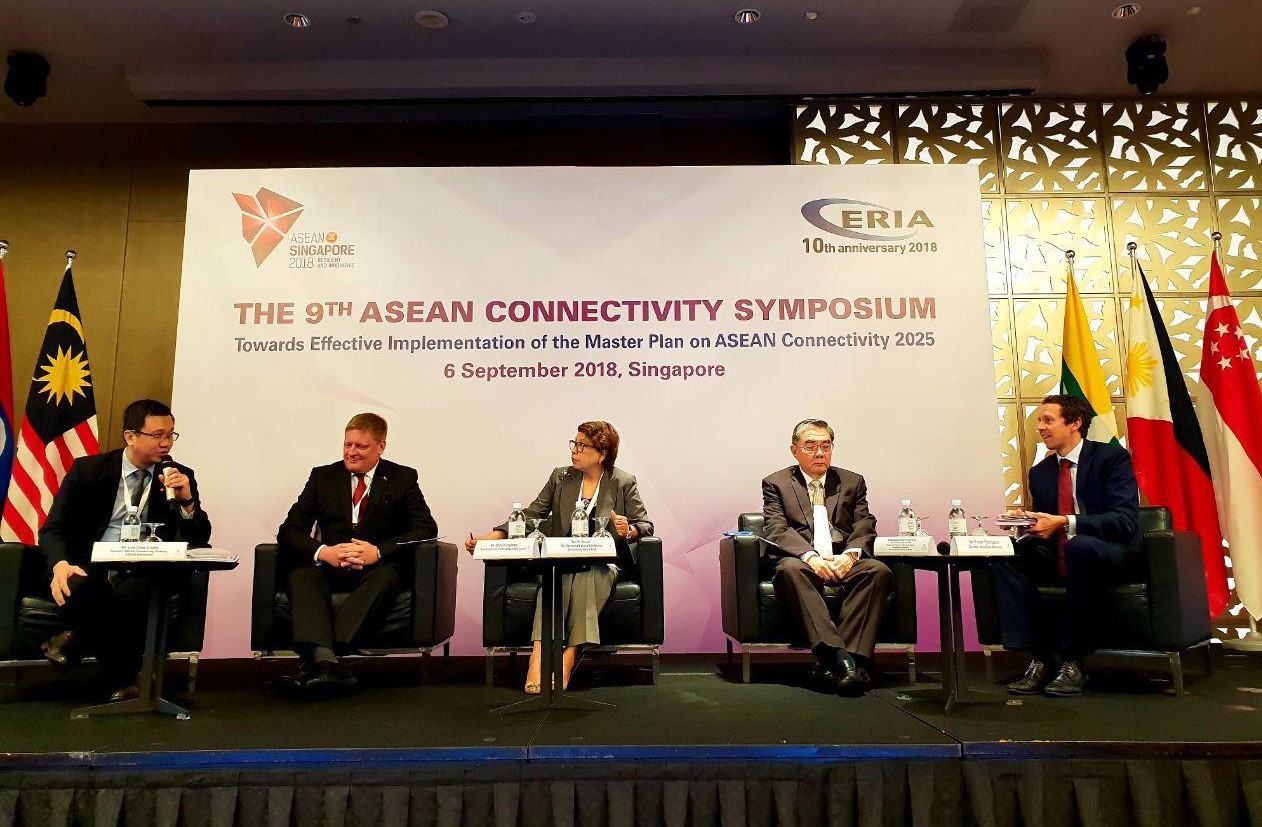 In his remarks, the President of ERIA Professor Hidetoshi Nishimura emphasised digital connectivity and the increasing importance of digital connectivity infrastructure. He noted that “we are in the era of the digital economy where sophisticated and seamless connectivity was key to unlock the potential gains of the digital economy.” He said that this would require the smooth flow of information, seamless logistics, and the free flow of capital. Digital technologies, along with big data and artificial intelligence, played key roles in digital innovation. Further, Prof. Nishimura stated that there is a need to prepare for critical transformations in both industries and societies given these rapid technological developments. ERIA hoped to provide relevant policy recommendations to ASEAN in this field.
***
