





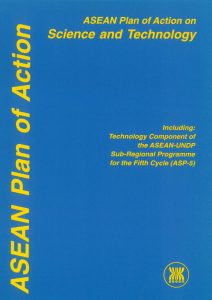
ASEAN Plan of Action on Science and Technology
Abstract
The mandate for the cooperation in science and technology (S&T) among the ASEAN Member Countries dates back to the founding of ASEAN as promulgated in the Bangkok Declaration of 1967. In order to provide appropriate guidelines for the identification and formulation of programmes and projects, achieve better coordination and cooperation and strengthen the capabilities in S&T within ASEAN, the first Plan of Action on Science and Technology was completed in 1981 by the ASEAN Committee on Science and Technology (COST) with the assistance of the ASEAN Secretariat. The Plan was revised and updated in 1989 to take into account the progress made in the S&T field and other developments in the region so as to ensure that the cooperative programmes remain effective and relevant.
The ASEAN Heads of Government, at their Fourth Summit Meeting in January 1992, pledged to continue to step up cooperation in science and technology and approved a Programme of Action which included several initiatives in the S&T area. In accordance with these guiding principles, the Fifth Meeting of the ASEAN Ministers for Science and Technology in September 1992 endorsed the proposal of COST to carry out a detailed review of the activities of the eight subcommittees of COST and formulate a revised ASEAN Plan of Action on S&T. The ASEAN Secretariat was again requested to assist COST in this endeavour.
With funding support from the United Nations Development Programme (UNDP), the ASEAN Secretariat prepared the draft Plan which was considered by COST at its 29th meeting in January 1994 before being submitted to and finally endorsed by the Sixth Meeting of the ASEAN Ministers for Science and Technology in February 1994.
The updated 1994 ASEAN Plan of Action on S&T therefore represents the strategic blueprint for the implementation of ASEAN S&T cooperative programmes that will support national and regional economic and social development initiatives into the next century. The Plan identifies six strategies and twenty supporting actions to attain the objectives that have been put forward. In order to operationalize the Plan of Action and address some of the key issues described in the Plan, the ASEAN Secretariat was again able to secure UNDP assistance to prepare a Technology Sub-Programme for consideration under the ASEAN-UNDP Sub-Regional Programme for the Fifth Cycle (ASP-5). UNDP has since approved the funding for the implementation of the ASP-5 which includes the Technology Sub-Programme component. The timely support received from UNDP at this critical juncture in the development of S&T cooperation within ASEAN is very much appreciated.
More Details
| Author | ASEAN Secretariat |
| Barcode | <000000019436> <000000019437> <000000019438> <000000019535> |
| Edition | |
| Place | Jakarta |
| Publisher | ASEAN Secretariat |
| Year | 1994 |
| Call Number | 216 ASE a |
| ISBN | 9788080068 |
| Language | English |
| Content Type | Text Book |
| Media Type | |
| Number of copies | 3 |

