





The Founding of ASEAN
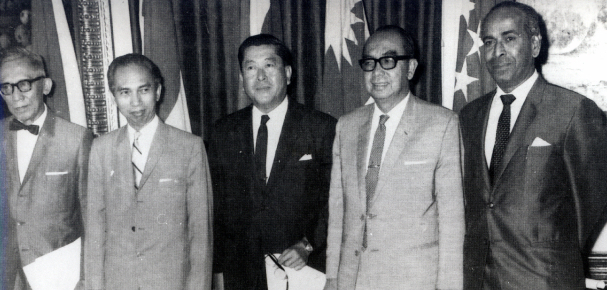
On 8 August 1967, five gentlemen – the Deputy Prime Minister of Malaysia, along with the Foreign Ministers of Indonesia, the Philippines, Singapore, and Thailand – gathered in the main hall of the Department of Foreign Affairs building in Bangkok, Thailand, and signed a document. By virtue of that document, the Association of Southeast Asian Nations (ASEAN) was established. Adam Malik of Indonesia, Narciso R. Ramos of the Philippines, Tun Abdul Razak of Malaysia, S. Rajaratnam of Singapore, and Thanat Khoman of Thailand would later be recognised as the Founding Fathers of arguably the most successful inter-governmental organisation in the developing world today. The document they signed would be known as the ASEAN Declaration.
It was a concise document consisting of just five articles. It established the formation of an Association for Regional Cooperation among the Countries of Southeast Asia, known as the Association of Southeast Asian Nations (ASEAN), and outlined its aims and purposes. These aims encompass cooperation in the economic, social, cultural, technical, educational, and other sectors, as well as the promotion of regional peace and stability through respect for justice, the rule of law, and adherence to the principles of the United Nations Charter. It specified that the Association would be open to all States in the Southeast Asian region that shared its aims, principles, and purposes. It declared ASEAN as representing “the collective will of the nations of Southeast Asia to bind themselves together in friendship and cooperation and, through joint efforts and sacrifices, secure for their peoples and for posterity the blessings of peace, freedom and prosperity.”
During Thailand’s efforts to broker reconciliation among Indonesia, the Philippines, and Malaysia over certain disputes, it became clear to the four nations that the time for regional cooperation had arrived, or else the region’s future would remain uncertain. Recalling one of the two surviving protagonists of that historic process, Thanat Khoman said: “At the banquet marking the reconciliation between the three disputants, I introduced the idea of forming another organisation for regional cooperation with Adam Malik. Malik agreed immediately but asked for time to consult his government and to normalise relations with Malaysia now that the confrontation was over. Meanwhile, the Thai Foreign Office prepared a draft charter for the new institution. In a few months, everything would be ready. I then invited the two former members of the Association for Southeast Asia (ASA), Malaysia and the Philippines, along with Indonesia, a key member, to a meeting in Bangkok. Additionally, Singapore sent S. Rajaratnam, then Foreign Minister, to discuss joining the new arrangement. Although the new organisation was planned to include only the ASA members plus Indonesia, Singapore’s request was favourably considered.
And so, in early August 1967, the five Ministers spent four days in the relative isolation of a beach resort in Bang Saen, a coastal town less than a hundred kilometres southeast of Bangkok. There, they negotiated over that document in a decidedly informal manner, which they would later delight in describing as “sports-shirt diplomacy.” Yet it was by no means an easy process. Each man brought into the deliberations a historical and political perspective that had no resemblance to that of any of the others. But with goodwill and good humour, as often as they huddled at the negotiating table, they finessed their way through their differences as they lined up their shots on the golf course and traded wisecracks on one another’s game, a style of deliberation which would eventually become the ASEAN ministerial tradition.
Now, with the rigours of negotiations and the informalities of Bang Saen behind them, and with their signatures neatly attached to the ASEAN Declaration, also known as the Bangkok Declaration, it was time for some formalities. The first to speak was the Philippine Secretary of Foreign Affairs, Narciso Ramos, a former journalist and long-time legislator who had given up the chance to be Speaker of the Philippine Congress to serve as one of his country’s first diplomats. He was then 66 years old, and his only son, the future President Fidel V. Ramos, was serving with the Philippine Civic Action Group in embattled Viet Nam. He recalled the tediousness of the negotiations that preceded the signing of the Declaration that “truly taxed the goodwill, the imagination, the patience and understanding of the five participating Ministers.” That ASEAN was established at all despite these difficulties, he said, meant that its foundations had been solidly laid. And he impressed upon the audience of diplomats, officials, and media personnel who had witnessed the signing ceremony that a great sense of urgency had prompted the Ministers to go through all that trouble. He spoke darkly of the forces arrayed against the survival of Southeast Asia’s countries in those uncertain and critical times.
“The fragmented economies of Southeast Asia,” he said, “(with) each country pursuing its own limited objectives and dissipating its meagre resources in the overlapping or even conflicting endeavours of sister states, carry the seeds of weakness in their incapacity for growth and their self-perpetuating dependence on the advanced, industrial nations. ASEAN, therefore, could marshal the still untapped potentials of this rich region through more substantial united action.”
When it was his turn to speak, Adam Malik, Presidium Minister for Political Affairs and Minister for Foreign Affairs of Indonesia, recalled that about a year before, in Bangkok, at the conclusion of the peace talks between Indonesia and Malaysia, he had explored the idea of an organisation such as ASEAN with his Malaysian and Thai counterparts. One of the “angry young men” in his country’s struggle for independence two decades earlier, Adam Malik was then 50 years old and one of a Presidium of five led by then General Soeharto that was steering Indonesia from the verge of economic and political chaos. He was the Presidium’s point man in Indonesia’s efforts to mend fences with its neighbours in the wake of an unfortunate policy of confrontation. During the past year, he said, the Ministers had all worked together toward the realisation of the ASEAN idea, “making haste slowly, to build a new association for regional cooperation.”
