





The Founding of ASEAN (part 2)
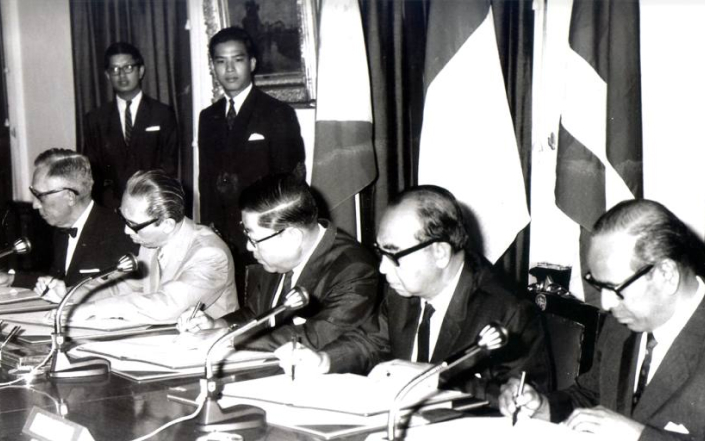
Adam Malik went on to describe Indonesia’s vision of a Southeast Asia developing into “a region which can stand on its own feet, strong enough to defend itself against any negative influence from outside the region.” He stressed that such a vision was not wishful thinking if the countries of the region effectively cooperated, considering their combined natural resources and manpower. He referred to differences of outlook among the member countries, but those differences, he said, would be overcome through a maximum of goodwill, understanding, faith, and realism. Hard work, patience, and perseverance, he added, would also be necessary.
The countries of Southeast Asia should also be willing to accept responsibility for what happens to them, according to Tun Abdul Razak, the Deputy Prime Minister of Malaysia, who spoke next. In his speech, he envisioned an ASEAN that would include all the nations of Southeast Asia. Tun Abdul Razak was then simultaneously his country’s Minister of Defence and Minister of National Development. It was a time when national survival was the primary focus of Malaysia’s relations with other countries. So as Minister of Defence, he was responsible for his country’s foreign affairs. He emphasised that the region’s countries should recognise that unless they assume their shared responsibility to shape their own future and prevent external intervention and interference, Southeast Asia would continue to be unstable and tense. And unless they took firm and collective action to prevent intra-regional conflicts from occurring, the nations of Southeast Asia would remain vulnerable to manipulation, turning against each other.
“We, the nations and peoples of Southeast Asia,” Tun Abdul Razak said, “must come together and form a new perspective and a new framework for our region. It is important that, individually and collectively, we develop a deep awareness that we cannot survive for long as independent but isolated peoples unless we also think and act together and unless we demonstrate through our deeds that we belong to a family of Southeast Asian nations united by bonds of friendship and goodwill, imbued with our own ideals and aspirations, and determined to shape our own destiny.” He added that, “with the establishment of ASEAN, we have taken a firm and bold step on that path.”
For his part, S. Rajaratnam, a former Minister of Culture of multi-cultural Singapore who served as its first Foreign Minister at that time, observed that two decades of nationalist fervour had not met the expectations of the people of Southeast Asia for better living standards. If ASEAN were to succeed, he stated, then its members would need to combine national and regional thinking.
“We must now consider two levels,” Rajaratnam said. “We must think not only of our national interests but also position them against regional interests: that is a new way of thinking about our problems. These are two different things, and sometimes they can conflict. Secondly, if we are truly serious about it, we must accept that regional existence requires painful adjustments to the practices and thinking in our respective countries. We must make these painful and difficult adjustments. If we do not do so, then regionalism remains a utopia.”
S. Rajaratnam expressed concern, however, that ASEAN might be misunderstood. “We are not against anything”, he said, “not against anybody”. Here, he used a term that would still sound ominous: balkanisation. In Southeast Asia, as in Europe and elsewhere, he said, outside powers had a vested interest in the balkanisation of the region. “We want to ensure,” he said, “a stable Southeast Asia, not a balkanised Southeast Asia. And those countries that are genuinely interested in the stability, prosperity, and improved economic and social conditions of Southeast Asia will welcome small countries coming together to pool their resources and wisdom to contribute to global peace.”
The goal of ASEAN, then, is to build, not to destroy. This, the Foreign Minister of Thailand, Thanat Khoman, emphasised when it was his turn to speak. At a time when the Viet Nam conflict was intensifying and American forces seemed perpetually entrenched in Indochina, he had anticipated their eventual withdrawal from the region and had accordingly worked to adapt Thailand’s foreign policy to a reality that would only become clear more than half a decade later. He must have had that in mind when, on that occasion, he stated that the countries of Southeast Asia had no choice but to adjust to the demands of the present, to move towards closer cooperation and even integration. Expanding on ASEAN objectives, he spoke of “building a new society that will be responsive to the needs of our time and effectively equipped to bring about, for the benefit and the material as well as spiritual advancement of our peoples, conditions of stability and progress. What millions of men and women in our part of the world particularly want is to erase the old and outdated concept of domination and subjugation from the past and replace it with a new spirit of give and take, of equality and partnership. More than anything else, they want to be masters of their own house and to enjoy the inherent right to decide their own destiny …”
While the nations of Southeast Asia resist efforts to strip them of their freedom and sovereignty, he stated that they must first free themselves from the material barriers of ignorance, disease, and hunger. None of these nations can achieve this alone, but by uniting and collaborating with those who share the same goals, these aims become easier to reach. Then Thanat Khoman concluded: “What we have decided today is only a small beginning of what we hope will be a long and ongoing series of achievements, of which we ourselves, those who will join us later, and future generations can be proud. Let it be for Southeast Asia, a region that is potentially rich—rich in history, in spiritual and material resources—and indeed for the whole ancient continent of Asia, the light of happiness and well-being that will shine over the countless millions of our struggling peoples.”
The Foreign Minister of Thailand concluded the inaugural session of the Association of Southeast Asian Nations by presenting each of his colleagues with a memento. Inscribed on the memento given to the Foreign Minister of Indonesia, was the citation, “In recognition of services rendered by His Excellency Adam Malik to the ASEAN organisation, the name of which was suggested by him.”
And that was how ASEAN was conceived, named, and established. It had been barely 14 months since Thanat Khoman introduced the ASEAN idea during his conversations with his Malaysian and Indonesian colleagues. In about three weeks, Indonesia would fully restore diplomatic relations with Malaysia, followed shortly by ties with Singapore. This was by no means the end of intra-ASEAN disputes, as soon the Philippines and Malaysia would clash over sovereignty issues concerning Sabah. Many disagreements between ASEAN nations continue to this day. However, all Member Countries remain deeply committed to resolving their differences peacefully and through mutual understanding. Every dispute has its season, but it would not hinder the broader goal. The focus at that time was to establish a framework for regional dialogue and cooperation.
The two-page Bangkok Declaration outlines not only the rationale for establishing ASEAN and its specific objectives but also reflects the organisation’s approach of building incrementally through voluntary and informal arrangements towards more binding and institutionalised agreements. All the founding member states and the newer members, have remained faithful to the spirit of the Bangkok Declaration. Over the years, ASEAN has progressively adopted several formal and legally binding instruments, such as the 1976 Treaty of Amity and Cooperation in Southeast Asia and the 1995 Treaty on the Southeast Asia Nuclear Weapon-Free Zone.
Against the backdrop of conflict in the then Indochina, the Founding Fathers had the foresight to build a community of and for all Southeast Asian states. Thus, the Bangkok Declaration promulgated that “the Association is open for participation to all States in the Southeast Asian region subscribing to the aforementioned aims, principles and purposes.” ASEAN’s inclusive outlook has paved the way for community-building not only in Southeast Asia, but also in the broader Asia Pacific region, where several other intergovernmental organisations now co-exist.
The original ASEAN logo depicted five brown sheaves of rice stalks, each representing a founding member. Beneath the sheaves is the word “ASEAN” in blue. These are set on a yellow background, encircled by a blue border. Brown symbolises strength and stability, yellow signifies prosperity, and blue represents the spirit of friendliness in which ASEAN affairs are conducted. When ASEAN marked its 30th Anniversary in 1997, the sheaves on the logo increased to ten – symbolising all ten Southeast Asian countries and reflecting the colours of their flags. Essentially, ASEAN and Southeast Asia became the same, just as the Founding Fathers envisioned. This vision was realised when Timor-Leste was admitted as ASEAN’s eleventh and newest Member State in October 2025.
(This article is based on the first chapter of ASEAN at 30, a publication of the Association of Southeast Asian Nations in commemoration of its 30th Anniversary on 8 August 1997, written by Jamil Maidan Flores and Jun Abad.)
