





Overview
The Importance of Trade in Services in ASEAN Economy
Services is a sizeable and continuously expanding component of GDP in ASEAN economies. As of 2018, services sector represents between 38% and 69% of ASEAN Member States’ Gross Domestic Product

(Source: ASEANStats, November 2019)
ASEAN's Export and Import of Services
Travel, transport, and other business services dominate the export and import of services of ASEAN in general. ASEAN’s export is dominated by travel services, while ASEAN’s import is dominated by transport services. In the distant fourth place, ASEAN’s export is also contributed by financial services, while ASEAN’s import comes from charges for the use of intellectual property. These services sectors are classified based on the IMF Balance of Payments Manual, 6th Edition.
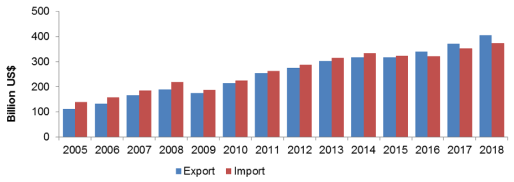
(Source: ASEANStats, November 2019)
ASEAN's Services Export by Sectors (2018 Data out of Total Export of US$ 404.9 billion)

ASEAN's Import Export by Sectors (2018 Data out of Total Import of US$ 373.8 billion)
Services sectors have also been traditionally the largest recipient of Foreign Direct Investments (FDI) into the region. With few exceptions, throughout the last 15 years, services sectors have attracted about 60 or higher percentage of total FDI flow into ASEAN.
(Source: ASEANStats, November 2019)
FDI Inflow to ASEAN by Sector
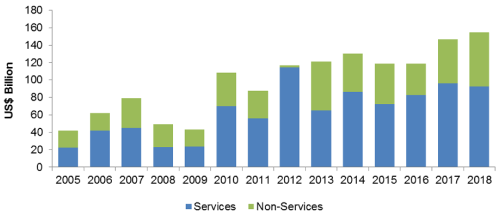
(Source: ASEANStats, November 2019)
Areas of Cooperation
ASEAN Framework Agreement on Services (AFAS)
Recognising the growing importance of trade in services, ASEAN Member States had commenced their joint effort to work towards free flow of trade in services within the region through the ASEAN Framework Agreement on Services (AFAS), signed on 15 December 1995 by ASEAN Economic Ministers (AEM) during the 5thASEAN Summit in Bangkok, Thailand.
AFAS provides broad guidelines for ASEAN Member Countries to progressively improve Market Access, and ensures equal National Treatment for services suppliers in ASEAN. All AFAS rules are consistent with international rules for trade in services provided by the General Agreement on Trade in Services (GATS) of the World Trade Organisation (WTO). AFAS aims at substantially eliminating restrictions to trade in services among ASEAN Member States to improve the efficiency and competitiveness of ASEAN services suppliers. Liberalisation of services trade under AFAS is also directed to achieve commitments beyond Member States’ commitments under the GATS.
Since the signing of AFAS, officials of ASEAN Member States have been working to achieve the objective of AFAS to create a freer trade in services within the region. This was implemented through rounds of negotiations, each resulting in packages of commitments, which stipulates the commitments of each ASEAN Member State in various services sector/sub-sector and mode of supply.
The ASEAN Economic Community (AEC) Blueprint adopted by ASEAN Leaders at the 13th ASEAN Summit on 20 November 2007 in Singapore, formalised and stepped up ASEAN’s effort to further liberalise towards the goal of free flow of services through bi-annual targets and thresholds laid out under this AEC Blueprint, which were further supplemented by additional parameters set forth by the Ministers.
AFAS has been updated with a new, more modern and comprehensive Agreement, namely the ASEAN Trade in Services Agreement (ATISA), which has been concluded and is expected to be signed by all AMS within 2020.
Movement of Natural Persons (MNP)
In November 2012, ASEAN Economic Ministers (AEM) signed the ASEAN Agreement on Movement of Natural Persons (MNP) in Phnom Penh, Cambodia. The MNP Agreement provides for streamlined and transparent procedures for applications for immigration formalities for the temporary entry or temporary stay of natural persons, and therefore is intended to facilitate the movement of natural persons engaged in the conduct of trade: in goods, trade in services and investment between Member States.
The schedules of commitment under the MNP Agreement supersede Mode 4 commitments of the earlier AFAS packages. The MNP Agreement enters into force on 14 June 2016 following completion of its ratification by all AMS. Pursuant to Article 7 of this Agreement, discussions on the updating of the schedules of commitments under this Agreement are currently on-going.
Mutual Recognition Arrangements (MRAs)
Mutual Recognition Arrangements (MRAs) forms another important area of ASEAN cooperation on trade in services. MRAs are enabling tools to allow mutual recognition of qualifications of professional services suppliers by signatory ASEAN Member States to facilitate mobility of professional services providers in the region.
At present, ASEAN has concluded MRAs in 7 (seven) professional services signed by the ASEAN Economic Ministers (AEM):
- MRA on Engineering Services signed on 9 December 2005 in Kuala Lumpur, Malaysia;
- MRA on Nursing Services signed on 8 December 2006 in Cebu, the Philippines;
- MRA on Architectural Services and Framework Arrangement for the Mutual Recognition of Surveying Qualifications
both signed on 19 November 2007 in Singapore; - MRA on Medical Practitioners signed on 26 February 2009 in Cha-am, Thailand;
- MRA on Dental Practitioners signed on 26 February 2009 in Cha-am, Thailand;
- MRA Framework on Accountancy Services signed on 26 February 2009 in Cha-am, Thailand, which is subsequently superseded by MRA on Accountancy Services signed on 13 November 2014 in Nay Pyi Taw, Myanmar.
ASEAN Member States are actively implementing these MRAs. The websites of the MRA Implementing Bodies are as follows:
- ASEAN Chartered Professional Engineers Coordinating Committee (ACPECC)
- ASEAN Architect Council (AAC)
- ASEAN Chartered Professional Accountant Coordinating Committee (ACPACC)
- ASEAN Healthcare Services Website
Details on the three MRAs related to the healthcare sector (i.e. nursing, medical practitioners and dental practitioners) can also be found in the Healthcare Services page.
ASEAN Qualifications Reference Framework (AQRF)
Another ASEAN initiative to facilitate mobility of people is the ASEAN Qualification Reference Framework (AQRF). AQRF is a common reference framework to compare qualifications throughout all education and training sectors across all AMS. With AQRF, countries could reference their national-level qualifications framework or system to this ASEAN-level framework. In this way, AQRF supports and enhances each country’s National Qualification Framework (NQF) as well as promotes transparency and higher quality qualifications systems. Further information is available on the AQRF page here.
External Engagements
In addition to the internal ASEAN integration efforts, ASEAN expands its area of cooperation to include its Dialogue Partners through Free Trade Agreements. These include the ASEAN-Australia-New Zealand FTA (AANZFTA), the ASEAN-China FTA (ACFTA), the ASEAN-Hong Kong, China FTA (AHKFTA), the ASEAN-India FTA (AIFTA), the ASEAN-Japan Comprehensive Economic Partnership (AJCEP) and the ASEAN-Korea FTA (AKFTA). ASEAN is also negotiating the Regional Comprehensive Economic Partnership (RCEP).
Highlights
Sectoral Bodies
The works on services integration in ASEAN are overseen by the ASEAN Economic Ministers (AEM). Following the decision of AEM at an Informal Meeting held on 28 June 1999 in Auckland, New Zealand, ASEAN Finance Ministers (AFMM) and ASEAN Transport Ministers (ATM) subsequently took the lead in the liberalisation of financial services and air transport services, respectively. Since March 2015, ASEAN Finance Ministers met jointly with the Central Bank Governors, and renamed as ASEAN Finance Ministers’ and Central Bank Governors’ Meeting (AFMGM).
Following the signing of the Protocol to Amend the Framework Agreement on the ASEAN Investment Area on 14 September 2001 in Ha Noi, Viet Nam, the works on services incidental to manufacturing, agriculture, fishery, forestry, and mining and quarrying were transferred to the investment track under the purview of ASEAN Investment Area (AIA) Council. This transfer is made in order to ensure coherence its works related to investment in the manufacturing, agriculture, fishery, forestry, and mining and quarrying sectors.
At the working level in implementing the various works under the AFAS, the Coordinating Committee on Services (CCS) was established in January 1996 to implement the agreement. The CCS reports to the AEM through the Senior Economic Officials Meeting (SEOM). For financial services, the works are undertaken by the Working Committee on Financial Services Liberalisation (WC-FSL) who reports to the AFMGM through the ASEAN Finance and Central Bank Deputies Meeting (AFCDM). For air transport services, the works are under taken by the Air Transport Working Group (ATWG), who reports to ATM through the Senior Transport Officials Meeting (STOM). For the 5 incidental services, the works are undertaken as part of the works under the Coordinating Committee on Investment (CCI) who reports to the AIA Council through SEOM.

Sectoral Working Groups under CCS
Under the CCS there are several Sectoral Working Groups (SWG) who meet back-to-back with the CCS Meetings. The currently active SWG are:
- Business Services Sectoral Working Group (BSSWG)
- Logistics and Transport Services Sectoral Working Group (LTSSWG)
- Healthcare Services Sectoral Working Group (HSSWG)
- Telecommunication and Information Services Sectoral Working Group (TISSWG)
The implementing bodies of the 7 MRAs specified above reports to the CCS through BSSWG and HSSWG respectively. The following charts shows the reporting lines of the implementing bodies of 7 MRAs to the CCS:

- AAC: ASEAN Architect Council
- AAEC: ASEAN Architect Education Committee
- ACPACC: ASEAN Chartered Professional Accountant Coordinating Committee
- ACPECC: ASEAN Chartered Professional Engineering Coordinating Committee
- AJCCN: ASEAN Joint Coordinating Committee on Nursing
- AJCCM: ASEAN Joint Coordinating Committee on Medical Practitioners
- AJCCD: ASEAN Joint Coordinating Committee on Dental Practitioners
- SURVEYING: Surveying Competent Authorities of the Framework Arrangement for the Mutual Recognition of Surveying Qualifications
Highlights
Agreements
ASEAN Framework Agreement on Services (AFAS)
- ASEAN Framework Agreement on Services (AFAS) (Bangkok, 15 December 1995)
- Protocol to Amend AFAS (Phnom Penh, Cambodia, 2 September 2003)
ASEAN has also concluded ten packages of commitments under the AFAS each operationalised through a Protocol to Implement signed by the ASEAN Economic Ministers (AEM). These packages provide for details of commitments of each ASEAN Member State in various services sectors and subsectors.
– Initial Package (1997)
– Second Package (1998)
– Third Package (2001)
– Fourth Package(2004)
– Fifth Package (2006)
– Sixth Package (2007)
– Seventh Package(2009)
– Eighth Package (2010)
– Ninth Package (2015)
– Tenth Package (2018)
In addition, there has also been seven additional packages of commitments in financial services under the AFAS signed by the AFMM (the second, third, fourth, fifth, sixth, seventh and eighth Packages of Commitments of Financial Services under the AFAS) and eight additional packages of commitments in air transport under the AFAS signed by the ATM (the fourth, fifth, sixth, seventh, eighth, ninth, tenth, and eleventh Packages of Commitments on Air Transport Services under the AFAS). They are featured in the respective pages of these Ministerial bodies.
Mutual Recognition Arrangement (MRA)
• MRA on Accountancy Services (Nay Pyi Taw, Myanmar, 13 November 2014)
MRA Framework on Accountancy Services (Cha-am, Thailand, 26 February 2009) (superseded)
• MRA on Medical Practitioners (Cha-am, Thailand, 26 February 2009)
Thailand PMRA Revision
• MRA on Dental Practitioners (Cha-am, Thailand, 26 February 2009)
– Philippines PDRA Revision
– Thailand PDRA Revision
• MRA on Engineering Services (Kuala Lumpur, 9 December 2005)
• MRA on Nursing Services (Cebu, Philippines, 8 December 2006)
– Cambodia PNRA Revision
– Malaysia PNRA Revision
• MRA on Architectural Services (Singapore, 19 November 2007)
• Framework MRA for Surveying Qualifications (Singapore, 19 November 2007)
ASEAN Agreement on the Movement of Natural Persons (MNP)
ASEAN Agreement on the Movement of Natural Persons (Phnom Penh, 19 November 2012)
– ASEAN MNP Schedule – Brunei Darussalam
– ASEAN MNP Schedule – Cambodia
– ASEAN MNP Schedule – Indonesia
– ASEAN MNP Schedule – Lao PDR
– ASEAN MNP Schedule – Malaysia
– ASEAN MNP Schedule – Myanmar
– ASEAN MNP Schedule – Philippines
– ASEAN MNP Schedule – Singapore
– ASEAN MNP Schedule – Thailand
– ASEAN MNP Schedule – Vietnam
Another ASEAN initiative to facilitate mobility of people is the ASEAN Qualification Reference Framework (AQRF). AQRF is a common reference framework to compare qualifications throughout all education and training sectors across all AMS. With AQRF, countries could reference their national-level qualifications framework or system to this ASEAN-level framework. In this way, AQRF supports and enhances each country’s National Qualification Framework (NQF) as well as promotes transparency and higher quality qualifications systems. Further information is available on the AQRF page here.
ASEAN minus X Agreements
Trade in Services Agreement with Dialogue Partners
ASEAN-China, (Cebu, Philippines, 14 January 2007)
• Commitments (1st Package) 2007
– Protocol to Implement 2nd Package of ASEAN China TIS (Bali, Indonesia, 16 November 2011)
• Commitments (2nd Package) 2011
– Protocol to Implement 3rd Package of ASEAN China TIS (as part of the Protocol to Amend ASEAN China
Framework Agreement – Kuala Lumpur, Malaysia, 21 November 2015)
• Commitments (3rd Package) 2015 – (page 82-540)
ASEAN-Korea (Singapore, 21 November 2007)
– Commitments
– Annex on Financial Services
– Letter of Understanding on AKTISA
– Protocol on the Accession of Thailand to the Trade in Services Agreement (2009) and its Annexes
ASEAN-Australia-New-Zealand (Cha-am, Thailand, 27 February 2009)
– Commitments
• ASEAN-India (Nay Pyi Taw, Myanmar, 13 November 2014)
– Commitments
• ASEAN-Japan (Hanoi, Viet Nam, 24 April 2019)
– Services Commitments
– MFN Exemptions
– List of Parties in relation to paragraph 3 of Article 50.3 (MFN Treatment)
– MNP Commitments
• ASEAN-Hong Kong (Nay Pyi Taw, Myanmar, 28 March 2018)
– Commitments
Highlights
Publications

