The Association of Southeast Asian Nations, or ASEAN, was established on 8 August 1967 in Bangkok, Thailand, with the signing of the ASEAN Declaration (Bangkok Declaration) by the Founding Fathers of ASEAN: Indonesia, Malaysia, Philippines, Singapore and Thailand. Brunei Darussalam joined ASEAN on 7 January 1984, followed by Viet Nam on 28 July 1995, Lao PDR and Myanmar on 23 July 1997, Cambodia on 30 April 1999, and Timor-Leste on 26 October 2025 making up what is today the eleven Member States of ASEAN.
ASEAN organs always strive to achieve ASEAN’s goals and objectives, the Secretary-General of ASEAN and the ASEAN Secretariat shall be functioned as coordinating Secretariat to help facilitate effective decision-making withing and amongst ASEAN bodies. In addition, each Member State shall appoint a Permanent Representative to liaise with Secretary-General of ASEAN and the ASEAN Secretariat
ASEAN shall develop friendly relations and mutually beneficial dialogues, cooperation and partnerships with countries and sub-regional, regional and international organisations and institutions. This includes external partners, ASEAN entities, human rights bodies, non-ASEAN Member States Ambassadors to ASEAN, ASEAN committees in third countries and international organisations, as well as international / regional organisations.
The rodmap for an ASEAN Community (2009-2015) was declared by the leaders in 2009. The ASEAN Community, anchored on three community pillars: Political-Security Community, Economic Community, Socio-Cultural Community was launched in 2015. The ASEAN 2025: Forging Ahead Together was introduced in 2015 as a Post-2015 Vision. It comprises the ASEAN Community Vision 2025, the ASEAN Political-Security Community Blueprint 2025, the ASEAN Economic Community Blueprint 2025 and the ASEAN Socio-Cultural Community Blueprint 2025
The Association of Southeast Asian Nations, or ASEAN, was established on 8 August 1967 in Bangkok, Thailand, with the signing of the ASEAN Declaration (Bangkok Declaration) by the Founding Fathers of ASEAN: Indonesia, Malaysia, Philippines, Singapore and Thailand. Brunei Darussalam joined ASEAN on 7 January 1984, followed by Viet Nam on 28 July 1995, Lao PDR and Myanmar on 23 July 1997, Cambodia on 30 April 1999, and Timor-Leste on 26 October 2025 making up what is today the eleven Member States of ASEAN.
ASEAN organs always strive to achieve ASEAN’s goals and objectives, the Secretary-General of ASEAN and the ASEAN Secretariat shall be functioned as coordinating Secretariat to help facilitate effective decision-making withing and amongst ASEAN bodies. In addition, each Member State shall appoint a Permanent Representative to liaise with Secretary-General of ASEAN and the ASEAN Secretariat
ASEAN shall develop friendly relations and mutually beneficial dialogues, cooperation and partnerships with countries and sub-regional, regional and international organisations and institutions. This includes external partners, ASEAN entities, human rights bodies, non-ASEAN Member States Ambassadors to ASEAN, ASEAN committees in third countries and international organisations, as well as international / regional organisations.
The rodmap for an ASEAN Community (2009-2015) was declared by the leaders in 2009. The ASEAN Community, anchored on three community pillars: Political-Security Community, Economic Community, Socio-Cultural Community was launched in 2015. The ASEAN 2025: Forging Ahead Together was introduced in 2015 as a Post-2015 Vision. It comprises the ASEAN Community Vision 2025, the ASEAN Political-Security Community Blueprint 2025, the ASEAN Economic Community Blueprint 2025 and the ASEAN Socio-Cultural Community Blueprint 2025
The United Kingdom of Great Britain and Northern Ireland (UK) was conferred Dialogue Partner status by ASEAN at the 54th ASEAN Foreign Ministers Meeting (AMM) held on 2 August 2021. The Plan of Action (POA) to Implement the ASEAN-UK Dialogue Partnership (2022-2026) was adopted at the ASEAN Post Ministerial Conference (PMC) Plus One Session with the UK on 4 August 2022. The POA sets out the broad direction of ASEAN-UK partnership across political and security cooperation, economic cooperation, and socio-cultural cooperation.
ASEAN-UK economic relations continue to grow, with the UK ranking as ASEAN’s 11th largest trade partner and 4th highest source of inward foreign direct investment (FDI) in 2024. Merchandise trade between ASEAN and the UK stood at 38.8 billion in 2024 while FDI inflow from the UK to ASEAN was recorded at USD 18.7 billion in the same year.
Overview
Regional mobility is central to services liberalisation in ASEAN. The region has made significant strides in increasing mobility through the ASEAN Agreement on Movement of Natural Persons, which facilitates the mobility of businesses and people across the region. ASEAN will continue its commitment to streamlining processes and reducing barriers to facilitate seamless movement of businesses and people across ASEAN Member States. ASEAN will continue to enhance mobility and improve the employment potential of professionals and talent in the region, including by developing plans to further refine and expand agreements to foster greater ease of travel, promote cross-cultural exchanges, and bolster the socio-economic ties binding the ASEAN community. These efforts will unlock the full potential of human capital and contribute to the dynamism and interconnectedness of the region.
Movement of Natural Persons (MNPs)
Originally signed in 2012 and updated in 2024, the Movement of Natural Persons (MNPs) Agreement provides a dedicated framework to facilitate the temporary cross-border movement of service providers within ASEAN. It supersedes Mode 4 commitments under the AFAS, offering a more streamlined and transparent mechanism for managing mobility.
The MNP Agreement supports ASEAN’s goal of achieving a single market and production base by enabling business visitors, intra-corporate transferees, and contractual service suppliers to move more easily across Member States. It establishes clear procedures for immigration formalities, while respecting national regulations and safeguarding domestic labour markets.
By enhancing mobility for skilled professionals and service providers, the MNP Agreement contributes to a more integrated and competitive ASEAN services economy, one that is more responsive to business needs and regional growth.
Click here for ASEAN Member States’ latest MNP commitments.
Mutual Recognition Arrangement (MRA)
ASEAN MRAs play a key role in facilitating the cross-border mobility of professionals across the region. These arrangements enable ASEAN Member States to recognise each other’s professional qualifications in the agreed sectors, reducing barriers to practice and enhancing regional integration.
Currently, MRAs cover seven key professions: Engineering, Architecture, Accountancy, Surveying, Medical Practice, Dentistry and Nursing. Each MRA is implemented and overseen by a dedicated coordinating committee, ensuring that professionals meet agreed standards and can be recognised across borders. These mechanisms help streamline licensing procedures, promote trust in qualifications, and support the development of a more competitive and mobile ASEAN workforce.
MRAs are a practical tool to support ASEAN’s vision of a single market and production base, and they complement broader frameworks such as the ASEAN Qualifications Reference Framework (AQRF) and the Movement of Natural Persons (MNP) Agreement.
Click here to see ASEAN MRAs for the seven professions.
ASEAN Qualifications Reference Framework (AQRF)
AQRF is a regional tool that supports the comparison and alignment of qualifications across ASEAN Member States and across occupations. It complements national qualification frameworks (NQF) and promotes quality assurance. It is implemented by an ASEAN Qualifications Reference Framework Committee (AQRFC).
Currently, four (4) ASEAN Member States have completed the referencing of their NQF into the AQRF.
The ASEAN Sub-Committee on Sanitary and Phytosanitary Measures (AC-SPS) was established for ensuring effective implementation of the provisions contained in Chapter 8 (Sanitary and Phytosanitary Measures) of the ATIGA.
Specifically, AC-SPS have the following functions:
Facilitate exchange of information on such matters as occurrences of sanitary or phytosanitary incidents in the Member States and Non-Member States, and change or introduction of sanitary and phytosanitary-related regulations and standards of the Member States, which may, directly or indirectly, affect trade between and among Member States;
Facilitate co-operation in the area of sanitary or phytosanitary measures including capacity building, technical assistance and exchange of experts, subject to the availability of appropriated funds and the applicable laws and regulations of each Member States;
Endeavor to resolve sanitary and phytosanitary matters with a view to facilitate trade between and among Member States. The AC-SPS may establish ad hoc task force to undertake science-based consultations to identify and address specific issues that may arise from the application of sanitary or phytosanitary measures; and
Submit regular reports of developments and recommendations in the implementation of the SPS Chapter to the AFTA Council, through SEOM for further action.
Countries in East Asia region have thriving trade and economic relations with each other through free trade agreements. The Association of Southeast Asian Nations (ASEAN) has free trade agreements with six partners namely People’s Republic of China (ACFTA), Republic of Korea (AKFTA), Japan (AJCEP), India (AIFTA) as well as Australia and New Zealand (AANZFTA).
In order to broaden and deepen the engagement among parties and to enhance parties’ participation in economic development of the region, the leaders of 16 participating countries established the Regional Comprehensive Economic Partnership (RCEP). The RCEP was built upon the existing ASEAN+1 FTAs with the spirit to strengthen economic linkages and to enhance trade and investment related activities as well as to contribute to minimising development gap among the parties.
In August 2012, the 16 Economic Ministers endorsed the Guiding Principles and Objectives for Negotiating the Regional Comprehensive Economic Partnership. The RCEP negotiations were launched by Leaders from 10 ASEAN Member States (Brunei Darussalam, Cambodia, Indonesia, Lao PDR, Malaysia, Myanmar, the Philippines, Singapore, Thailand and Viet Nam) and six ASEAN FTA partners (Australia, People’s Republic of China, India, Japan, Republic of Korea, and New Zealand) during the 21st ASEAN Summit and Related Summits in Phnom Penh, Cambodia in November 2012.
The objective of launching RCEP negotiations is to achieve a modern, comprehensive, high-quality, and mutually beneficial economic partnership agreement among the ASEAN Member States and ASEAN’s FTA partners. The RCEP negotiations commenced in early 2013.
COVERAGE AREAS
The RCEP negotiation includes: trade in goods, trade in services, investment, economic and technical cooperation, intellectual property, competition, dispute settlement, e-commerce, small and medium enterprises (SMEs) and other issues.
WHAT RCEP MEANS FOR BUSINESSES
RCEP has the potential to deliver significant opportunities for businesses in the East Asia region, given the fact that the 16 RCEP participating countries account for almost half of the world’s population; contribute about 30 per cent of global GDP and over a quarter of world exports. RCEP will provide a framework aimed at lowering trade barriers and securing improved market access for goods and services for businesses in the region, through:
Recognition to ASEAN Centrality in the emerging regional economic architecture and the interests of ASEAN’s FTA partners in enhancing economic integration and strengthening economic cooperation among the participating countries;
Facilitation of trade and investment and enhanced transparency in trade and investment relations between the participating countries, as well as facilitation of SMEs’ engagements in global and regional supply chains; and
Broaden and deepen ASEAN’s economic engagements with its FTA partners.
RCEP recognises the importance of being inclusive, especially to enable SMEs leverage on the agreement and cope with challenges arising from globalisation and trade liberalisation. SMEs (including micro-enterprises) make up more than 90% of business establishments across all RCEP participating countries and are important to every country’s endogenous development of their respective economy. At the same time, RCEP is committed to provide fair regional economic policies that mutually benefit both ASEAN and its FTA partners.
In the domain of analysis, several impactful programs drive the advancement of informed decision-making and deeper understanding within the ASEAN community. Through a multifaceted approach, these initiatives collectively contribute to the progress of the ASEAN Socio-Cultural Community, elevating the region’s socio-economic landscape.
At the heart of the commitment to knowledge dissemination, the KnowASCC serves as a central repository for valuable insights and resources. This platform acts as a dynamic space where stakeholders can access essential information, fostering a collaborative environment for informed decision-making.
The ASCC R&D Platforms Programme is the ASEAN Socio-Cultural Community’s commitment to monitor and assess regional trends socio-cultural issues. This initiative acts as a catalyst for innovative solutions, ensuring the region remains at the forefront of evolving challenges and opportunities.
Capturing the essence of ASEAN’s cultural diversity, The ASEAN Magazine promotes regional pride and understanding. By showcasing vibrant stories and perspectives within the community, this initiative aims to strengthen the bonds that tie ASEAN nations together.
For a comprehensive grasp of the ASEAN Socio-Cultural Community’s impact, a number of Publications are being developed regularly. These includes the ASCC in Facts and Figures that distills complex information into accessible insights and is designed to provide stakeholders with a clear and concise overview of ASCC’s achievements, facilitating better-informed decision-making, and the ASEAN Development Outlook aimed at charting the ASEAN Socio-Cultural Community’s progress towards inclusive and sustainable development, while identifying best practices and lessons learned to equip the region with tools needed to address future challenges.
Together, these initiatives embody a dedication to advancing analysis within ASEAN, ensuring that knowledge serves as a cornerstone for regional growth and understanding.
Overview
The ASCC Blueprint 2025 is the strategy and planning mechanism of the ASEAN Socio-Cultural Community (ASSC) to develop and strengthen coherent policy frameworks and institutions to advance human and sustainable development, social justice and rights, social protection and welfare, environmental sustainability and ASEAN awareness, and to narrow the development gap.
It has five characteristics namely (i) Engages and Benefits the People which focus on ensuring a committed, participative and socially-responsible community through an accountable and inclusive mechanism for the benefit of all ASEAN; (ii) Inclusive which promotes high quality of life, equitable access to opportunities for all and promotes and protects human rights; (iii) Sustainable ensures the attainment of a community that promotes social development and environmental protection; (iv) Resilient with enhanced capacity and capability to adapt and respond to social and economic vulnerabilities, disasters, climate change, and other new challenges; and (v) Dynamic which aims for an ASCC that is harmonious and is aware and proud of its identity, culture and heritage.
Across these five characteristics are 18 Key Result Areas which includes biodiversity conservation, social protection, institutional strengthening and empowerment of people and communities, reducing barriers and providing equitable access to basic services, disaster management, climate resiliency, and strengthening health systems.
The ASCC Blueprint’s Strategic Measures under each of the KRAs are translated into concrete programmes, projects and activities by the 15 ASCC Sectoral Bodies.
The ASCC Monitoring Division supports the Senior Officials’ Committee for ASCC (SOCA) and the ASCC Council in coordinating, monitoring and evaluating the implementation of the ASCC Blueprint 2025 and the ASCC Post – 2025 Strategic Plan as well as assisting SOCA and ASCC Council in preparations for the ASEAN Summits.
Trade in Services in ASEAN
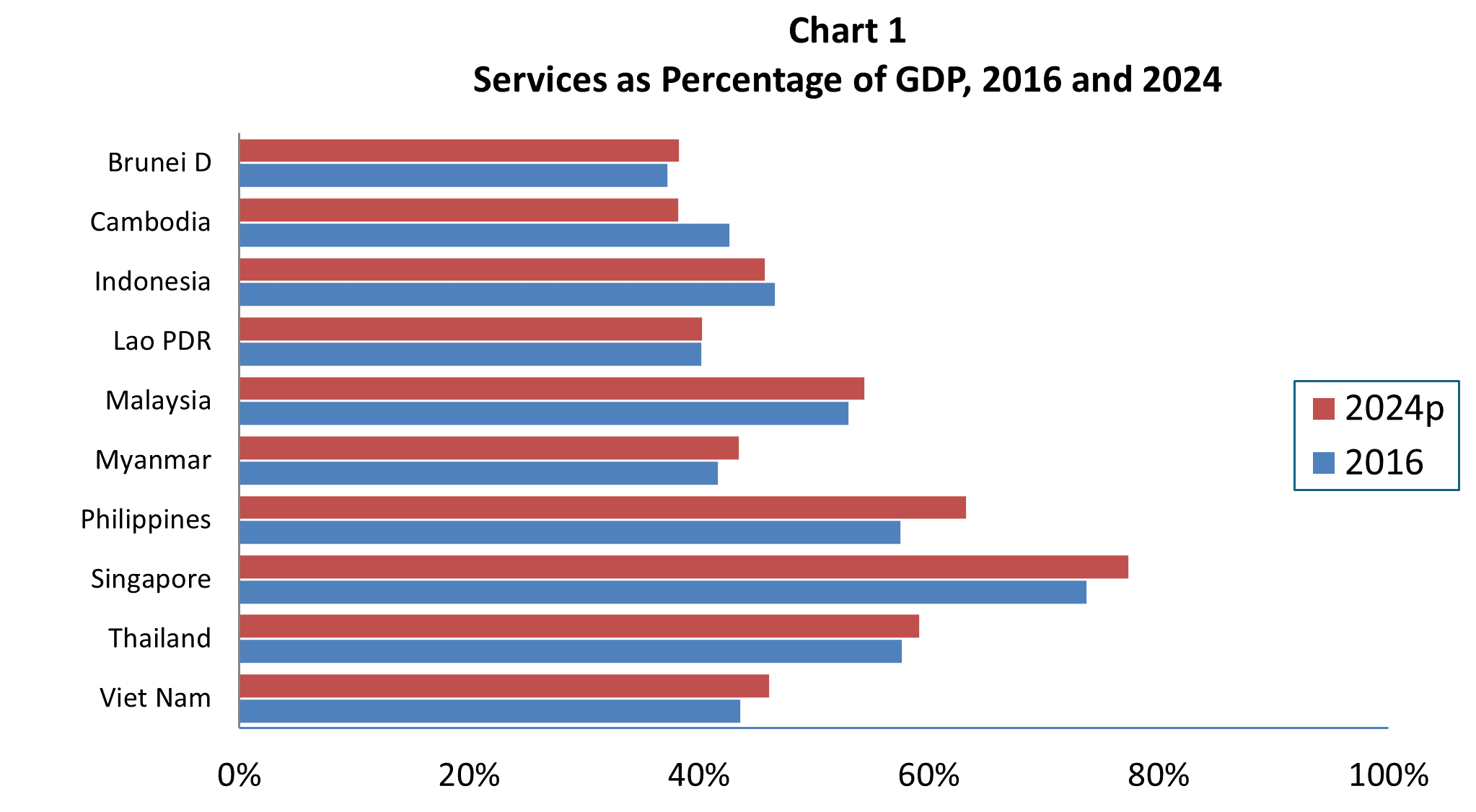
Services is a sizeable and is in general continuously expanding component of GDP in ASEAN economies. As of 2024, services sector represents between 38% and 77% of ASEAN Member States’ Gross Domestic Product (GDP), with a median of 50.6%.
(Source: ASEANStats, 2019 and 2025)
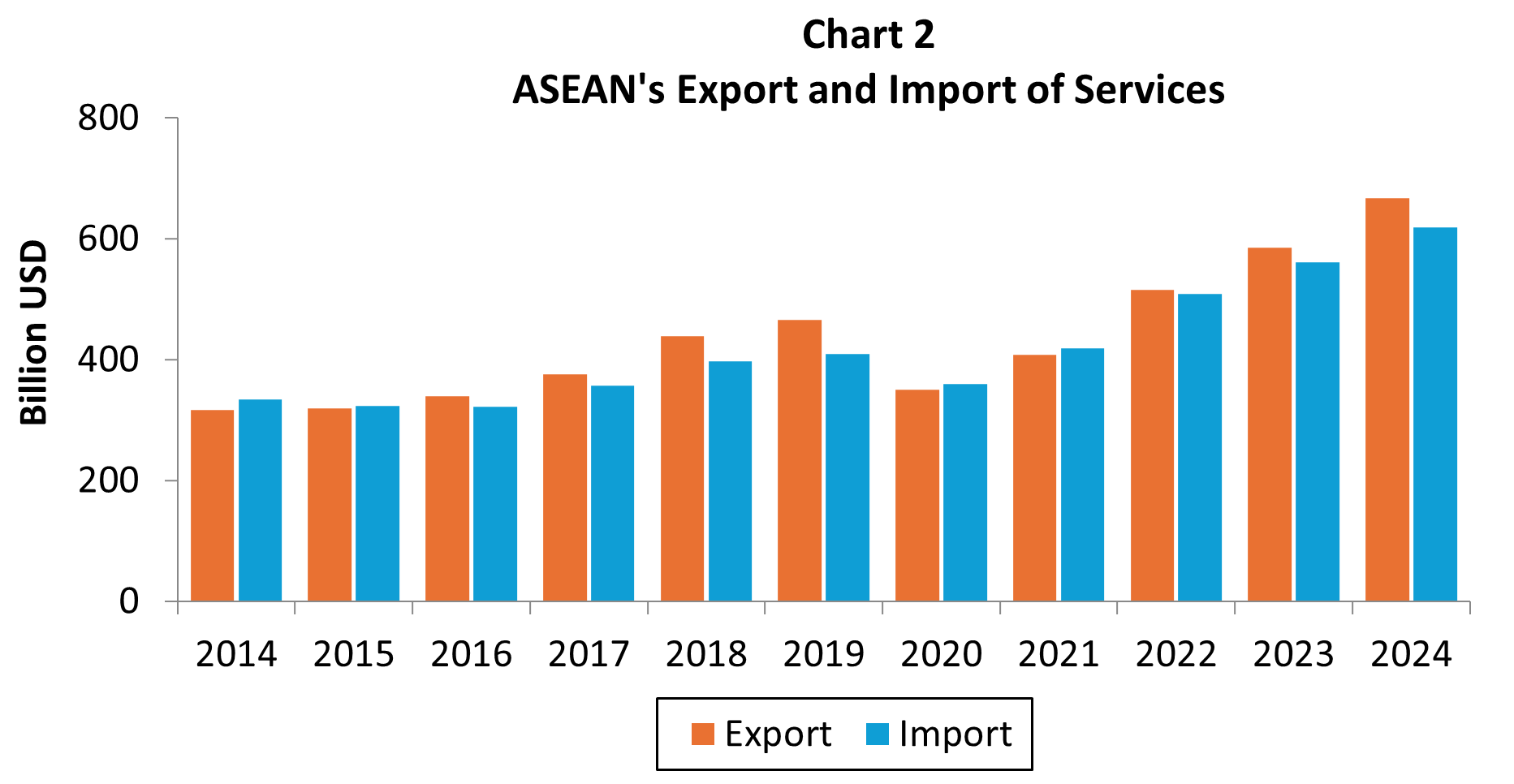
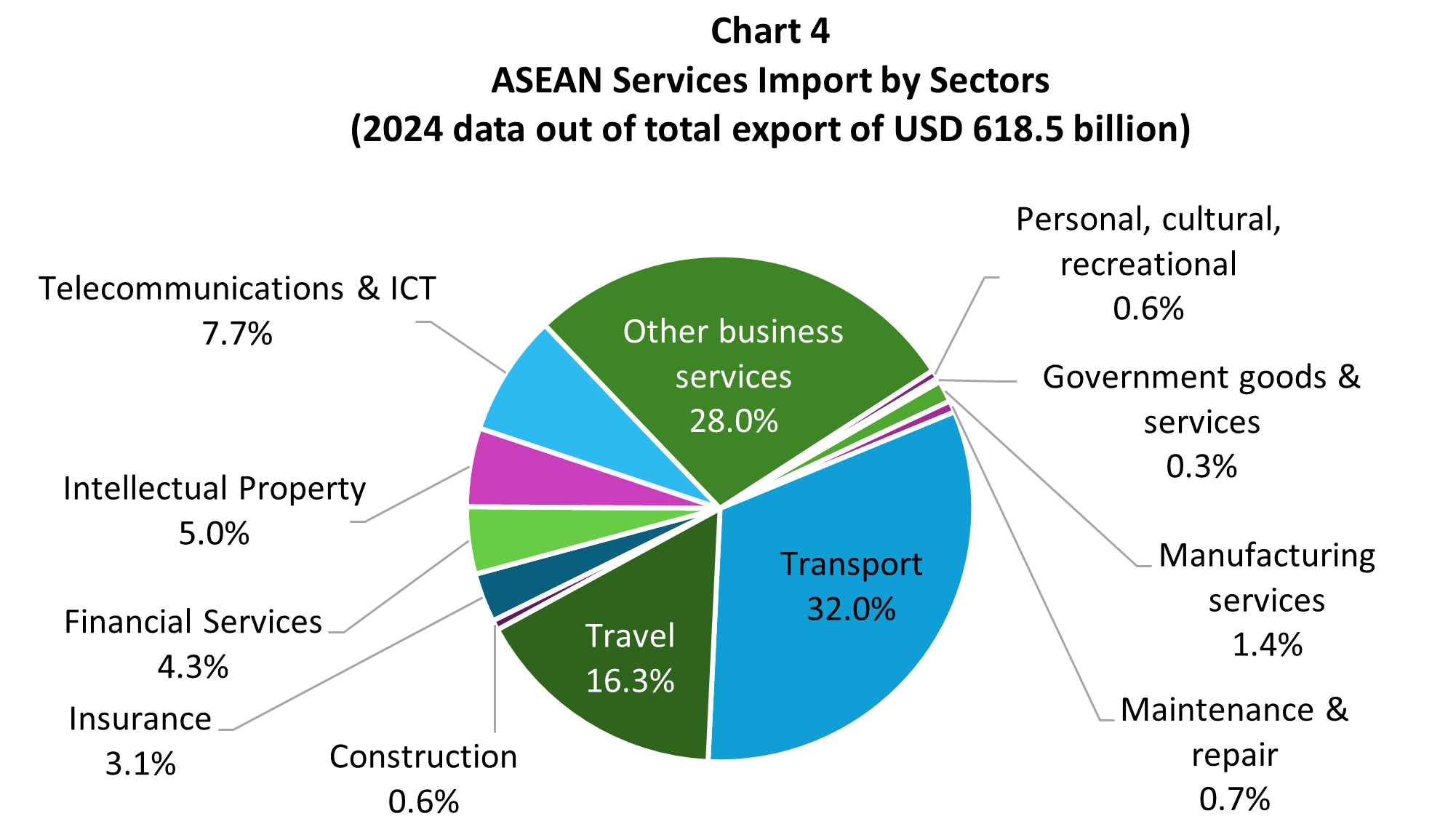
Except for the decrease of trade during the 2020 global COVID-19 pandemic, ASEAN’s services export grew steadily from USD 319.2 billion in 2015 to USD 667.9 billion in 2024, at an annual average growth rate of 7.7%; while ASEAN’s services import also increased from USD 323.0 billion to USD 618.5 billion, at an annual average growth rate of 6.7%. Encouragingly, since 2016, ASEAN has already become a net exporter of services, except for the first two years of the COVID-19 pandemic.
(Source: ASEANStats, 2025)
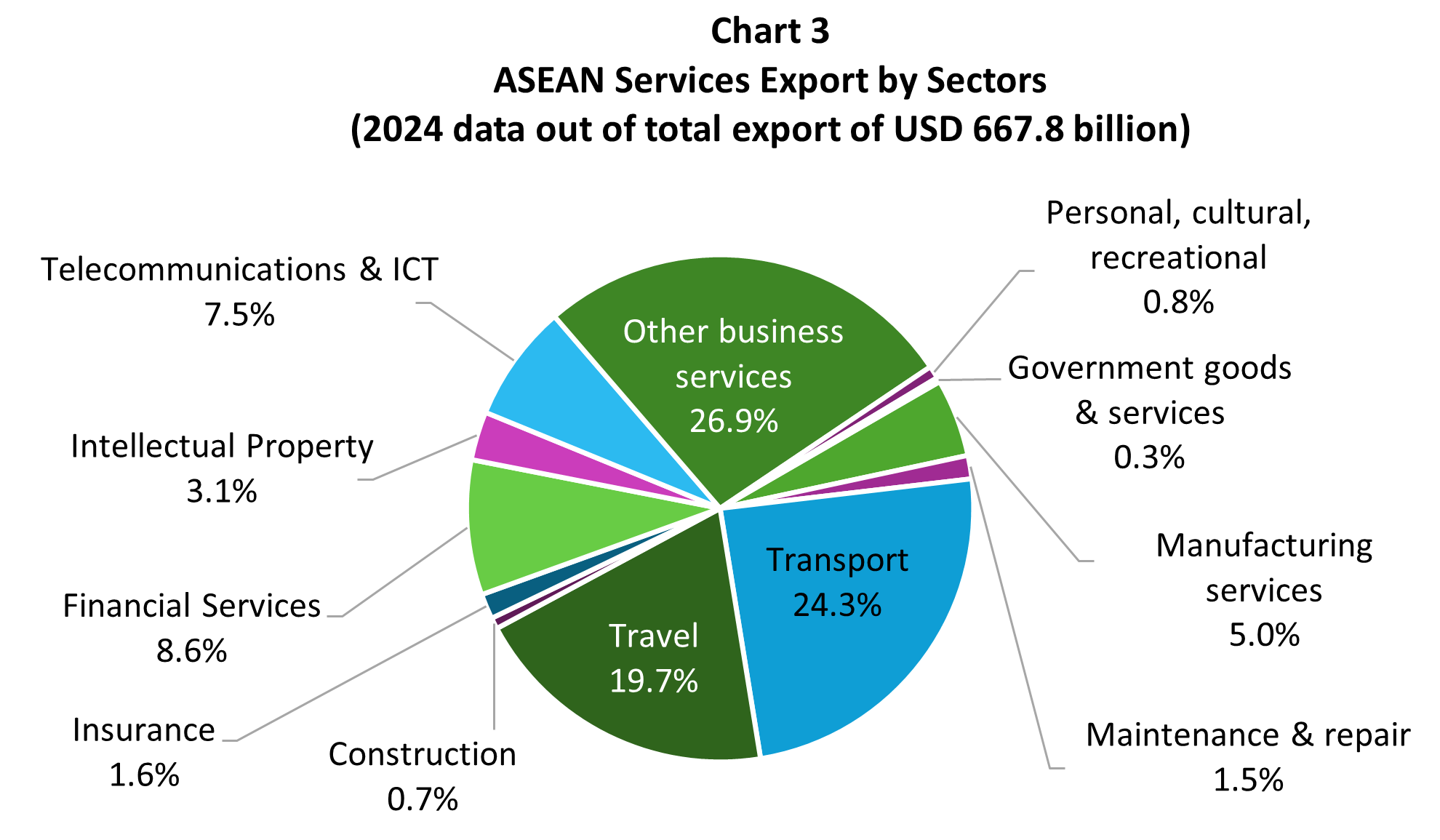
Transport, travel, and other business services have significantly dominated the export and import of services of ASEAN over the past years, followed by financial services at the distant fourth place. However, over the past decade, telecommunications and ICT services have become an increasingly significant component of ASEAN’s services trade, followed by manufacturing services for exports and intellectual property charges for imports. This trend highlights ASEAN’s growing role as one of the world’s key manufacturing hubs. These services sectors are classified based on the IMF Balance of Payments Manual, 6th Edition.
(Source: ASEANStats, 2025)
(Source: ASEANStats, 2025)
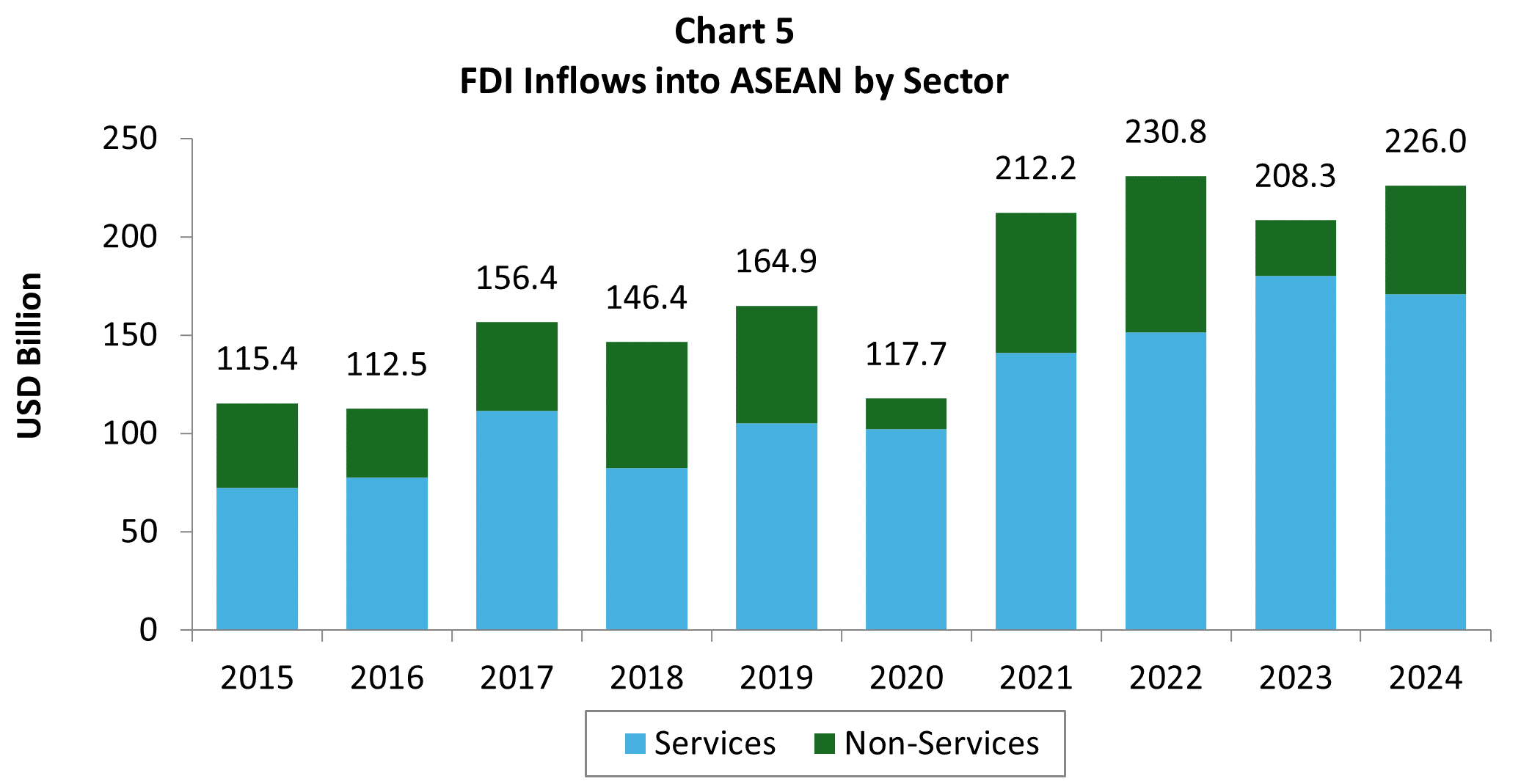
Services sectors have also been traditionally the largest recipient of Foreign Direct Investments (FDI) into the region. Throughout the last 15 years, services sectors have attracted about 60 or higher percentage of total FDI flow into ASEAN.
(Source: ASEANStats, 2025)
ASEAN Framework Agreement on Services (AFAS)
Signed by the ASEAN Economic Ministers (AEM) in 1995, AFAS marked ASEAN’s commitment to promoting the free flow of services. It aligns with and builds upon the WTO’s General Agreement on Trade in Services (GATS) and has led to multiple rounds of negotiations to improve the commitments of ASEAN Member States on top of their WTO commitments and aim to deepen regional integration.
Continued efforts in ASEAN have resulted in ten packages of commitments under the AFAS signed by the AEM. These packages provide for details of commitments of each ASEAN Member State in various services sectors and subsectors. In addition, there has also been seven additional packages of commitments in financial services under the AFAS signed by the finance ministers and nine additional packages of commitments in air transport services under the AFAS signed by the ATM.
All of these contribute to progressively deeper level and wider coverage of ASEAN Member States’ commitment to substantially eliminate restrictions to trade in services among them.
Click here for ASEAN Member States’ AFAS commitments under the ASEAN Economic Ministers (AEM)
Click here for ASEAN Member States’ AFAS commitments in air transport services under the ASEAN Transport Ministers (AEM)
Click here for ASEAN Member States’ AFAS commitments in financial services under the ASEAN Finance Ministers’ and Central Bank Governors’ Meeting (AFMGM)
ASEAN Trade in Services Agreement (ATISA)
Signed in 2020, ATISA represents major milestone in ASEAN’s journey toward deeper regional integration in services. Building on the foundation laid by the AFAS, ATISA strengthens legal commitments among ASEAN Member States and sets a clearer obligation in liberalising trade in services.
ATISA introduces a modern and more business-friendly approach to services commitments by adopting the negative list scheduling method. This means that all services sectors are considered open unless explicitly listed as reservations, providing greater transparency and predictability for businesses.
Under the ATISA, ASEAN Member States are transitioning their AFAS commitments, previously scheduled using the GATS-style positive list, into schedules of Non-Conforming Measures (NCMs). This transition will be done within the timeline stipulated in the Agreement. The transformation will enhance clarity and accessibility of information for service suppliers and investors, supporting a more integrated and competitive ASEAN services market.
Click here for the text of the ATISA along with its annexes
ASEAN Services Facilitation Framework (ASFF)
Adopted in 2024, ASFF is a non-binding framework providing policy guidelines to reduce regulatory barriers and improve the ease of doing business in services. It complements the legally binding ATISA by focusing on practical measures that enhance the business environment for service providers across ASEAN.
ASFF promotes a forward-looking approach to services facilitation through five key pillars:
Streamlined Regulations: Encouraging objective, transparent, and efficient administrative procedures for service authorisation and licensing
Digitalisation: Supporting the adoption of digital technologies and the development of single digital platforms to simplify service delivery and regulatory compliance.
Transparency: Promoting the publication of relevant laws, procedures, and standards, and enabling stakeholder input through public consultations.
Mobility: Facilitating the temporary movement of service suppliers and enhancing the recognition of professional qualifications.
Sustainability and Innovation: Advancing policies that support circular economy principles, ESG standards, and innovation in service sectors.
Together, these elements help ASEAN Member States create a more predictable, inclusive, and competitive services ecosystem, one that supports regional integration and benefits businesses of all sizes.
Click here for the text of the ASEAN Services Facilitation Framework (ASFF)
Sectoral Cooperations
ASEAN’s services integration is supported by targeted cooperation in key sectors that are vital to regional development and connectivity. These sectors, namely healthcare and logistics, are guided by dedicated roadmaps and working groups that aim to improve service quality, facilitate professional mobility, and enhance infrastructure and regulatory coherence. These sectoral initiatives complement broader ASEAN frameworks by addressing practical challenges and enabling smoother cross-border operations.
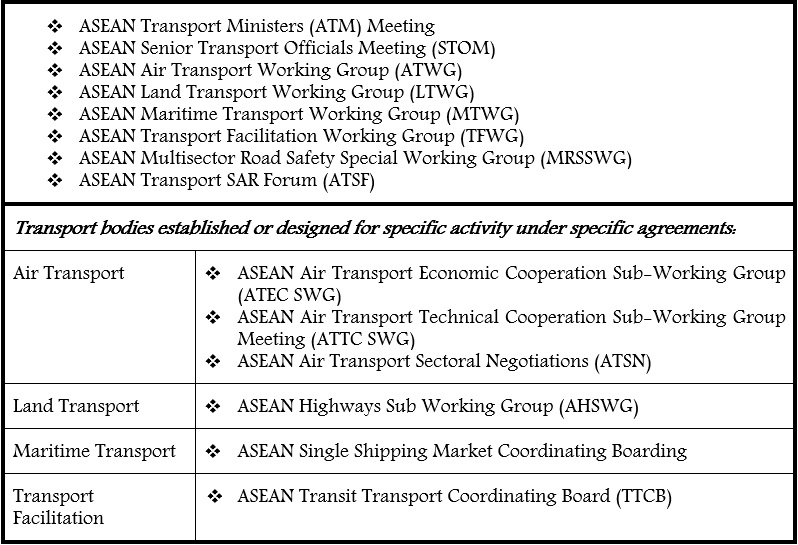
ASEAN Transport Ministers (ATM) Meeting, as the highest ASEAN transport body, shall set policy directions in the transport sector and discuss issues of common interest. The ASEAN Senior Transport Officials Meeting, as the executive body, shall supervise, coordinate, and review programmes as well as directions set by ASEAN Transport Ministers.
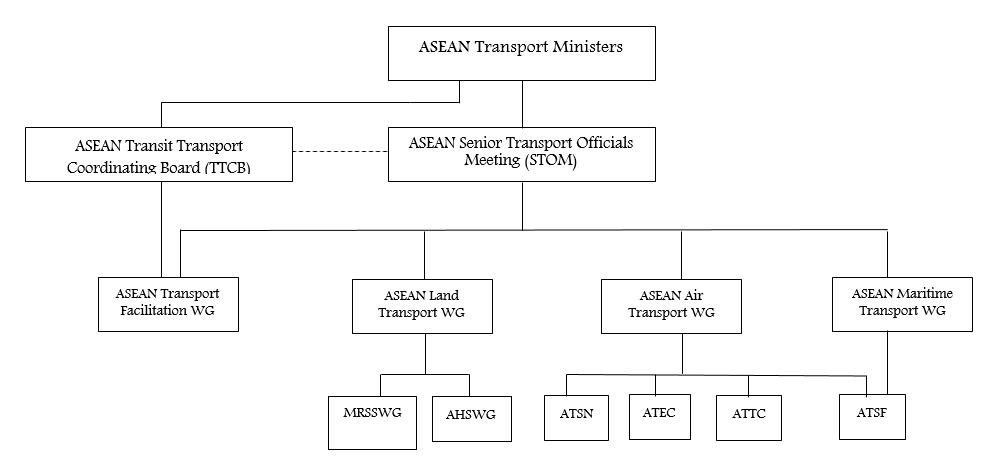
The existing working groups, namely: ASEAN Air Transport Working Group, ASEAN Land Transport Working Group, ASEAN Maritime Transport Working Group, and ASEAN Transport Facilitation Working Group shall be continued as the principal coordinating and implementing arms of the ASEAN Senior Transport Officials Meeting (STOM) in carrying out the various programmes, projects and activities of the sectoral areas as specified in the ASEAN Transport Strategic Action Plan 2016-2025. Transport bodies which have been established or designed for specific activity under specific agreements shall also continue their work. The transport organs and the organizational structure are as follows:
Organisational Structure of ASEAN Transport Cooperation
Chairmanship and Vice-Chairmanship
Chairmanship and Vice-Chairmanship of ATM-STOM, Working Groups and Sub-Working Groups, unless otherwise agreed by the concerned body, shall be on rotation basis or alphabetical order.
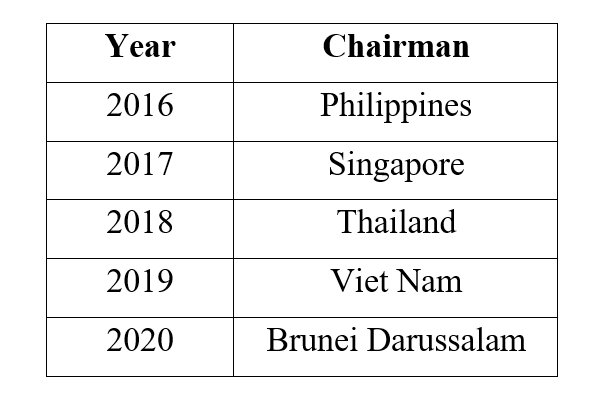
Chairmanship of ATM and STOM shall be for a period of 1 year and chairmanship of Working Group shall be for a period of 2 years. Vice-Chairman shall assume chairmanship of the respective meetings thereafter.
The Member States assuming the chairmanship of the ATM-STOM, Working Group and Sub-Working Group shall be the host of the meetings, unless otherwise agreed by the concerned body.
The chairmanship and vice-chairmanship for transport meeting will be, as follows:
Chairmanship of STOM-ATM
Overview
On 15 December 1995, ASEAN Member States signed the Treaty of Southeast Asia Nuclear Weapon-Free Zone (SEANWFZ Treaty) as a commitment to preserve the Southeast Asian region as a region free of nuclear and other weapons of mass destruction. The Treaty is also known as the Bangkok Treaty. Through thisTreaty, ASEAN reaffirms the importance of the Treaty on the Non-Proliferation of Nuclear Weapons (NPT) in preventing the proliferation of nuclear weapons and in contributing towards international peace and security. It also marks the establishment of a Nuclear Weapon-Free Zone (NWFZ) in Southeast Asia – one among five NWFZs in the world. The other four NWFZs are in Latin America and the Caribbean, South Pacific, Africa, and Central Asia.
The Protocol to the SEANWFZ Treaty welcomes the signing and early ratification of the Nuclear Weapon States (NWS), which will contribute to the promotion of the realisation of a Southeast Asia Nuclear Weapon-Free Zone. Efforts are underway towards the accession of the NWS to the Protocol.
Overview
The South China Sea is a strategic body of water bordering Brunei Darussalam, Malaysia, Indonesia, the Philippines, Singapore, Thailand, Viet Nam and China. As one of the busiest trade routes in the world and home to a wealth of marine and mineral resources, the South China Sea holds great economic and geostrategic importance.
Overview
Preventive diplomacy is one of the three evolutionary stages of the ARF’s confidence building measures. The ARF agreed on the ARF Concept and Principles of Preventive Diplomacy in 2001, which among others stipulated the definition, possible measures, and key principles of preventive diplomacy.
It was agreed that preventive diplomacy is a “consensual diplomatic and political action taken by sovereign states with the consent of all directly involved parties to help prevent disputes and conflicts from arising between states that could potentially pose a threat to regional peace and stability, to help prevent such disputes and conflicts from escalating into armed confrontation, and to help minimize the impact of such disputes and conflicts in the region. The ARF agreed that the definition, concept and principles of preventive diplomacy are not legal obligation.”
In light of this, preventive diplomacy measures could include efforts to build mutual trust and confidence between states, norms building, enhancing channels of communication to advance information-sharing, provide early warning and facilitate dialogue, and the ARF Chair to play a role as determined by the ARF participants.
Overview
Recognising the importance of regional cooperation in the areas of nuclear safety, security and safeguards, the ASEAN Network of Regulatory Bodies on Atomic Energy (ASEANTOM) was formally established in 2013.
Overview
The issue of non-proliferation has been in the agenda of ARF since the inception of the Forum in 1994. Deliberation on NPD are undertaken through the convening of ad-hoc activities and also through the ARF Inter-Sessional Meeting at Non-Proliferation and Disarmament (ISM on NPD). Discussions are mostly centred around the recent developments in nuclear non-proliferation and disarmament, including the Non-Proliferation Treaty (NPT) review; recent developments on nuclear, chemical, and biological weapons of mass destruction non-proliferation; updates on the peaceful uses of nuclear energy; and international mechanisms to prevent and counter WMD proliferation.
Overview
ASEAN recognises the multi-faceted nature of maritime issues and therefore commits to a holistic, integrated and comprehensive approach to address them. More specifically, ASEAN recognises sea piracy as a form of transnational crime with linkage to other form of transnational crime, such as terrorism, illicit drug trafficking, illicit trafficking of wildlife and timber, trafficking in persons and people smuggling.
Overview
ASEAN recognises the multi-faceted nature of maritime issues and therefore commits to a holistic, integrated and comprehensive approach to address them. Maritime cooperation constitutes an important component of the ASEAN Political-Security Community (APSC) Blueprint, which calls for, among others, the establishment of the ASEAN Maritime Forum (AMF) and a comprehensive approach that focuses on the safety of navigation and security issues in the region that are of common concern to ASEAN.
Overview
The Treaty of Amity and Cooperation in Southeast Asia (TAC) was established in 1976 and embodies universal principles of peaceful coexistence and friendly cooperation among States in Southeast Asia. It is a legally-binding code for inter-state relations in the region and beyond. The Treaty has been amended three times, in 1987, 1998, and 2010, respectively, to allow for accession by states outside Southeast Asia as well as for regional organisations whose members are sovereign states, among others. As of October 2024, there are 55 High Contracting Parties to the TAC.
Overview
Women’s voices and leadership are key to sustaining peace, stability and development in the region. ASEAN is committed to advancing women, peace and security (WPS) as a regional priority agenda.
The WPS agenda in ASEAN is guided by the commitments to implement the United Nations Security Council Resolution 1325 (2000) and other related resolutions on women, peace and security. Other key reference instruments are the Beijing Platform for Action, the Convention on the Elimination of All Forms of Discrimination against Women, and ASEAN policy statements and plans of action on the promotion of the women, peace and security agenda as well as the protection of women’s rights.
Since the adoption of the Joint Statement on Promoting Women, Peace, and Security in ASEAN by ASEAN Leaders at the 31st ASEAN Summit in 2017, ASEAN has set important milestones in implementing the WPS agenda through concerted multi-sectoral efforts and partnerships:
The ASEAN Women for Peace Registry was established in 2018 as a creative initiative to mobilise resource and consolidate knowledge for capacity building and advocacy on a gendered approach to peace and conflict in the region.
Aligning efforts of the ASEAN Committee on Women, the ASEAN Commission on the Promotion and Protection of the Rights of Women and Children and the ASEAN Institute for Peace and Reconciliation have been pivotal to ASEAN’s collective action in mainstreaming women’s rights and gender equality in peace and security.
Furthermore, ASEAN women military and law enforcement officers have also made a positive impact globally through their active participation in UN peacekeeping operations.
To further enhance women’s engagement for sustainable peace, ASEAN has embraced an all-encompassing approach to women, peace and security from the angle of preventing and countering violent extremism, disaster management and climate change to women in peace processes and post-conflict rehabilitation. Recognizing the mutual reinforcement and interconnectivity of economics and peace , regional efforts are forged to articulate women, peace and security in the context of economic integration. Women’s economic empowerment is also enforced as a form of conflict prevention, resolution and recovery.
Overview
ASEAN Charter calls for ASEAN to develop friendly relations and mutually beneficial dialogue cooperation and partnerships with countries and sub-regional, regional and international organisations and institutions. ASEAN External Relations sets out the framework for ASEAN to widen and deepen its relations with external parties through the conferment of the formal status of Dialogue Partner (DPs), Sectoral Dialogue Partner (SDPs) and Development Partner.
ASEAN continues to be the primary driving force in fostering regional collaboration and maintaining its central role in regional cooperation mechanisms.
Under the ASEAN Community Vision 2025, the ASEAN Political-Security Community Blueprint 2025, section C.2. also highlights the importance for ASEAN to deepen cooperation with Dialogue Partners, strengthen engagement with other external parties, reach out to new potential partners for mutually beneficial relations, and to respond collectively and constructively to global developments.
To date, ASEAN has established Dialogue Partnerships with:
The promotion of gender equality and the empowerment of women and girls are consistent priorities of ASEAN. High-level political commitment has been afforded by the ASEAN Leaders in advancing the rights and welfare of women and girls through ASEAN’s regional cooperation, and in the national policies and programmes of ASEAN Member States.
The ASEAN Human Rights Declaration, in its General Principles, states that the rights of women, among others, are an inalienable, integral and indivisible part of human rights and fundamental freedoms. The ASEAN Community Vision 2025 envisions “an inclusive community that promotes high quality of life, equitable access to opportunities for all and promotes and protects human rights of women…”, among others. The ASEAN Socio-Cultural Community 2025 has identified strategic measures that seeks to reduce barriers faced by women and girls, promote and protect human rights, and ensure equitable access for all, among others.
The regional strategic direction that ASEAN is taking towards the empowerment of women and girls are guided by the following regional instruments:
ASEAN’s cooperation on promoting gender equality and the empowerment of women and girls are also guided by and resonates with the Convention on the Elimination of All Forms of Discrimination against Women (1979), the Beijing Declaration and Platform for Action (1995), and the 2030 Agenda on Sustainable Development Goals.
History
In 1975, during the first meeting of the ASEAN Standing Committee, it established the ASEAN Sub-Committee on Women (ASW). The ASW held its first meeting in June 1976 in Makati City, the Philippines to discuss the ASEAN Strategy for the implementation of the World Plan of Action towards achieving the objectives of the United Nations International Decade for Women (1975-1985). It was also during the first meeting of the ASW that a working group was established to draft the constitution of the ASEAN Confederation of Women’s Organisations (ACWO) in order to strengthen the role of women in development with the cooperation of women non-government organisations.
In 1981, the ASW met again as the ASEAN Women’s Programme (AWP) under the Committee on Social Development (COSD). At this meeting, AWP ratified and adopted ACWO’s constitution, and subsequently a plan of action covering the period 1981 to 1986 was developed.
In 1996, at the 15th AWP Meeting, the AWP agreed to be renamed as the ASEAN Sub-Committee on Women (ASW), which was duly approved by the COSD.
In 2001, at the 20th ASW Meeting, a decision was made to elevate ASW into a full committee, which is the ASEAN Committee on Women (ACW).
In 2002, the 1st ACW Meeting was held in Luang Prabang, Lao PDR. A key discussion during the meeting was the convening of the ASEAN Ministerial Meeting on Women (AMMW).
In 2011, the ministers in-charge of women from all the ten ASEAN Member States convened the AMMW Preliminary Meeting in Bogor, Indonesia. Subsequently, the 1st AMMW Meeting was held back-to-back with the 10th ACW Meeting in Lao PDR.
Regional mechanisms
ASEAN Ministerial Meeting on Women (AMMW). Composed of ministers in-charge of women and girls in all ASEAN Member States, the AMMW sets the strategic policy direction on ASEAN’s regional cooperation on women. The AMMW is under the ASEAN Socio-Cultural Community (ASCC) Pillar.
ASEAN Committee on Women (ACW). ACW is a subsidiary body of the AMMW composed of senior officials in the respective ministries in-charge of women and girls. The ACW supports AMMW by recommending regional policies, developing and implementing the five-year regional work plan, and managing partnerships.
ACW Plus Three. This is an annual meeting of the ACW with the Plus Three Countries namely China, Japan and the Republic of Korea, and serves as a regular platform for exchanging policies and good practices on the empowerment of women and girls.
ACW-ACWC Consultation Meeting. This consultative meeting serves as a platform for the ACW and the ASEAN Commission on the Promotion and Protection of the Rights of Women and Children (ACWC) to synergise their efforts on areas of mutual interest, as well as purposively facilitate partnerships on complementing issues such as gender mainstreaming, gender and climate change, and non-gender stereotyping, among others.
ACW and ACWC Joint Ad-hoc Working Group on Gender Mainstreaming. The ad-hoc working group was established to develop a comprehensive strategy to mainstream gender perspectives across all the three ASEAN Community pillars.
ASEAN Women Entrepreneurs Network (AWEN). AWEN is a network of business women in the region. It serves as a platform to exchange knowledge and experiences on promoting economic and trade activities in order to enhance gender equality, and empower and strengthen entrepreneurship skills of women in ASEAN Community. AWEN seeks to create a favorable environment for female-led enterprises and support for women entrepreneurship in the region.
ASEAN Committee on Women Work Plan 2016-2020
Building on the gains from implementing the Work Plan for Women’s Advancement and Gender Equality (2005-2010), the Work Plan to Operationalise the Declaration on the Elimination of Violence against Women (2006-2010), and the ACW Work Plan 2011-2015, the ASEAN Committee on Women Work Plan 2016-2020 was developed. This five-year work plan contains the following objectives and priority areas:
Objectives:
Increase the proportion of women in leadership at AMS levels, particularly in appointed and elected positions in the public and private sectors.
Promote gender-sensitivity and eliminate gender-stereotyping in primary, secondary and/or tertiary levels in public schools.
Raise understanding and awareness of media practitioners on gender equality.
Strengthen the mechanisms for effective gender mainstreaming in AMS and in ASEAN particularly in the three pillars.
Establish and/or strengthen effective prevention and protection services supported by national EVAW legal framework and institutional mechanism.
Increase access of women entrepreneurs, including young women, to finance, credit, markets, skill training, technology and social protection.
Enhance regional and national initiatives to improve the protection and empowerment of women, especially those in vulnerable situations, including the elderly, and those with disabilities, key affected women of HIV/AIDS (women living with HIV/AIDS), internally displaced persons, and women at risk or victims of gender-based violence including domestic violence and trafficking.
Priority Areas:
Promotion of women leadership
Non-gender stereotyping and social norm change
Gender mainstreaming across the three ASEAN Community pillars
Elimination of violence against women
Economic empowerment of women
Protection and empowerment of women in vulnerable situations
Partnerships
The AMMW, with the support of and through the ACW, continues its strategic partnership with ASEAN’s Dialogue Partners, international organisations and civil society organisations such as Australia, Canada, US, UN Women, UNICEF, UNDP, and ACWO, among others.
Publications
The Thesaurus on Women in Development (1996) (no online copy);
The First Regional Report on the Advancement of Women (1997) (no online copy);
The Second Regional Report on the Advancement of Women (2002) (no online copy);
The ASEAN Senior Law Officials Meeting (ASLOM) was established in 1985 and held its first Meeting on 26 – 28 September 1985 in Jakarta, Indonesia. ASLOM reports its work to the ASEAN Law Ministers’ Meeting (ALAWMM) which was established in 1986 and held its first meeting on 11 – 12 April 1986 in Bali, Indonesia.
The ASLOM meets regularly every 12 months, while the ALAWMM holds its meeting every 24 months. Since 2005, ASLOM and ALAWMM have expanded its mandate to address all common matters pertaining to legal cooperation to support ASEAN integration initiatives in all ASEAN Member States. Initial legal cooperation of ASLOM and ALAWMM covers the following areas:
• exchange of legal materials;
• judicial cooperation; and
• legal education and legal research.
Overview
ASEAN Member States share a common interest in and commitment to the promotion and protection of human rights and fundamental freedoms. In accordance with the ASEAN Charter, respect for and promotion of human rights underspin regional cooperation among ASEAN Member States on human rights and its cooperation with relevant national, regional and international institutions and organisations.
Human rights is the fundamental basis for peace, stability and sustainable development. The adoption of the ASEAN Human Rights Declaration in 2012 attests ASEAN’s commitment to advance the promotion and protection of human rights in the region.
The Declaration defines a broad range of internationally accepted rights, including civil, political, economic, social and cultural rights. Furthermore, the right to development, as recognised in the Declaration, entitles people of ASEAN to participate in and contribute to the process of narrowing the development gap within ASEAN and promoting equitable and sustainable development, fair trade practice and effective international cooperation.
Human rights is a crosscutting theme across ASEAN Community building in the key areas of peace and security, sustainable development, humanitarian assistance, and economic, social and cultural affairs. ASEAN has gradually expanded its regional human rights framework to encompass specific standards for women, children, persons with disabilities and other vulnerable groups.
Overview
The work towards a Treaty on Mutual Legal Assistance in Criminal Matters (MLAT) was initially explored by Malaysia at the 8th ASLOM held on 15 – 16 June 2002 in Bangkok, Thailand. The proposal aimed to support and strengthen ASEAN Member States’ effort and capacity to combat transnational crimes and other transnational challenges by enhancing cooperation in law enforcement and mutual legal assistance in criminal matters. It was also in response to the need to improve the effectiveness of judicial assistance and to regularise and facilitate mutual legal assistance’s process in view of ASEAN Member States’ different legal systems and procedural requirements.
Subsequently, Malaysia initiated and hosted the meetings of like-minded ASEAN Member States to formulate the MLAT that leads to its conclusions on 29 November 2004 in Kuala Lumpur, Malaysia. Myanmar and Thailand became Signatory’s States to the MLAT in 2006. The MLAT entered into force in 2013 following the completion of all necessary internal legal procedures of ASEAN Member States for its entry into force.
Following the MLAT’s entry into force, further discussions and considerations to upgrade the MLAT were initiated. It was successfully completed as an ASEAN Treaty and was endorsed during the 6th Meeting of the Attorneys-General/Ministers of Justice and Minister of Law on Mutual Legal Assistance in Criminal Matters (6th AG MLAT) on 25 April 2019 in Yogyakarta, Indonesia. The 6th AG MLAT also endorsed the “Senior Officials’ Meeting of the Central Authorities on Mutual Legal Assistance in Criminal Matters” (“SOM-MLAT”) and “ASEAN Ministers/Attorneys-General Meeting of the Central Authorities in Mutual Legal Assistance in Criminal Matters” (“AMAG-MLAT”). Both the AMAG-MLAT and its SOM-MLAT have now been included as ASEAN Sectoral Ministerial Body in Annex 1 of the ASEAN Charter under the ASEAN Political-Security Community pillar.
Overview
In recent years, ASEAN has seen significant progress in internet and computer connectivity with rapid increase in the penetration rate of internet users. This increasing reliance upon the internet, however, has created number of cyberthreats that can cause not only immense harm to individual users, but also to government agencies, businesses and non-profits sectors.
Please also see: Information and Communication Technology and Tourism’s page for more information.
Overview
Terrorism issues have grown in complexity and posed more threats to communities around the world, including ASEAN. Advancement of the internet and social media has resulted in the extensive network of global and regional groups as well as new patterns of radicalisation. The emergence of lone wolf terrorists and regional groups that pledged allegiance to Daesh/the Islamic State of Iraq and Syria (ISIS) as well as the return of foreign terrorist fighters (FTFs) remain as major concerns for ASEAN.
A few key milestones of ASEAN’s efforts in countering terrorism is the adoption and implementation of the ASEAN Convention on Counter Terrorism (ACCT) and the ASEAN Comprehensive Plan of Action on Counter Terrorism (ACPoA on CT). Since 2013, the ACCT has been in force in all ASEAN Member States.
Overview
The dynamics of globalisation has affected the way states have approached borders, issues regarding borders and the subsequent border management that cuts across multiple issues and are deeply complexed. The region is facing an increasing arrays of transnational threats that mandate greater vigilance and resilient border control. These threats include transporting counterfeit goods, trafficking of timber and wildlife, illicit drug trafficking and smuggling and trafficking of people across borders, and growing threats of cross-border terrorism.
At the 34th ASEAN Summit in Bangkok, Thailand on 23 June 2019, the Leaders, through the Chairman Statement, agreed to strengthen cooperation on border management and to further enhance the effectiveness of existing relevant ASEAN mechanisms on border management cooperation and explore possible border management cooperation arrangements under the relevant Sectoral Bodies.
Overview
Cooperation on combating illicit drugs can be traced back to the Declaration of ASEAN Concord issued by the Heads of Government in 1976 which called for “the intensification of cooperation among member states as well as with the relevant international bodies in the prevention and eradication of the abuse of narcotics and the illegal trafficking of drugs.” This then led to the signing of the ASEAN Declaration of Principles to Combat the Abuse of Narcotics Drugs by the Foreign Ministers of the five ASEAN founding members later in the same year. Among others, the Declaration calls for AMS to strengthen cooperation on vigilance and preventive and penal measures, drug research and education and improvements in national legislation in the fight against drug abuse.
In 1997, the coordinated efforts against illicit drugs gained momentum with the reaffirmation of a mutual political resolve among the ASEAN Member States at the 2nd Informal Summit. For the first time, ASEAN leaders embraced the idea of “a Southeast Asia free of illicit drugs, free of their production, processing, trafficking and use.”
In July 1998, the ASEAN Foreign Ministers signed the Joint Declaration for a Drug-Free ASEAN by 2020 to eradicate the production, processing, trafficking and use of illicit drugs in Southeast Asia by the year 2020. Two years later, in July 2000, the ASEAN Foreign Ministers agreed to expedite the target year for realising a drug-free ASEAN to 2015 and adopted the “Bangkok Political Declaration in Pursuit of a Drug-Free ASEAN 2015” in Bangkok. The commitment for ASEAN’s cooperation to fight against illicit drugs was further strengthened in 2012 with the ASEAN Leaders’ Declaration on Drug-Free ASEAN 2015.
Overview
Globalisation and the advancement of technology have generated greater mobility of people and resources across national borders. In light of this development and against the backdrop of ASEAN vision for integration, irregular movement of people, including trafficking in persons (TIP) and people smuggling, have emerged to be major regional concerns. Due to the transboundary nature of these threats, the ASEAN Member States are affected as the source, transit or destination country for such cases, where perpetrators often exploit the vulnerability of victims living in poor socio-economic condition.
The complex web of syndicates facilitating the smuggling and trafficking of people through various routes across borders perpetuates this situation, where victims are vulnerable to life-threatening condition. The threats of people smuggling and TIP have also exacerbated during the COVID-19 and post-COVID-19 pandemic, where reopening of borders has led to increased new modus operandi and growing syndicates in the criminal activities.
ASEAN has stepped up its effort to fight against TIP through the adoption and implementation of the ASEAN Convention Against Trafficking in Persons, Especially Women and Children (ACTIP) and the ASEAN Plan of Action Against Trafficking in Persons, Especially Women and Children (APA). Since early 2020, ACTIP has been in force in all ASEAN Member States. Recognising the multi-faceted issues of TIP, ASEAN adopted the Bohol TIP Work Plan 2017-2020. Led by the ASEAN Senior Officials Meeting on Transnational Crime (SOMTC), this Work Plan provided a holistic framework to addressing various elements of TIP, such as law enforcement, criminal justice, border security, health, education and gender, involving nine cross-pillar Sectoral Bodies in ASEAN. Upon conclusion of the Bohol TIP Work Plan, on 21 August 2023, the 17th ASEAN Ministerial Meeting on Transnational Crime (AMMTC) adopted the successor ASEAN Multi-Sectoral Work Plan Against TIP 2023-2028. The implementation of the Work Plan is currently ongoing and involves ten relevant ASEAN Sectoral Bodies, which reaffirms ASEAN’s commitment in tackling the threat of TIP through cross-pillar and cross-sectoral coordination and cooperation.
Overview
The rising concern over international economic crime derives from criminal activities that have been taking advantage of innovations and regulatory gaps in the financial and economic sector. In the case of ASEAN, international economic crime generates wider ramifications beyond financial and economic loss across the region. Transnational crime has also become increasingly pervasive, diversified and organised as an impact of globalisation, the advancement of technology and greater mobility of people and resources across national borders. In light of this development, money laundering has emerged as a new form of organised crime that transcends national borders. ASEAN recognises the increasing linkages between international economic crime and money laundering as well as between these two issues with other forms of transnational organised crime, such as cybercrime, money laundering, illicit drug trafficking, illicit trafficking of wildlife and timber, trafficking in persons, arms smuggling and terrorism.
Overview
Cooperation on Immigration and Consular Matters was first initiated in 1996. In order to provide the necessary guidance to enhance cooperation for immigration and consular matters, the ASEAN Plan of Action (PoA) for Cooperation on Immigration Matters was adopted in 2000.
Notable milestones from this cooperation includes the ASEAN Framework Agreement on Visa Exemption and the establishment of the ASEAN Lane. Adopted in 2016, the ASEAN Framework Agreement on Visa Exemption exempts citizens of other ASEAN Member States holding valid national passports from visa requirement for a period of stay of up to 14 days from the date of entry, provided that such stay shall not be used for purposes other than visit.
Meanwhile, the implementation of ASEAN Lanes at major international airports in the region provides ASEAN citizens with an expedited immigration processing lane to facilitate the travel of nationals from the ASEAN Member States and to boost tourism.
Overview
One of the key elements to regional peace and stability is defence. Its critical role in maintaining national security and the ability to muster assets and capabilities is assumed by the military. In the international setting, there has been an increasing recognition of the role of regional cooperation in promoting confidence among defence establishments.
ASEAN established the ASEAN Defence Ministers’ Meeting (ADMM) in 2006 and expanded it to engage its Dialogue Partners, through the ADMM-Plus in 2010.
Overview
The development of the minerals sector in ASEAN is important to the socio-economic development of the region because mining, minerals and metals form the material bases of any modern economy. Every item of manufacture or processing or construction that is not plant- or animal-based, would have its raw material traced to mining or mineral products sourced from within and outside the region.
ASEAN is one of the largest markets in the world for the supply of mineral raw materials and ASEAN Member States are among the top global suppliers of major mineral and metal products. Trade in minerals accounted for $250 billion or close to 9% of ASEAN’s total trade in 2018. 21% of the trade in minerals are internal ASEAN trade.
ASEAN cooperation in the minerals sector was institutionalized back in August 2005 through a Ministerial Understanding on ASEAN Cooperation in Minerals. This was in response to a specific mandate from the ASEAN Summit to cooperate on minerals development. The Ministerial Understanding established the future basis of cooperation which aimed to
develop the minerals sector to be an engine for greater economic growth and social progress in the ASEAN region,
enhance trade and investment in the ASEAN minerals sector, and
promote environmentally sound and socially responsible mineral development practices.
The year 2005 also saw the establishment of the ASEAN Ministerial Meeting on Minerals (AMMin) and the adoption of the first ASEAN sectoral plan for minerals or the ASEAN Minerals Cooperation Action Plan 2005-2010 (AMCAP-I). The series of five-year AMCAPs have to date served as a blueprint for ASEAN minerals cooperation and continue to aspire towards dynamism in the ASEAN minerals sector.
Since its inception, ASEAN cooperation in minerals has a strong focus on capacity building across ASEAN Member States including in areas such as geological survey, resource assessment and mapping, mine rehabilitation and sustainable development, mineral mining licensing, mining business and investment opportunities for rare earth minerals, processing of tin and industrial minerals and geological and mineral resources development. These capacity building initiatives have been generously supported by Member States themselves and by partner organisations and Dialogue Partner governments.
Regional cooperation has further expanded to promoting sustainable minerals development through better monitoring, sharing and recognition of best practices, and promoting the adoption of sustainable frameworks and standards.
Overview
Australia and New Zealand are among the first ASEAN’s Dialogue Partners. Formal relationships were established in 1974 and 1975 respectively. The economic partnerships between ASEAN, Australia and New Zealand began at the first Consultations held between the ASEAN Economic Ministers (AEM) and Ministers from Australia and New Zealand in 1995 and have grown stronger since.
In 2024, the total two-way trade between ASEAN and Australia reached USD 96.3 billion, while two-way trade between ASEAN and New Zealand stood at USD 12.7 billion. Foreign direct investment (FDI) inflow from Australia to ASEAN recorded at USD 2.4 billion, while FDI inflow from New Zealand to ASEAN recorded at USD 481 million.
Overview
ASEAN is also the most natural disaster-prone region in the world with more than 50 percent of global disaster mortalities occurred in the region during the period of 2004 to 2014. The rising frequency and intensity of disasters have resulted in greater economic loss, increase in the rate of disaster mortality and the number of displaced populations in the region. Reducing disaster risks is one of the top priorities of ASEAN to ensure that the region will achieve the target of the Sendai Framework for Disaster Risk Reduction (SFDRR) and the Sustainable Development Goals by 2030. The ASEAN Agreement on Disaster Management and Emergency Response (AADMER) sets as policy backbone for the ASEAN Member States to enhance their collective efforts in reducing disaster risks and responding to disasters in the region.
However, to ensure a comprehensive and robust disaster management and emergency response system is in place requires a flexible and innovative implementation of the AADMER. Three mutually-inclusive strategic elements – Institutionalisation and Communications, Finance and Resource Mobilisation, and Partnerships and Innovations – are the key guiding principles identified in the ASEAN Vision on Disaster Management 2025 to guide the direction of the future implementation of the AADMER.
As ASEAN moves toward a more localized approach, it is important to look beyond national capitals and engage with subnational entities such as cities and provinces as key players in disaster management. In ASEAN, many initiatives have progressed with regard to partnership with civil society organisations which offers great advantage for swift and timely emergency response. For example, a consortium of seven (7) international organisations called AADMER Partnership Group (APG), which has significantly contributed to the institutionalisation of AADMER and in supporting the AHA Center as part of the ASEAN-ERAT, as well as contributing to the capacity building programme. It is important to nurture these relationships and invest in new ones to expand the membership of APG and the number of NGOs affiliated to ASEAN over the next ten years as societies evolve and new actors emerge.
ASEAN Leaders signed the Declaration on “One ASEAN One Response: ASEAN Responding to Disasters as One in the Region and Outside the Region” at the 28th ASEAN Summit in Lao PDR on 7 September 2016. The declaration laid out high-level and solid political commitments of ASEAN to achieve faster response, mobilize greater resources and establish stronger cross-sectoral and cross-pillar coordination to ensure ASEAN’s collective response to disasters. Through these mutually-inclusive strategic elements, ASEAN is trying to position itself as a pioneer in transforming the disaster management landscape in the Southeast Asian region and beyond, and strengthen its leadership to maintain ASEAN Centrality. In doing so, ASEAN will also continue to further develop and apply its people-centered approach as a main priority. This approach will ensure inclusiveness and empower those who are most vulnerable such as women and children.
As disasters affect all aspects of development, deeper cross-sectoral collaboration will be needed to fully implement a comprehensive disaster management strategy. It is essential that disasters are approached holistically across the ASEAN Socio-Cultural Community, ASEAN Economic Community and ASEAN Political-Security Community and coordinated through the ASEAN Secretariat. The ASEAN Secretariat should administer dedicated platforms for cross-sectoral collaboration to actively engage others in implementing AADMER and to collaborate with other sectors mandated to cover, respond to and mitigate different types of risks with regional implications. This would move the region forward significantly to better assess the needs and provide protection during humanitarian crises.
Overview
ASEAN is home to 20 percent of all known species of the world and is the centre of the world’s marine biodiversity. All these rich natural resources, however, is confronted with immense environmental challenges and stresses. Increasing population, rapid urbanisation and progressive economic development has led to increase demand and consumption of food, water and energy. ASEAN region has also been facing a rise in average and extreme temperatures, increases in wet season rainfall, rainfall intensity and duration, and greater frequency of extreme events such as droughts, floods, land and/or forest fires.
Since 1977, ASEAN has cooperated closely in promoting environmental cooperation among its member states and its partners. In 2015, ASEAN leaders adopted ASCC Blueprint 2025 which envisions an ASEAN Community that engages and benefits the peoples and is inclusive, sustainable, resilient, and dynamic. The Blueprint guides ASEAN cooperation to include the conservation and sustainable management of biodiversity and natural resources, promotion of environmentally sustainable cities, climate change adaptation and mitigation, as well as promotion of sustainable consumption and production towards circular economy.
Through the leadership of the ASEAN Ministerial Meeting on Environment (AMME), the ASEAN Senior Officials on Environment (ASOEN) together with its thematic working groups and the ASEAN Centre for Biodiversity, continue to identify and implement regional policies, measures and programmes to promote environmental protection and sustainable development. ASOEN also promotes coordination, collaboration and/or partnerships with other ASEAN sectoral bodies, ASEAN Dialogue Partners, international organisations, and relevant stakeholders.
ASEAN continuously makes collective efforts in environmental protection through policy dialogue and harmonisation, research, capacity building, technical assistance, scaling up and replication of good practices across ASEAN countries; and awareness raising.
Some flagship initiatives include the ASEAN Heritage Parks Programme, ASEAN SDG Frontrunner Cities Programme, and ASEAN Eco-schools and Youth Eco-champion Award Programmes. ASEAN also regularly develops ASEAN State of Environment Reports and recently developed an ASEAN State of Climate Change Report to support evidence-based policy decision making process in ASEAN.
Moving forward, ASEAN is exploring ways to support the region’s transition to circular economy by taking into consideration the recommendations from the gap analysis study on circular economy for plastics.
ASEAN is also working towards establishing a climate resilient ASEAN by taking into consideration the outcomes and recommendations of the joint study on drought.
To further support ASEAN’s efforts to move towards into a more sustainable and environmentally-friendly meeting setup, ASEAN adopted ASEAN Guidelines on Green Meetings.
Guided by ASEAN Vision 2025, ASEAN continues to work hand in hand to strive for clean and green environment for the peoples of ASEAN.
Overview
Rapid growth and changes in ASEAN pose challenges to the health systems of its Member States. Communities are faced with overpopulation, pollution and environmental health problems. Poverty remains an important determinant for health status — mainly for marginalized and vulnerable groups, including those living in remote, isolated, mountainous, island communities or resource-poor areas.
Some AMS also face the double burden of non-communicable and communicable and emerging infectious diseases. These are further complicated by the region’s vulnerability to natural hazards affecting the local communities especially the poorer segments of the population, and the increasing impacts of climate change. Inequitable access to affordable, appropriate and quality healthcare also remain an issue between and within AMS in the region.
As an ASEAN Community, Member States believe that efforts and resources of each national health system geared towards protecting and improving the health of their peoples will have maximum outcomes when done in a collaborative, complementary and synergistic manner. Since its official establishment as a regional cooperation in 1980, the ASEAN Health Sector, has gone a long way in protecting the region from high-impact public health emergencies or pandemics. Collectively, it continuously engages with populations in the prevention and control of specific health conditions, such as non-communicable diseases; enables health systems improvement; and, implements regional measures to support common gaps in ensuring safe, sustainable and healthy communities.
Overview
Across ASEAN region, sports have ancient roots and remarkable legacies that crosses time, age, gender, race, ethnicity, religion and nationality. More than as a mean to a healthy body and mind, sports promotes the values of respect, inclusion, fairness and unity
Sports is also used as a tool to promote ASEAN awareness and to foster the sense of ASEAN Community. Mutually beneficial sports exchange programmes and sporting activities are also promoting mutual understanding and friendship in the region. ASEAN leaders hope to harness the power of sports to be an enabler of sustainable development as well as a tool for peace and social cohesion.
Overview
The region is home to a diverse population of persons with disabilities, ranging from children with disabilities, women with disabilities, and older persons with disabilities, with varying types of impairments and support requirements . Such intersectionalities of disabilities with sex, gender, race and age continue to impinge upon their accessibility, mobility and meaningful participation in decision-making processes. This condition has often times led to marginalisation and exclusion from services, fair treatment and complete information which is a manifestation of discrimination, violence, neglect and abuse.
The region is rapidly becoming an ageing society with an increasing number of older persons of which the majority are women . A significant number of older persons are working and staying in formal and informal labor markets due to financial and related needs. While some of them experience poverty, particularly those living in poor and overcrowded urban and in rural areas, some of them actively contribute to the growth of the economy by being part of the Silver Economy that recognizes the potential purchasing power and specific needs of population over 60 year-old. Older persons continue to experience ageism and discrimination, and are prone to abuse and neglect. Yet, as older persons in the region assert their agency and independence, there is greater demand for policy innovations that promote their dignity, ensure respect, and secure equal accessibility to long-term care.
In the past two decades, ASEAN has seen a steady decline of poverty, from 47% in 1990 to 15% in 2015. However, it persists especially in the region’s rural areas . Poverty goes beyond a mere lack of income. It manifests through the inability to afford and access basic needs, such as food, health and education. Poor people face multiple challenges that deprive them of living long and healthy lives, and realising their full potentials. Different forms of deprivations have been experienced by many in the region especially the poor and the vulnerable. Exacerbated by recurring risks and shocks both human-induced or natural disasters, they are prone to sliding back to poverty. Moreover, poverty is also driven and reinforced by gender inequalities and discrimination and thus affects women and girls differently than men and boys.
In achieving the Sustainable Development Goals, the region is on track in achieving the targets on quality education (SDG4) and industry, innovation and infrastructure (SDG9). Good progress is made on achieving zero hunger (SDG2) and good health and well-being (SDG3) . However, much still needs to be done on reducing inequalities (SDG10), climate action (SDG13), and peace, justice and strong institutions (SDG16) .
Considering the multi-dimensional nature of poverty, ASEAN promotes multi-sectoral and integrated approaches to eradicating poverty and realising the ASEAN Community Vision 2025 and Sustainable Development Goals. Action researches, capacity building initiatives and platforms for knowledge and exchanges have been established to facilitate dialogues among multiple stakeholders to eradicate poverty and promote rural development.
Overview
Women make up slightly over half the population in ASEAN and significant progress has been made for women and girls in the region especially on access to education, participation in the labour force, increased quality or reproductive health and widened space to express their voices and exercise their agencies . However, numerous challenges impeding the realization of full potentials of women and girls remain.
Adolescent girls and young women in the region continue to face challenges such as different types of violence and discrimination including child, early and forced marriage (CEFM), limited access to support such as reproductive health education and services, and access to opportunities. As women enter the work force, most of them are found in the informal sector with minimal access to social protection . An increasing number of women work in the garments and textile industry, as well as tourism and creative industries, which tends to reinforce gender stereotypes . In both formal and informal sectors, women earn less than their male counterparts, and those in the corporate sector have limited opportunities to break the glass ceiling and occupy senior management positions. Across the formal and informal sectors, and the urban and rural continuum, women in the region continue to fight violence and discrimination, to advocate for the recognisation, redistribution and remuneration for unpaid care and domestic work, and realise their rights towards gender equality.
The young population in the region age 18 and below is increasingly engaged in the realisation of their human rights amidst a number of existing and emerging threats. Across the region, children’s access to the internet creates opportunities but also raises concerns regarding online safety, including exploitation and abuse as well as breaches of personal privacy. Children are increasingly affected by the climate crisis, which exacerbates existing vulnerabilities and disparities. Voluntary and forced migration also significantly impacted children and their families. And the incidence of different forms of violence continue to negatively affect children in the region at the detriment of their potential contributions to ASEAN Community Building.
During the1980s and 1990s, ASEAN experienced major episodes of fire and transboundary haze pollution. One of the most damaging haze pollutions in recorded history happened between 1997-1998. It affected Brunei Darussalam, Indonesia, Malaysia, Philippines, Singapore and Thailand, and is estimated to cost the region more than USD 9 billion in economic, social and environmental losses. Environmentally, it released an estimated 1-2 billion tonnes of carbon[1].
One of the major contributors to the transboundary haze pollution in ASEAN region is peatland fire. ASEAN is home to 56% of global tropical peatlands but more than 3 million hectares of peatlands area in Southeast Asia have been destroyed by the fire. Over 70% of total peatland areas in Southeast Asia are in Indonesia, while the remaining are found in Brunei Darussalam, Cambodia, Lao PDR, Malaysia, Myanmar, Philippines, Thailand, and Viet Nam[2].
Peatland fires has negatively impacted human health, food production and biodiversity as well as contributed to global climate change. Peatlands of the region are thought to store up to 5% of all carbon stored on the world’s land surface[3]. The practice of draining and land clearing have caused the fragile ecosystems of the region’s peatlands to turn from carbon storage to carbon emitter.
Overview
Technological advances, demographic transition, and the rise of green economy offer both opportunities and challenges for workers and businesses in the ASEAN Community. Having a vibrant demography, ASEAN continues to show commitment in preparing its human resources and businesses for these transformative changes on the future of work.
ASEAN places green jobs as high priority in the future of work agenda. ASEAN is undertaking a range of knowledge development activities to promote the policy ecosystem and workforce to be ready for these jobs.
As ASEAN is moving towards ASEAN community in 2025, ASEAN envisions a work environment with enhanced competitiveness, productive employment, safe, harmonious and progressive workplace with adequate social protection. One of the critical areas to pursue in the development of ASEAN workforce is improving the inclusiveness, responsiveness, and cohesiveness of its labour, educational, economic policies and institutional frameworks. This will develop qualified, competent, and well-prepared workers that would benefit from, as well as cope with the challenges of the regional integration.
Development of human resource is at the heart of ASEAN strategic objectives and investing in HRD is made more urgent with the accelerated pace of the rapidly changing business models and shifting employment landscape. ASEAN is resolved to manage and build a preventative Occupational and Safety Health (OSH) with the capabilities to anticipate and respond to new and emerging work-related safety and health risks.
Social protection is one of the most important political agendas in the region and a pivotal element in achieving inclusive and sustainable economic growth,. ASEAN has embarked on regional studies on social protectioninitiatives and provided feedback for a comprehensive approach towards effective social security policies, particularly for informal workers and those in new forms of employment.
As transition to the future of work is expected to impact the availability of jobs, organisation of work, and skills requirements, ASEAN Member States have jointly established mutual cooperation to ensure that their migration policies and programmes are ready to respond to these shifts and ensure that the rights of migrant workers are and will continue to be protected and promoted.
The continued cooperation on labour through workforce enhancement and decent work promotion will ultimately contribute towards a shared vision of a better quality of life, productive employment, and adequate social protection for ASEAN peoples.
Overview
Education is a powerful transformative force in the lives of ASEAN peoples. Thus inclusive and quality education is key to the sustainable development of the region. Quality education leads to better health outcomes, higher social capital, peaceful and gender-equal societies, and decent work opportunities. It prepares ASEAN’s human resources to be resilient, competitive and ready to face an ever-changing future. Aside from being a powerful driver of social and economic development, education has the potential to raise ASEAN awareness and foster a regional identity.
ASEAN supports global and regional commitments in education by promoting lifelong learning underpinned by the principles of equity, inclusion and quality. Specific priorities include advancing future-ready education at basic and higher education levels and technical and vocational education and training; ensuring inclusive education; building the capacity of education personnel; and mobilising resources for education through partnerships with various key stakeholders.
Highlights of ASEAN’s work in education include:
Supports for students and learners transition to the workforce through internship opportunities, higher education scholarships and responsive skills development
Supports for teachers and vocational trainers on the latest teaching methods and strategies
Advocacy to reach out-of-school children and youth
Advocacy for safe and resilient schools
Overview
Raising ASEAN awareness and facilitating greater information flow on the benefits of ASEAN developments are important priorities of regional cooperation in the information and media sectors. To better respond to the digital information age, the information sector is taking concrete steps to raise information and media literacy skills of ASEAN citizens. Policy and project initiatives targeting different segments of ASEAN societies are also developed to better equip ASEAN peoples to be more discerning in consuming information.
Through the use of different types of media including print media (newspapers, magazines), broadcast media (TV, radio), outdoor media (advertising) and internet (social media, websites, TV and radio based internet), the information sector promotes ASEAN awareness and communicates the benefits and opportunities of regional integration to the people. The effectiveness of the outreach efforts is monitored and evaluated through studies including the Poll on ASEAN Awareness 2018, to provide a guide in developing future communication strategies.
A multitude of activities such as workshops, conferences, competitions and capacity building and trainings are conducted annually. Longstanding activities include the ASEAN Television News, the Voice of ASEAN – Beyond Boundaries, and the ASEAN Quiz series. These activities work towards creating linkages and knowledge exchanges among ASEAN media, promoting tolerance in the media for diverse cultures and practices, and enhancing the use of advancements in ICTs to promote ASEAN awareness and belonging.
To better navigate the information landscape, the sector is proactively implementing the ASEAN Communication Master Plan (ACMP) II (2018-2025) which serves as the framework to communicate messages about the organisation, development and vision of ASEAN and the ASEAN Community to regional and global audiences. To this end, the information sector is leveraging a suite of new media platforms including podcasts, webinars, and videos, to excite and inspire ASEAN citizens to be a part of the community-building journey.
Information and media cooperation is established at the First Conference of ASEAN Ministers Responsible for Information (AMRI) in Jakarta, 24-25 May 1989. It is committed to raising and advocating awareness of ASEAN policies and initiatives, and communicating through traditional, mainstream and new media. Together with ASEAN’s Dialogue Partners and other stakeholders, AMRI strives to create a regional sense of belonging, and to foster and promote ASEAN Identity.
Overview
As ASEAN continues to anticipate changes due to technological advancement, globalisation, ageing societies, climate change, and greening economy, among others, the civil service sector is evolving along with it. It must be equipped with the necessary capabilities and capacities to administer public resources responsibly and innovatively to meet the increasing needs, challenges, and expectations of the people. According to an OECD-ADB study, ASEAN Member States have implemented digital government strategies to keep up with the rapid digital transformation and disruptive technology and to accelerate the establishment of an agile civil service.
ASEAN has heightened its cooperation on civil service matters and good governance to support the establishment of a people-oriented, people-centered, and rules-based ASEAN Community. One key achievement of the cooperation was the establishment of the ASEAN Resource Centres (ARC). Over the years, ARC plays an integral role in strengthening cooperation in civil service matters and in providing avenues for capacity building. To complement the ARCs, the ASEAN Network of Public Service Training Institutes was established to enhance the competencies of ASEAN civil services and their capacity to respond to emerging challenges. Further, the ASEAN Resource Centre for ASEAN Pool of Expert on Civil Service is a mechanism that provided information on experts in various fields of the public sector.
The expansion of civil service cooperation to Dialogue Partners started when ASEAN welcomed China, Japan and Republic of Korea (known together as the Plus Three Countries). Since then, the cooperation has led to the implementation of various efforts in the areas of e-governance, human resource management and development, and public sector productivity, among others.
With increased regional integration and mobility, ASEAN has recognized civil services as a catalyst for enhanced cross-sector and cross-pillar cooperation towards building the ASEAN Community. One strategic activity of the cooperation is the development of the ASEAN Civil Service Talent Management Initiatives. It serves as a medium for information exchange to attract and retain highly qualified civil servants and meet the organisation’s vision and mission through talent management practice, fair remuneration, performance-oriented culture, and work-life balance environment.
In 2020, ASEAN finalized the ASEAN Guidelines on Public Service Delivery, which is expected to guide the Member States in providing high standard, people-oriented public service through five principles that could drive progress in the region’s public service delivery, notably: accessibility to information, participation, responsiveness, accountability, and non-discrimination and inclusiveness.
Forward-looking initiatives in the region includes among others: the conduct of studies on civil service modernization in ASEAN and comparative analysis on human resource management; and the development of a framework on preventing ethical issues for leaders, and standard operating procedures in the human resource management system. The completed and ongoing civil service cooperation in ASEAN will ultimately contribute to empowered people, strengthened institutions, and enhanced equitable public service access towards an open, responsive, and adaptive ASEAN community.
Overview
Celebrating the rich cultural diversity and heritage of ASEAN remains an important driver of the culture and arts sector. Culture and arts cooperation serves as an engine for economic growth and sustainable development, a building block for social cohesion and transformation, an asset for regional pride as well as a vehicle for forging closer friendship and understanding.
In a world of prevailing cultural pessimism, our culture sector continues to play a leading role to fostering a culture of peace, tolerance and mutual understanding. Longstanding efforts to mainstream the role of culture and arts in achieving peace and progress in the region are evident with the multitude of policy and project initiatives put in place yearly. Flagship initiatives include the ASEAN City of Culture, and the Best of ASEAN Performing Arts. Other activities span cultural showcases, preservation and conservation of tangible and intangible heritage, support and promotion of creative and cultural industry (SMCEs), arts exhibitions, capacity building for museum professionals, music, literature, performing arts, contemporary arts, food and cultural festivals, and cultural policy dialogues.
The culture sector is riding the digital waves with several key initiatives in collaboration with our dialogue partners, including with Japan on the development of the ASEAN Cultural Heritage Digital Archive (ACHDA) website, and with South Korea on the virtual reality of ASEAN UNESCO heritage sites which can be enjoyed at the ASEAN Cultural House in Busan, ROK.
Going forward, the culture sector is spearheading the development of the Narrative of ASEAN Identity, as part of the continuing efforts to promote awareness and foster a shared Identity. To further celebrate the cultural dynamism and vibrancy of the region, efforts are underway to promote and develop our small and medium cultural enterprises (SMCEs) to bolster regional development of the digital and creative economy. ASEAN’s culture and arts sector is committed to the advancement of culture as an important foundation for building the ASEAN Community. The culture sector collaborates with Dialogue Partners and various stakeholders to raise awareness and celebrate the rich histories, cultures, arts, traditions and values of ASEAN region.
Overview
Youth comprise approximately a third of the combined population of ASEAN, constituting the largest ever cohort of ASEAN youth. The youth population of the region is projected to peak at over 220 million by 2038.
As the region’s future leaders, change makers, in novators and influencers of the region, ASEAN’s youth is both the region’s asset and hope of tomorrow that needs to be provided with meaningful opportunities to influence policies that have a direct impact on their lives.
Youth development in the region is supported through youth exchanges, youth leadership programmes, and youth volunteerism opportunities as well as skills training and social entrepreneurship programmes. ASEAN youth is encouraged to engage with ASEAN leaders and senior officials, to make their voices heard on issues that matter to them through various available platforms. These efforts are further complemented with research on youth development to support the development of policies and programmes that respond to their needs specifically in the areas of education; health and well-Being; employment and opportunities; participation and engagement; and ASEAN awareness, values and identity.
Overview of The AEC Monitoring
ASEAN Economic Community (AEC) was officially launched on 31 December 2015 as one of the ASEAN Community pillars. The first AEC Blueprint was adopted at the 13th ASEAN Summit in 2007. This first blueprint set the foundation for the establishment of AEC in 2015. At the 27th ASEAN Summit in November 2015, AEC Blueprint 2025 was adopted to guide the development of AEC from 2016 to 2025.
The Blueprint covers the five characteristics of: (1) A Highly Integrated and Cohesive Economy; (2) A Competitive, Innovative, and Dynamic ASEAN; (3) Enhanced Connectivity and Sectoral Cooperation; (4) A Resilient, Inclusive, People-Oriented, and People-Centred ASEAN; and (5) Global ASEAN, which in turn comprises different sectors and strategic measures. Their implementation is operationalised through the sectoral work plans adopted by relevant sectoral bodies.
In 2016, ASEAN Economic Ministers (AEM) and the ASEAN Economic Community Council (AECC) endorsed the AEC 2025 Monitoring and Evaluation Framework to ensure a timely and effective implementation of the AEC Blueprint 2025.
AEC monitoring comes under the purview of the ASEAN Secretariat’s ASEAN Integration Monitoring Directorate (AIMD). Formerly named the Macroeconomic and Finance Surveillance Office (MFSO) and later the ASEAN Integration Monitoring Office (AIMO), the AIMD was regularised as part of the endorsed new structure of the ASEAN secretariat on 1 January 2016. The AIMD is mandated to:
Spearhead the implementation of regional surveillance and economic integration monitoring in ASEAN;
Provide high level policy and technical advice and recommendations to support ASEAN economic integration initiatives;
Shape economic research and policy analysis programmes of ASEAN Secretariat;
Ensure effective information dissemination, communication and reporting on ASEAN economic integration; and
Provide in-house capacity development for economic integration monitoring, analysis and research.
Overview
In anticipating the increased and more diverse demand for ASEAN statistics at both national and regional level, the ASEAN Framework of Cooperation in Statistics (AFCS) was adopted by the ASEAN Heads of Statistical Offices Meeting (AHSOM) and acknowledged by ASEAN leaders at the 17th ASEAN Summit in 2010. The overall objectives of AFCS are to strengthen organisational framework and statistical capacity of ASEAN Member States (AMS) in order to be able to produce timely and comparable statistics in support of a rule-based ASEAN community.
To implement the AFCS, ASEAN Community Statistical System (ACSS) was established in 2011. It consists of national statistical systems of AMS, and the relevant sectoral bodies under ASEAN Community Council. The current vision of ACSS is to be responsive in providing high quality statistics, with the mission to provide relevant, timely and comparable ASEAN statistics in support of evidence-based policy and decision making and enhance the capacity of ASEAN Member States and ASEAN Secretariat.
The current (2016-2025) ACSS Strategic Plan provides the framework for an effective facilitation, coordination, production, harmonisation, dissemination and communication of ASEAN Statistics. It also charts the mechanism in ensuring sustainable development in the dissemination of statistical information, delivery of statistical information needs, and statistical capacity building.
Overview
ASEAN-Canada dialogue relationship was established in February 1977. In 1981, the ASEAN-Canada Economic Cooperation Agreement (ACECA) was signed, laying the grounds for industrial, commercial, and technical cooperation between the two sides. In the past decade, Canada ranked as the 9th largest trading partner among ASEAN’s Dialogue Partners for most of the time. According to ASEAN’s preliminary statistics, ASEAN-Canada two-way trade was recorded at USD 23.4 billion in 2024, up from USD 20.3 billion in 2023. In terms of investment, Foreign Direct Investment (FDI) inflow from Canada was valued at USD 4.9 billion in 2024, a significant rebound from 2023, when Canada recorded a negative investment of USD 2.2 billion. As a group, ASEAN represents Canada’s sixth-largest trading partner.
Joint Declaration between ASEAN and Canada on Trade and Investment (JDTI) was signed on 2 October 2011 in Jakarta, Indonesia. Since then, three 5-year Work Plans have been endorsed to implement the JDTI, i.e. the 2012-2015 Work Plan (endorsed at the 1st AEM-Canada Consultations on 31 August 2012 in Siem Reap, Cambodia), the 2016-2020 Work Plan (endorsed at the 4th AEM-Canada Consultation on 25 August 2015, Kuala Lumpur, Malaysia), and the 2021-2025 Work Plan to implement JDTI (endorsed by 9th AEM-Canada Consultations on 29 August 2020).
Following the conclusion of the ASEAN-Canada JDTI for 2021-2025, the 14th AEM-Canada Consultation will endorse the ASEAN-Canada JDTI Work Plan for 2026-2030. This Work Plan serves as a guiding document for officials in implementing the ASEAN-Canada JDTI, which aims to strengthen commercial ties and deepen economic cooperation between ASEAN and Canada.
Since the launch of the ACAFTA negotiation in November 2021 during the 10th AEM-Canada Consultation, a total of 15 ACAFTA Meetings have been convened, comprising of 14 regular rounds and 1 special round. The most recent meeting, the 14th ACAFTA TNC Meeting and Subsidiary Bodies Meetings, were held from 7-11 July 2025 in Kuala Lumpur, Malaysia. According to the analysis conducted by ASEAN, it shows that the impact of an agreement which includes goods liberalisation, a reduction of NTMs and improvements to trade facilitation would increase ASEAN’s GDP by USD 39.4 billion, or equivalent to 1.6 percent increase, and Canada’s GDP by USD 5.1 billion, or equivalent to 0.3 percent increase. Likewise, an agreement would increase ASEAN’s exports to Canada by USD 3.36 billion, equivalent to 18.7 percent increase, and Canadian exports to ASEAN by USD 3.18 billion, equivalent to 26.5 percent increase.
Overview
ASEAN-China Dialogue Relations commenced when H.E. Qian Qichen, the then Foreign Minister of the People’s Republic of China, attended the opening session of the 24th ASEAN Ministerial Meeting in July 1991 in Kuala Lumpur as a guest of the Malaysian Government. He expressed China’s keen interest to cooperate with ASEAN for mutual benefit. Subsequently, China was accorded full Dialogue Partner status at the 29th AMM in July 1996 in Jakarta, Indonesia.
China has retained its position as ASEAN’s largest trading partner since 2009, while ASEAN has been China’s largest trading partners since 2019. Two-way merchandise trade between ASEAN and China reached USD 772.4 billion, which accounts for 20.1 per cent of ASEAN’s total trade in 2024. Foreign direct investment (FDI) from China to ASEAN in 2024 amounted to USD 19.3 billion, which position China as the third largest source of FDI among ASEAN Dialogue Partners in 2024.
Overview
ASEAN-EAS Economic Cooperation refers to the cooperation among the ten member states of the Association of Southeast Asian Nations (ASEAN) and their eight external partners, namely Australia, China, Japan, India, New Zealand, the Republic of Korea, Russia and the United States.
EAS plays a significant role in community building in the region and forms an integral part of the evolving regional architecture. ASEAN’s role as the driving force in the EAS plays a critical role in working with other EAS Participating counties. The EMM has achieved significant consensus on the commitments to further strengthen regional economic integration in the East Asia region and continue to fight protectionism including all unfair trade practices while recognising the role of legitimate trade defense instruments.
The combined nominal GDP of EAS participating countries stood at USD 65.9 trillion in 2024. The Ministers also noted that, based on preliminary ASEAN data, ASEAN merchandise trade with non-ASEAN EAS reached USD 1.9 trillion in 2024 while Foreign Direct Investment (FDI) flows from non-ASEAN EAS participating countries to ASEAN was recorded at USD 92.8 billion of ASEAN’s total FDI inflows in the same year.
Overview
ASEAN-Hong Kong, China (HKC) trade value reached USD 132.5 billion in 2024, accounting for 3.5% of ASEAN’s total trade, placing HKC as the 6th largest trading partner for ASEAN. Meanwhile, FDI inflows from the HKC to ASEAN amounted to USD 14.3 billion in 2024, accounting for 6.3% of ASEAN’s total FDI in the same year.
During the AEM Retreat held in Vietnam on 7-10 March 2013, AEM decided to engage on a FTA with HKC. Considering the Basic Law of the Hong Kong Special Administrative Region (HKSAR) both ASEAN and HKC agreed to have a separate investment agreement which is negotiated in parallel with the main FTA agreement. The negotiations for the AHKFTA and AHKIA commenced in 2014 and was concluded on 9 September 2017. The ASEAN-HKC Free Trade Agreement (AHKFTA) and the ASEAN-HKC Investment Agreement (AHKIA) entered into force on 11 and 17 June 2019, respectively. They are comprehensive in scope, encompassing trade in goods, trade in services, investment, economic and technical co-operation, dispute settlement mechanism and other related areas. The Agreements are expected to bring legal certainty, better market access and fair and equitable treatment in trade and investment, thus creating new business opportunities and further enhancing trade and investment flows between ASEAN and HKC.
On 19 September 2024, Economic Ministers from ASEAN and Hong Kong, China signed the First Protocol to Amend the ASEAN-Hong Kong, China Free Trade Agreement (AHKFTA) to incorporate the new Product Specific Rules of Origin to the AHKFTA to further facilitate seamless trade between ASEAN and HKC. All Parties have also concluded the negotiations for the First Protocol to Amend the ASEAN-Hong Kong, China Investment Agreement (AHKIA) and commenced the preparatory work to give effect to the Schedules of Reservations of Parties.
Overview
ASEAN and India established the full dialogue partnership in 1995. Since then, India has become one of ASEAN’s key trading partners. In 2024, the two-way merchandise trade between ASEAN and India reached USD 106.83 billion, while total FDI inflows from India amounted to USD 3.5 billion. This placed India as ASEAN’s eighth largest trading partner and eight largest source of FDI among ASEAN Dialogue Partners.
Overview
Japan’s formal relationship with ASEAN was first established in 1977 as among the first ASEAN’s Dialogue Partners. ASEAN and Japan commemorated the 50th Anniversary of ASEAN-Japan Friendship and Cooperation in 2023. At the 26th ASEAN-Japan Summit on 6 September 2023 in Jakarta, ASEAN and Japan adopted a Joint Statement on the Establishment of the ASEAN-Japan Comprehensive Strategic Partnership (CSP).
Japan consistently features as ASEAN’s top 10 trading partners. In 2024, total two-way trade between ASEAN and Japan reached USD 236.4 billion, whilst total foreign direct investment (FDI) flows from Japan into ASEAN were valued at USD 17.5 billion. These figures placed Japan as ASEAN’s fourth largest trading partner and fifth largest source of FDI.
The AEM–METI Economic and Industrial Cooperation Committee (AMEICC) was established in 1998 to promote the revitalisation of the economy and industry in ASEAN. Operating under the framework of the AEM–METI Consultations, AMEICC serves as a mechanism to exchange views, information, and experiences on matters related to ASEAN–Japan economic and industrial cooperation. The Committee also plays an active role in the Joint Consultation between the ASEAN Coordinating Committee on Micro, Small, and Medium Enterprises (ACCMSME) and the SME Agency of Japan, which is convened back-to-back with the ACCMSME Meeting, to strengthen collaboration in MSME development.
To further enhance trade, investment, and tourism promotion, the ASEAN–Japan Centre (AJC) was established in May 1981 in Tokyo, Japan, through the Agreement Establishing the ASEAN Promotion Centre on Trade, Investment and Tourism. The Centre plays a pivotal role in fostering economic linkages between ASEAN Member States and Japan by promoting exports, facilitating investment, and supporting tourism cooperation across the two regions.
Overview
ASEAN and Korea established sectoral dialogue relations in 1989 and Korea was accorded full Dialogue Partner status by ASEAN in 1991. This relationship was elevated to a Comprehensive Strategic Partnership (CSP) at the 25th ASEAN-ROK Summit to Commemorate the 35th Anniversary of Dialogue Relations in October 2024.
Today, Korea is ASEAN’s 5th largest trading partner and 7th largest source of foreign direct investments with trade amounting to USD 208 billion and foreign direct investment (FDI) inflow from ROK to ASEAN standing at USD 7.5 billion in 2024.
Overview
The ASEAN-Plus Three (APT) consists of 10 ASEAN Member States, China, Japan, and the Republic of Korea (ROK). Started in 1997 by way of the convening of an Informal Summit among the Leaders of ASEAN, China, Japan, and the Republic of Korea, the APT platform was institutionalised in 1999 where APT Leaders resolved to strengthen and deepen East Asia cooperation at various levels and in various areas, particularly in economic, social, political and other fields.
Today, the APT remains a cornerstone of East Asian economic integration, contributing to broader regional frameworks such as the Regional Comprehensive Economic Partnership (RCEP). It continues to serve as an engine for promoting resilience, connectivity, and sustainable growth across ASEAN and its Northeast Asian partners.
In 2024, the total two-way trade between ASEAN and the Plus Three countries reached USD 1.2 trillion, whilst Foreign Direct Investment (FDI) from the Plus Three countries to ASEAN reached USD 44.4 billion.
Overview
The European Union (EU) became ASEAN’s Dialogue Partner in 1977, marking the beginning of a long-standing and comprehensive partnership. This relationship was further institutionalised with the signing of the ASEAN–European Economic Community (EEC) Cooperation Agreement on 7 March 1980, which established the Joint Cooperation Committee (JCC) to promote and facilitate cooperation between the two regions in economic and other fields.
On 1 December 2020, the 23rd ASEAN–EU Ministerial Meeting (AEMM) agreed to elevate the partnership to a Strategic Partnership, underscoring the growing importance of ASEAN–EU cooperation across political, economic, and socio-cultural dimensions.
The EU remains one of ASEAN’s most important economic partners, serving as a key source of trade, investment, and technology. In 2024, two-way merchandise trade between ASEAN and the EU reached USD 292.8 billion, making the EU ASEAN’s third-largest trading partner. In the same year, the EU was also ASEAN’s third-largest source of Foreign Direct Investment (FDI), with inflows amounting to USD 20 billion.
ASEAN–EU cooperation in trade and economic matters has been grounded in a shared commitment to open, rules-based, and sustainable trade. At the 8th ASEAN Economic Ministers (AEM)–EU Trade Commissioner Consultation in May 2007, Ministers agreed to launch negotiations for an ASEAN–EU Free Trade Agreement (FTA). To facilitate this, both sides established a Joint Committee (JC) to develop detailed modalities, a work programme, and a negotiation schedule. Between 2007 and 2009, the ASEAN–EU JC convened seven times before both sides agreed to pause the region-to-region FTA negotiations.
In 2017, during the 15th AEM–EU Trade Commissioner Consultation, Ministers agreed to launch region-to-region discussions to develop a framework setting out the parameters for a future ASEAN–EU FTA. A Joint Working Group (JWG) was established to undertake this task and met four times between 2017 and 2020 to finalise the Draft Framework Setting Out the Parameters of a Future ASEAN–EU FTA (also referred to as the Parameters Paper).
However, at the 18th AEM–EU Trade Commissioner Consultation in 2022, Ministers acknowledged the challenges in concluding the Parameters Paper. They reaffirmed that a region-to-region FTA remains a long-term objective, while agreeing to intensify cooperation in specific sectors in the short to medium term. To this end, Ministers tasked the JWG to explore enhanced and concrete sectoral initiatives in areas that could build confidence and deepen the ASEAN–EU economic partnership, including (i) Digital Trade, (ii) Green technologies and green services, and (iii) Supply chain resilience.
Since 2023, the ASEAN–EU Joint Working Group has been meeting annually to advance discussions in these priority areas and explore pathways for deepening ASEAN–EU economic cooperation.
Overview
Dialogue relationship between ASEAN and the U.S. was started in 1977 and has progressively improved since. U.S. is a major economic partner for ASEAN; the U.S. remains ASEAN’s largest source of foreign direct investment and second largest trading partner. In 2024, total two-way trade between ASEAN and U.S. reached USD 453.19 billion making the United States the ASEAN’s second largest trading partners. U.S. is also ASEAN’s largest external source of foreign direct investment in 2024, with total FDI inflows amounting to USD 42.13 billion, accounting for 18.64% of ASEAN’s total FDI. U.S.’s investments have played a critical role in supporting innovation, capacity-building, and job creation in ASEAN, which has contributed to peace, stability, and prosperity in the Indo-Pacific region.
As one of ASEAN’s important trading partner, economic cooperation between ASEAN and the US is stipulated under the Trade and Investment Framework Arrangement (TIFA). The TIFA was signed by ASEAN Economic Ministers and United States Trade Representatives (USTR) on 25 August 2006, in Kuala Lumpur and serves as a mechanism to strengthen ASEAN-US economic ties. TIFA Work Plans are discussed and agreed on annually by both sides.
At the U.S.-ASEAN Leaders Sunnylands Summit on 15–16 February 2016, President Obama announced the U.S.-ASEAN Connect initiative. Following this announcement, ASEAN Connect Center in Jakarta and strategic Connect locations in Singapore and Bangkok were operationalised in September 2016. These Connect locations provide opportunities for ASEAN and the U.S. to stay connected through better access to information and resources in the four areas of business, energy, innovation, and policy.
The U.S. development assistance under the economic pillar is currently channelled through the Inclusive Growth in ASEAN through Innovation, Trade and E-Commerce (ASEAN-USAID IGNITE). Since the completion of the IGNITE project during the Q1 2024, the activities under the ASEAN-U.S. TIFA have been supported under the successor programme, which are the U.S.-ASEAN Connect and the ASEAN-US Partnership Program (AUPP). The AUPP is covered by the Regional Development Cooperation Agreement (RDCA), which has been extended through 2029.
Overview
The private sector is a key stakeholder in ASEAN’s economic integration and has been an integral part of ASEAN strategies since the AEC Blueprint 2025, which emphasised the importance of structured Public-Private sector engagement (PPE) in shaping an inclusive, competitive, and resilient ASEAN Economic Community (AEC). As a major driver of trade, investment, and employment, businesses play a critical role in ensuring that ASEAN’s economic initiatives remain practical, future-ready, and responsive to market needs. Effective PPE allows industry to better understand ASEAN’s economic priorities, while providing valuable feedback that strengthens trade and investment facilitation and informs the design of impactful regional strategies.
ASEAN engages the business community through mechanisms such as sector-specific public-private consultative platforms, consultation at the Ministerial-level, as well as through mechanisms such as ASEAN Business Advisory Council (ASEAN-BAC) and the Joint Business Councils. Through these channels, the private sector contributes to key priorities, including supply chain resilience, digital economy integration, sustainable and green growth, MSME development, and standards harmonisation, among others. As ASEAN embarks on the implementation of the ASEAN Economic Community (AEC) Strategic Plan 2026-2030, while advancing long-term goals under the ASEAN 2045: Our Shared Future, meaningful private sector participation remains crucial to building a competitive, innovative, and inclusive regional economy.
Overview
Micro, Small and Medium Enterprises (MSMEs) are integral to the economic development and growth of ASEAN Member States. Allowing for different definitions, there are 70 million MSMEs in ASEAN, accounting for between 97.2% – 99.9% of total establishments in ASEAN Member States. Where data is available, the micro enterprises often constitute the largest share of enterprises. Regionally, the MSMEs contribute 85% to employment, 44.8% to GDP and 18% to national exports.
These figures indicate that MSMEs play important roles to economic and social development, contributing to value-added activities, innovation and inclusive growth through the creation of job opportunities and their widespread presence in both urban and rural areas. MSMEs are thus the backbone of ASEAN and are fundamental towards achieving long-run and sustainable economic growth and in narrowing the development gap.
Overview
ASEAN’s journey towards economic integration has been accelerated over the past decade, with continued efforts to enhance regulatory framework and recognise the importance of digitalisation to promote economic competitiveness and inclusive development. Prior to 2020, ASEAN’s digital transformation has been progressing steadily, however, uneven developments persist in some parts of the region, hindered by gaps in digital infrastructure development, regulation harmonisation and digital literacy. While some ASEAN Member States (AMS) were rapidly adopting digital transformation around e-government, digital banking and moving towards innovation systems, others were lagging due to limited broadband access, lack of skilled digital talent, and affordability issues.
Recognising different digital regulatory maturity and readiness across AMS, ASEAN took its first step in strengthening its digital regulatory integration by establishing the ASEAN Coordinating Committee on Electronic Commerce (ACCEC) in 2016 with a mandate to harness the transformative potential of e-commerce and digital technologies in driving regional economic growth. The ACCEC played a vital role in coordinating cross-sectoral efforts and in the development of the ASEAN Agreement on Electronic Commerce, which was signed in 2019 and entered into force in December 2021, with the aim to facilitate e-commerce transactions, deepen cooperation among member states, and foster trust and confidence in digital platforms. ACCEC also developed the Work Plan of the ASEAN Agreement on Electronic Commerce (2021–2025), which was endorsed at the 53rd ASEAN Economic Ministers’ (AEM) Meeting in September 2021, to provide a coherent and harmonised approach for AMS to implement the Agreement. In 2021, ACCEC evolved into the ASEAN Coordinating Committee on E-Commerce and Digital Economy (ACCED) to reflect the cross-sectoral process and facilitate cross-cutting efforts needed to synergise e-commerce and digital economy efforts.
In 2021, the Bandar Seri Begawan Roadmap (BSBR): an ASEAN Digital Transformation Agenda to Accelerate ASEAN’s Economic Recovery and Digital Economic Integration (BSBR) was endorsed. Building upon these strategic roadmaps and coordinated efforts, ASEAN has charted concrete initiatives to elevate digital regulatory integration, collaboration, and the region’s digital transformation.
Currently, negotiations are ongoing for the ASEAN Digital Economy Framework Agreement (DEFA), with substantial conclusion achieved at the 47th ASEAN Summit in October 2025. The conclusion of the negotiations and the signing of ASEAN DEFA is expected to take place in 2026, which will mark a critical step in ASEAN’s journey towards a digitally-enabled and future-ready economy.
Since its inception, ASEAN has consistently recognised the importance of STI. The ASEAN Committee on Science and Technology and Innovation (COSTI), formally known as the Ad Hoc Committee on Science and Technology (COST), was established to promote and intensify cooperation in science and technology.
Science, Technology, and Innovation (STI) are crucial for ASEAN economies – driving growth, enhancing wellbeing, and promoting regional integration. STI advancements boost productivity, living standards, job creation, and collaboration – leading to greater resilience and interconnectivity across the region.
The ability of nations to harness the power of STI has become a decisive factor in ongoing sustainable development and economic resilience. The Association of Southeast Asian Nations (ASEAN) is a region marked by dynamic growth and diverse economies. Attuned to change and dynamic priorities, ASEAN prioritises competitiveness by staying at the forefront of emerging technologies and digital transformation. As a sectoral plan, the ASEAN Plan of Action on Science, Technology and Innovation 2026-2035 (APASTI) serves as a vital instrument for ASEAN to lead as an enterprising region as well as a hub and centre of excellence, that leverages on advances in sciences, technology and innovation, and harnesses new sources of competitiveness to elevate its economic integration agenda and create a thriving ecosystem.
As a catalyst for technological advancements, the APASTI positions ASEAN at the forefront of global innovation to drive competitiveness, enhance economic growth and improve the quality of life for its citizens. With a focus on innovation, global collaboration, and sustainable development, the APASTI provides a roadmap to a future state where ASEAN thrives as a dynamic and integrated community, leading the way in STI on the world stage.
Overview
Tourism is one of the key areas of ASEAN’s cooperation since the early establishment of the Association. In 1977, the ASEAN Leaders agreed to establish a Committee on Trade and Tourism, as one of the five permanent Committees under the purview of the ASEAN Economic Ministers. Four years after the formalisation of the tourism cooperation among the ASEAN Member States in 1976, ASEAN established the ASEAN Tourism Forum (ATF) in 1981. The Forum is an avenue for the ASEAN governments to engage with private sector and relevant civil society organisations to promote ASEAN as a single tourism destination. As the structure of the organisation is evolving and as cooperation in tourism sector is also growing and expanding, the ASEAN Leaders agreed to have a standalone sectoral body for managing the tourism sector under the ambit of the Meeting of the ASEAN Tourism Ministers in 1997.
Recognising the vital importance of the tourism sector in contributing to the economic development of the region, the ASEAN Leaders, through the Manila Declaration in 1987, encouraged more intra-ASEAN travel and a development of a viable and competitive tourist industry. In January 1998, the ASEAN Tourism Ministers signed a Ministerial Understanding on ASEAN Cooperation in Tourism, during their Meeting in Cebu City, Philippines. The document provides among others the development and promotion of ASEAN as a single tourism destination with world-class standards, facilities and attractions. On 4 November 2002, the ASEAN Tourism Agreement was signed at the Eight ASEAN Summit in Phnom Penh, Cambodia. This Agreement further underscores ASEAN’s commitment to engage the private sector as a policy to improve the efficiency and competitiveness of ASEAN’s tourism sector. Through this Agreement, ASEAN Member States commit to cooperate closely in facilitating intra-ASEAN and international travel and provide greater market access under the ASEAN Framework Agreement on Services, develop quality tourism, ensure the safety and security of travelers, actively conduct joint marketing and promotion, and develop human resources in the tourism and travel industry.
Overview
Energy is key to realising the ASEAN Economic Community (AEC)’s goal of a well-connected ASEAN to drive an integrated, competitive, and resilient region. However, energy also has long been a critical issue for ASEAN. The AEC’s establishment in late 2015 provides opportunities as well as challenges to meet the region’s primary energy requirement that has grown at an average of 3.5% annually between the period of 2007-2015. The latest ASEAN Energy Outlook (5th AEO, 2017) has projected that following a business-as-usual scenario, in 2040, ASEAN is expected to require more than 2.3 times its energy demand in 2015 to meet its economic growth targets.
In September 1980, ASEAN Economic Ministers convened the first ASEAN Economic Ministers on Energy Cooperation (AEMEC) in Bali, Indonesia. The Agreement on ASEAN Energy Cooperation signed by ASEAN Member States on 24 June 1986 marked the formal establishment of the energy cooperation.
Cooperation in the energy sector is guided by the ASEAN Plan of Action for Energy Cooperation (APAEC), a series of five-year implementation plans for energy sector cooperation. ASEAN Member States cooperate to ‘enhance energy connectivity and market integration in ASEAN to achieve energy security, accessibility, affordability and sustainability for all’.
The current APAEC 2016-2025 Phase I: 2016-2020 is the fourth of these implementation plans, a continuation from the three previous energy plans namely: APAEC 1999-2004, APAEC 2004-2009 and APAEC 2010-2015.
Overview
The ASEAN Digital sector was formerly known as the ASEAN Information and Communications Technology (ICT) sector and covers cooperation of ICT infrastructure, telepcommunications regulation, ICT development policies, information and network security, ICT skills, and other areas under the purview of ASEAN ministries of ICT.
As the adoption of ICT or digital technology grows rapidly with the digitalization of almost all sectors of the economy, the roles of the ASEAN ICT ministries have expanded into facilitators of transformation into the digital economy and society. The ministries have also been tasked to be in charge of digital data policy and regulation, cybersecurity in a broader context, online platform and content regulation, and other policy areas. In October 2019, the sectoral name was officially changed from ICT to Digital, in line with the vision to position ASEAN as a leading digital community and economic bloc, powered by secure and transformative digital services, technologies and ecosystem.
Overview
Intellectual Property in ASEAN has increasingly become an area of growing importance, as an enabler of trade, a force in innovation and a tool towards the growth of ASEAN MSMEs. Appropriate management of Intellectual Property can help increase revenue streams of businesses and enhance shareholders’ value, while timely and efficient registration can help protect these revenue streams against infringing products and services.
Intellectual Property includes patents, utility models, copyright, industrial designs, trademarks, plant variety protection, integrated circuits design, genetic resources, trade secret, traditional knowledge and geographical indications. Intellectual Property is present throughout the supply chain and plays a role in the promotion of several key industries within the ASEAN Economic Community.
Recognising the critical role of intellectual property in strengthening regional competitiveness, the cooperation on intellectual property rights (IPR) began with the ASEAN Framework Agreement on Intellectual Property Cooperation (AFAIPC) signed in December 1995. The Agreeement laid the foundation for strengthening IP development and cooperation to support ASEAN’s broader economic integration efforts.
The AFAIPC, scheduled for upgrading after 2026, sets out cooperation modalities and key thematic priorities, including convergence in AMS IP laws, policies, and enforcement measures; supporting ASEAN micro, small and medium-sized enterprises (MSMEs) in the creation, protection, and commercialisation of IP; advancing regional ASEAN IP mechanisms; and aligning approaches to IP commercialisation, including IP valuations and financing, with international IP practices and principles. All of these will drive the development of a more integrated IP system, which will position ASEAN as an attractive single integrated market, for investors and businesses seeking streamlined intellectual property protection in the region.
IPR cooperation in ASEAN is spearheaded by the ASEAN Working Group on Intellectual Property Cooperation (AWGIPC), which was established in 1996 to promote cooperation in the field of Intellectual Property. To help advance the work of the AWGIPC, several ASEAN sub-committees have since been established, namely the Trademarks Task Force (TMTF)the Patent Task Force (PTF), the Industrial Design Task Force (IDTF), the ASEAN Network of IP Enforcement Experts (ANIEE), the Digital Transformation Task Force (DTTF), and the Technology and Innovation Support Center (TISC) Network.
These mechanisms collectively advance ASEAN’s work to accelerate the pace and scope of IP asset creation, commercialization and protection; to improve the regional framework of policies and institutions relating to IP and IPRs; to promote IP cooperation and dialogues within the region as well as Dialogue Partners and organizations; to strengthen IP-related human and institutional capabilities in the region, including fostering greater public awareness of IP and IPR issues and implications.
Progress has been made in recent years on enhancing work-sharing arrangement through the establishment and utilization of the ASEAN Patent Examination Cooperation (ASPEC) program which is the first regional patent work sharing program among AMS.
Regional IP databases have also been created and improved, with the ASEAN IP Register currently serving as a consolidated, regional database covering the registration of patents, trademarks, industrial designs and geographical indications for all AMS. The IP Register improves transparency, accessibility, and the availability of IP information across all AMS.
Cooperation activities to support the key areas of the upgraded AFAIPC will be implemented through the ASEAN IPR Action Plan 2026-2030 and subsequent Action Plans. The ASEAN IPR Action Plan 2026-2030 sets, out the following strategic measures:
Strengthen the effectiveness of national IPR regimes to stimulate economic growth, by enabling adaptation to new technological measures and emerging trends;
Harmonise IP regulatory frameworks and advance regional platforms and institutions;
Facilitate IP asset creation, management, and commercialisation for economic growth;
Foster an ASEAN culture of respect for IP, compliance, and enforcement of IP rights; and,
Promote IP for sustainable and inclusive growth in ASEAN.
Implementation Strategic Measures under the AIPRAP 2026-2030 will improve ASEAN’s IP systems and increase the confidence of IP users and creators. The five Strategic Measures are supported by 14 Activities and a further 43 Strategic Initiatives.
The Activities, which will provide the basis for achieving the objectives of the ASEAN IPR Action Plan 2026-2030, are as follows:
Build digitally empowered IP Offices that provide accessible, user-centric services;
Develop a global ready ASEAN IP system which closely aligns with international IP standards
Develop national IP strategies to enhance the impact and effectiveness of overall national development goals towards achieving regional harmonization
Advance convergence of IP regulatory frameworks within ASEAN
Upgrade IP regional cooperation mechanisms and platforms to strengthen ASEAN’s competitiveness
Advance ASEAN IP’s institutionality
Enhance ASEAN’s capacity to better facilitate and incentivise market-driven IP/IA asset generation across ASEAN and beyond
Empower ASEAN innovators/ creators to adopt an IP-centric, value-based approach to managing and commercialising IP/IA assets.
Strengthen IP/IA support mechanisms and services tailored to nurturing Micro, Small and Medium-sized Enterprises (MSMEs) and startups.
Develop and implement a comprehensive and relevant public awareness roadmap to build a strong culture of respect and advocacy for IP across ASEAN.
Catalyse and foster collaborative efforts across the IP enforcement ecosystem for effective enforcement of IPRs
Foster dialogue and collaboration with relevant IP stakeholders across and beyond ASEAN to promote compliance and support enforcement of IPRs.
Promote the strategic use of IP/IA to address key challenges and identify new opportunities in sustainable development.
Support inclusive access to economic opportunities for all innovators and creators through capacity building and raising awareness.
Beyond the initiatives and deliverables under the AIPRAP 2026–2030, the cross-cutting nature of Intellectual Property means that IP is embedded across numerous ASEAN economic frameworks, including those relating to the Digital Economy, Creative Economy, innovation and technology development, and sustainable development. Recognising this broad relevance, the AWGIPC also monitors IP-related activities across other ASEAN economic sectors to ensure coherence, complementarity, and strategic alignment in advancing ASEAN’s wider economic integration agenda.
Overview
Enhanced regional cooperation is set to safeguard the well-being and interests of over 600 million consumers in ASEAN through education, mobilisation and representation. As the region continues to grow with increased globalisation, cross border purchasing, changes in consumer demographics and advances in technological innovation, consumer protection ensures that consumers make well-informed decisions about their choices and have access to effective redress mechanisms. It also pushes for businesses to guarantee the quality of the products and services they offer.
According to the ASEAN High-Level Principles on Consumer Protection , consumers have among others the following rights:
Consumers are equipped with the skills, knowledge, information and confidence to exercise their rights;
Consumers are protected from harmful goods and services;
Consumers have access to appropriate and convenient sources of advice and redress including alternative dispute resolution (ADR);
Consumers understand the impact of consumption decisions on the shared environment; and
Consumers in e-Commerce are protected. Consumer protection requires strengthening the awareness of consumers rights; establishing effective and vocal consumer associations, redress mechanisms and enforcement machineries; providing up-to-date consumers education; increasing the capacity of government consumer agencies and building cross border cooperation and enforcement in an increasingly connected and fast moving global market place.
Regional Cooperation on consumer protection began with the establishment of the inter-governmental ASEAN Coordinating Committee on Consumer Protection, which was later renamed the ASEAN Committee on Consumer Protection (ACCP) in 2007. The ACCP serves as the focal point to implement and monitor regional arrangements and mechanisms to foster consumer protection in the ASEAN Economic Community.
Through the support of ACCP, consumer protection laws are now in place in all 10 ASEAN Member States. ACCP also developed a website and a product recalls portal which features real time notification on product recalls in each AMS. Other strategic approaches such as the development of training tools to strengthen the capacity of consumer protection officials in dealing with issues across various sector are reflected in the strategic approaches under the work plan for the ACCP 2012-2015 .
CONSUMER PROTECTION
Page 2 of 15
In 2016, the ASEAN Strategic Action Plan for Consumer Protection (ASAPCP) 2025 was developed to guide the ACCP’s work towards developing a dynamic, people-centered AEC that generates prosperity and builds consumer confidence. The strategic goals under the ASAPCP 2025 are as follows:
Establish a common ASEAN consumer protection framework;
Ensure a high common level of consumer empowerment and protection;
Ensure high consumer confidence in the AEC; and
Integrate consumer concerns in all ASEAN policies. Following its 5 th year of implementation, the ACCP has among others;
developed the ASEAN Framework of Cross Border Cooperation to provide a menu options to strengthen cooperation amongst consumer protection authorities in the region,
develop the ASEAN Capacity Building Roadmap for Consumer Protection 2025 to assess and enhance the capacity of consumer authorities,
undertake the ASEAN Consumer Empowerment Index to monitor consumer awareness of the consumer protection regime that are in place in the region, and undertaken regional information campaigns to educate consumers on the risks of online shopping.
Competition policy helps to promote and protect the competitive process and provides a level playing field for all enterprises. Fair and effective competition contributes to improvements in economic efficiency, economic growth and development, as well as consumer welfare.
Broadly speaking, competition policy can be defined as a government policy that helps maintain the level of competition in markets. This includes governmental measures that directly affect the behavior of enterprises, as well as the structure of industries and markets.
Competition policy basically covers:
A set of policies that promote competition in local and national markets, for example policies to eliminate restrictive trade practices, favor market entry and exit, reduce unnecessary governmental interventions and put greater reliance on market forces; and
A competition law that comprises specific legislation and regulations aimed at preventing anti-competitive agreements, abuse of dominance and anti-competitive mergers.
Competition policy complements other government policies such as trade policy, industrial policy and regulatory reform, and accommodates other economic and social objectives to enhance technological advancement, industrial diversification and job creation.
Fair competition is a key element of a functioning market economy. It provides impulses to innovation and promotes an optimal allocation of resources. By setting limits to market power, competition policy ensures the fair participation of companies and safeguards the interests of consumers. The increased competitiveness of economies, resulting from a competitive economic framework, is a crucial prerequisite for growth.
Competition policy also leads to greater consumer sovereignty and welfare. In a fair and competitive business environment, companies are under constant pressure to respond to consumer preferences in order to attract more customers and thus increase their market share. This means that they are forced to offer the best possible quality at reasonable or reduced prices. In other words, consumers have a wider range of goods and services to choose from.
Overview
Russia became ASEAN Dialogue Partner in 1996. Since then, the ASEAN-Russia trade and investment relationship continued to flourish. The total trade between ASEAN and Russia reached 18.1 billion in 2024, while Russia’s foreign direct investment flows into ASEAN registered at a value of USD 65 million in the same year.
Efforts to enhance economic cooperation activities was intensified in 2002 when the 3rd ASEAN-Russia Joint Cooperation Committee (ARJCC) Meeting endorsed the establishment of the ASEAN-Russia Working Group on Trade and Economic Cooperation (ARWGTEC). The Working Group was tasked to handle economic cooperation activities between ASEAN and Russia. Its first meeting was held in the same year with Senior Economic Officials from ASEAN (Director General level) and representatives from Russia comprising several Ministries, i.e. Economic Development and Trade, Foreign Affairs, Transport, Atomic Energy, Education, Finance, Chamber of Commerce and Industry and other business sector representatives.
The work of the Working Group led to the adoption of the following documents: (i) Inter-governmental Agreement between ASEAN and Russia on Economic and Development Cooperation; and (ii) Comprehensive Program of Action to Promote Cooperation between ASEAN and the Russian Federation (2005-2015) at the inaugural ASEAN-Russia Summit in Malaysia in December 2005.
In July 2006, ASEAN and Russia convened the inaugural Senior Economic Official Meeting (SEOM-Russia Consultations) and agreed to meet as and when the need arises. The 2nd SEOM-Russia Consultations was held in Brunei Darussalam in July 2010. At this Meeting, ASEAN and Russia agreed to place the purview of the ARWGTEC under SEOM-Russia Consultations. Furthermore, ASEAN and Russia also agreed to inaugurate the ASEAN and Russia Economic Ministerial Meeting (AEM-Russia Consultations) in August 2010. One of the major outcomes of the 1st AEM-Russia Consultations was the establishment of the ASEAN-Russia Expert Group mandated to develop a Roadmap for ASEAN-Russia Comprehensive Economic Cooperation.
The Roadmap was endorsed by ASEAN and Russia Economic Ministers in November 2012. The Roadmap comprises five (5) key areas, namely High-level policy dialogue; Consultations at the Senior Economic Officials level; Sectoral dialogues between ASEAN and Russian officials; Trade and investment facilitation; and Enhancing dialogue with business. A Work Programme to implement the Roadmap was also developed and subsequently endorsed by ASEAN and Russia Economic Ministers at the 2nd AEM-Russia Consultations held on 21 August 2013 in Brunei Darussalam. Aiming to expand the areas of economic cooperation, the Roadmap was modified in 2015 (Post-2015 Roadmap) and 2017 (Post-2017 Roadmap). A Work Programme to implement the activities was set out in the Post-2017 Roadmap (Work Programme) and was endorsed at the 6th AEM-Russia Consultations in 2017.
Recognising the change of the global economy due to COVID-19, the 10th AEM-Russia Consultation held on 14 September 2021 endorsed the revised ASEAN-Russia Trade and Investment Cooperation Roadmap and ASEAN-Russia Trade and Investment Work Programme 2021-2025 that envision cooperation development between ASEAN and Russia in three key dimensions: trade and investment, digital transformation and sustainable development. The implementation of the Work Programme has contributed to ASEAN-Russia economic cooperation, particularly in the areas of trade, digital economy, MSMEs, agriculture, energy and climate change.
Overview
ASEAN Finance Ministers first met in Phuket, Thailand, in March 1997, heeding the ASEAN Leaders’ decision that ASEAN shall move towards greater economic integration by building on existing economic cooperation activities, initiating new areas of cooperation and promoting closer cooperation in international fora. This meeting highlighted the importance of a concrete and closer cooperation in the area of finance as part of the building block to realise ASEAN’s goal of greater economic integration.
At the height of the Asian Financial Crisis in 1998, the ASEAN Surveillance Process was established as a mechanism for peer review among senior officials and Finance Ministers to facilitate closer collaboration on economic developments and policy issues in ASEAN.
In 2003, the Roadmap for ASEAN Integration in Finance (RIA-Fin) was established to further deepen ASEAN’s financial and monetary integration by 2015. The roadmap covers the (i) development of the ASEAN capital markets; (ii) liberalisation of the financial services; and (iii) liberalisation of the capital account
In March 2015, the 1st Joint Meeting of the ASEAN Finance Ministers and Central Bank Governors (AFMGM) was convened in Kuala Lumpur, Malaysia. Held during the 19th ASEAN Finance Ministers Meeting, it served as a strategic channel to deliberate on key issues of common concern and to widen the extent of discussions on policy dialogue on monetary and financial stability issues. The 1st Joint Meeting also reiterated their support for the activities under the Roadmap for Monetary and Financial Integration in ASEAN, which in turn would sustain the goals of the ASEAN Economic Community in 2015 and beyond.
In 2016, the 2nd AFMGM in Vientiane, Lao PDR, endorsed the Strategic Action Plans (SAPs) of the ASEAN Financial Integration 2016-2025. The SAPs included the promotion of financial integration, financial inclusion and financial stability in ASEAN and are in line with the ASEAN Economic Community Monitoring and Evaluation Framework. It also includes policy actions, targets and milestones to guide the implementation of the finance sector’s integration initiatives. Complementing this, at the 3rd AFMGM in 2017, the ministers and central bank governors adopted a monitoring and evaluation framework for the effective implementation of the AEC Blueprint 2025.
The ASEAN Finance is actively pursuing cooperation in various areas.
On further integration and resilience enhancement, ASEAN is working to re-establish the ASEAN Swap Arrangement (ASA), a multilateral currency swap arrangement, which was an early symbol of ASEAN financial integration first introduced in 1977. ASEAN is also working to promote greater use of local currencies in trade and investment, with the added benefit of greater resilience to market stress, through the implementation of the ASEAN Local Currency Transaction (LCT) Framework. Works are also being done in expanding payment linkages, with a particular focus on expanding the QR payment transaction.
On capital market development, the 12th AFMGM endorsed the ASEAN Capital Markets Forum (ACMF) Action Plan 2026–2030. The Action Plan focuses on sustainability, financial empowerment, enhanced regional integration, global competitiveness, and digitalisation.
Efforts are also being made to advance cooperation in taxation and treasury functions. The First ASEAN Treasury Forum (ATF) was launched in Bali in October 2024. The forum created working groups in public expenditure management, cash management, government accounting/reporting, and digital public financial management—key platforms for best-practice exchanges. ASEAN member states are making strides for enhanced bilateral treaties, raising BEPS Pillar 2 awareness, and implementing the Tax Identification Number (TIN) framework under the Common Reporting Standard.
The ASEAN Finance Track is also concerned with the sustainability issues. Since 2022, through the ASEAN Taxonomy Board (ATB), ASEAN has launched and regularly updated the ASEAN Taxonomy for Sustainable Finance, a common language and classification system for sustainable activities and projects across ASEAN Member States. Furthermore, the 12th AFMGM endorsed the ASEAN Infrastructure Fund (AIF) 2025–2028 Action Plan, which features strategic priorities such as expanding financing capacity, competitiveness, new facilities, and increased visibility and partnerships for enhanced sustainable infrastructure financing in ASEAN member states.
In implementing its mandate, the ASEAN Finance Track continuously reflects and makes efforts to make its process more effective and efficient. “Project Revive” initiative was launched in 2025 to improve governance, structural alignment, and process synergy—paving the way for agile and efficient policy coordination aligned with the ASEAN Strategic Plan 2026–2030 and the ASEAN Community Vision 2045.
Overview
Trade facilitation has improved significantly, and the elimination of tariffs contributes to lower product costs. Nevertheless, non-tariff barriers, including technical barriers to trade continue to hinder seamless trade in goods. Such technical barriers include different product specifications or standards, regulations on safety, quality and efficacy, and technical requirements including pre-market approval requirements. This underscores the imperative to advance the harmonisation of standards, technical regulations, and conformity assessment procedures as a core pillar of ASEAN’s economic integration efforts.
Specifically, the reduction, if not total elimination of technical barriers to trade (TBT) is mandated to the ASEAN Consultative Committee for Standards and Quality (ACCSQ). The ACCSQ was established in 1992 to support the realisation of the ASEAN Free Trade Area (AFTA) and subsequently in pursuit of greater economic integration. In line with the ASEAN priority integration initiative and ASEAN connectivity master plan, priority sectors have been identified as the focus of TBT elimination, namely: automotive, electrical and electronics, prepared foodstuff, rubber-based, building and construction, digital trade, and healthcare sectors such as medical devices, pharmaceuticals, cosmetics, traditional medicines and health supplements. The ACCSQ has established product working groups for each of the priority sector to discuss and address trade impediments. Working groups on standards, conformity assessment, and legal metrology are also in place to develop policies that cuts across product sectors for elimination of TBT.
The elimination of TBTs consistent with international principles such as: (i) transparency/exchange of information, (ii) harmonisation of standards, (iii) mutual recognition arrangements (MRA) of conformity assessment results, (iv) harmonisation of regulatory regimes, and (v) technical cooperation and capacity building. Reduction of technical barriers has also been extended to the free trade area agreement (FTA) partners through the TBT or Standards, Technical Regulations and Conformity Assessment (STRACAP) chapter of the ASEAN plus 1 FTAs, while capacity building programs have been established with ASEAN Dialogue Partners on Standards and Conformance.
The initiatives and measures on reducing TBT constituted the realisation of AFTA in 2010, as well as aligns with the realisation of the ASEAN Economic Community (AEC) in December 2015, AEC Blueprint 2025, and the ASEAN Economic Community (AEC) Strategic Plan 2026-2030. The AEC Strategic Plan 2026-2030 forms as foundational basis of the ASEAN Consultative Committee for Standards and Quality (ACCSQ) Sectoral Plan 2026-2030.
Overview of The Sector
The ASW is a regional environment that connects the National Single Windows (NSWs) of all ASEAN Member States, thereby facilitating the secure electronic exchange of trade-related documents. This integration significantly expedites cross-border clearance processes and strengthens ASEAN’s economic integration.
ASEAN is working to enhance trade efficiency and competitiveness by enabling the electronic exchange of trade-related documents among Member States through the ASEAN Single Window (ASW) initiative. Agreed by ASEAN Leaders at the 9th ASEAN Summit in Bali in October 2003, the ASW is a key step towards the realisation of the ASEAN Economic Community (AEC). At the 11th ASEAN Summit held in Kuala Lumpur in December 2005, ASEAN Economic Ministers signed the Agreement to Establish and Implement the ASW (ASW Agreement). This was soon followed by the signing of the Protocol to Establish and Implement the ASW (ASW Protocol) in 2006, which sets out the institutional arrangements and bodies responsible for its implementation. To strengthen the legal foundation, the Protocol on the Legal Framework to Implement the ASW (PLF) was signed in 2015 and subsequently ratified by all ASEAN Member States in 2017. The PLF provides the basis for facilitating secure electronic transactions within the ASW environment.
Key Outcomes
To launch live operations of the ASW, the ASEAN Trade in Goods Agreement (ATIGA) electronic Form D (ATIGA e-Form D) was adopted as the first document for exchange. The ATIGA Operational Certification Procedures (OCP) were amended in 2017, granting the ATIGA e-Form D the same legal recognition as its hard-copy counterpart. The exchange of the ATIGA e-Form D was piloted by five ASEAN Member States in 2018, and by the end of 2019, all ten Member States are participating. As of June 2025, all ASEAN Member States are exchanging both the ATIGA e-Form D and the ASEAN Customs Declaration Document (ACDD) through the ASW. In addition, Indonesia, the Philippines, and Thailand have begun exchanging electronic Phytosanitary (e-Phyto) certificates. The live operation of the ASW continues to open a wide range of opportunities for the region, including the potential exchange of additional trade-related documents, such as electronic Animal Health (e-AH) and electronic Food Safety (e-Food Safety) certificates.
Way Forward
Looking ahead, ASEAN is advancing towards the New Generation of ASW (ASW 2.0), with the aim of exploring the potential to connect the ASW with its Dialogue Partners. Discussions are already underway with China, Japan, the Republic of Korea, and the United States on Single Window cooperation. ASW 2.0 seeks to establish a standardised framework for National Single Windows across ASEAN Member States, including guidance on the necessary legal provisions to facilitate cross-border paperless trade, as well as recommendations on technical standards to ensure interoperability between ASEAN Member States’ National Single Windows and the trade platforms of Dialogue Partners.
Overview
Against flat FDI inflows in developing economies overall, investment in ASEAN rose by 8 per cent in 2024, to $226 billion – $5 billion short of its 2022 record (figure 1). The region accounted for a 15 per cent share of global FDI inflows, maintaining its status as the leading recipient among developing regions for the fourth consecutive year. Major factors contributing to the increase included international supply chain restructuring prompted by trade tensions, as well as growing investor interest in key industries such as electronics, electric vehicles (EVs), pharmaceuticals and the digital economy.
Figure 1. FDI Inflows in ASEAN and ASEAN Share of World Inflows, 2018–2024 (Billions of dollars and percentage)
Source: ASEAN Investment Report (2025)
FDI in seven Member States rose, pushing up investment in the region. Investment in Cambodia, Singapore and Viet Nam climbed to record levels. More than 60 per cent of total inflows were concentrated in Singapore. This concentration was also led by large-ticket manufacturing investment projects and significant FDI in finance, holding companies and R&D activities.
The number of announced greenfield investment projects rose by 4 per cent, to 1,638 in 2024. This upward trend underscores improving investor sentiment and favourable future investment plans in the region. It corresponds to the increasing numbers of FDI projects realized since the COVID-19 pandemic. In 2024 manufacturing and services, in that order, were the main industrial targets for greenfield investment, accounting for nearly all projects by value.
International project finance deals in ASEAN declined, by both number of projects and value, for the second consecutive year. The value fell by nearly half to $71 billion, reflecting the global situation of international project finance, which declined by 26 per cent . Concerns about tightening financing constraints, uncertainty about interest and exchange rates, and geopolitical tensions were key factors. International project finance in sectors relevant to the Sustainable Development Goals (SDGs) such as health, education and infrastructure fell.
The value of cross-border Mergers and Acquisitions fell by 61 per cent, from $28 billion in 2023 to just $11 billion, with a decline in the number of deals and megadeals.
In 2024, investor from 10 economies contributed 75 per cent of FDI in ASEAN, down from 85 per cent in 2023. These included top 5 sources which are United States, intra-regional investment, China, United Kingdom, and Japan. Intraregional investment rose 45 per cent to $31 billion, pushing its share of FDI in ASEAN to 14 per cent, up from 10 per cent in 2023.
FDI in the top five industries accounted for 87 per cent of total inflows, with finance (including banking and insurance) and manufacturing together accounting for 60 per cent of investment (figure 2). Strong investment growth in the manufacturing and professional, scientific and technical activities sectors significantly boosted overall FDI, offsetting the decline in FDI in finance.
FDI in wholesale and retail trade also rose, driven by increasing consumerism, expanding economies and growing e-commerce activities. FDI in professional, scientific and technical activities, experienced the largest surge. This was followed by the significant increase in FDI in information and communication, driven by rising demand for data centres, cloud computing and the expanding digital economy.
Figure 2.ASEAN Top Five Industry Recipients of FDI, 2023 and 2024 (Billions of dollars)
Source: ASEAN Investment Report (2025)
ASEAN’s significance as global FDI host in 2023 confirmed its long-term trend. The region’s share of global FDI averaged 11 per cent during the AEC 2025 period (2016–2023), nearly doubling from the 6 per cent recorded during the previous AEC phase (2006–2015). The sustained flows are supported by increasing investment in high-value and knowledge-intensive services, strong financial sector activity, rising interest from key Dialogue Partners such as the United States and China, and growing investment in digital and renewable energy industries.
ASEAN Agreements on Investment
Investment is an essential element of overall ASEAN economic integration efforts. Under the outgoing ASEAN Economic Community (AEC) Blueprint 2025 investment is listed under the first characteristic of the AEC as a highly integrated and cohesive economy, while under the upcoming AEC Strategic Plan 2026-2030 investment is also listed under the first strategic goal of an action-oriented community: realising an integrated single market and production base with new sources of competitiveness. In the area of investment, ASEAN’s main objective is to achieve ASEAN as an attractive investment destination, underpinned by the implementation of existing ASEAN investment instruments and leveraging ASEAN’s potential in unlocking opportunities from emerging megatrends, including technological innovation and sustainable development.
The ASEAN Comprehensive Investment Agreement (ACIA) is ASEAN’s main policy lever to achieve the main objective of realising a free and open investment regime in the region. ACIA was signed by ASEAN Economic Ministers (AEM) on 26 February 2009 in Cha-Am, Thailand and entered into force on 29 March 2012. The ACIA aims to create a liberal, facilitative, transparent and competitive investment environment in ASEAN.
ACIA is a comprehensive agreement that covers investment liberalisation, protection, facilitation and promotion. It adopts a single negative list approach and extends automatic Most-Favoured Nation (MFN) treatment to all Member States. It also carries a comprehensive and detailed investor-state dispute settlement mechanism and many more. ACIA is also looking to prohibit performance requirements, and require provision on Senior Management and Board of Directors (SMBD) to encourage inflow of key foreign managerial and senior management personnel. Various works are on-going to effectively implement the ACIA to ensure that the benefits from the Agreement are realised, as well as to continue enhancing the ACIA, as necessary. To-date, ACIA has been enhanced five times through five amendment Protocols.
To further complement the ACIA in facilitating investment into ASEAN as the region gears up for a post-pandemic environment and taking into account the potential brought about by global supply chain restructuring, in 2021 ASEAN also adopted an ASEAN Investment Facilitation Framework (AIFF) that each Member State will endeavour to put in place in order to: (i) improve accessibility and transparency of measures of general application and information related to investment conducive to increased investment; (ii) streamline and expedite administrative procedures and requirements for the entry, retention and expansion of investment; and (iii) create favourable conditions for investment and doing business.
ASEAN Economic Ministers (AEM) is a ministerial body under the AEC Council responsible for steering ASEAN’s economic integration. The AEM comprises of economic or trade ministers from all 10 ASEAN Member States. The first AEM meeting took place in November 1975 in Jakarta, Indonesia. At the First ASEAN Summit in 1976 in Bali, Indonesia, the leaders agreed that economic ministers would meet “to consider measures to be taken towards implementing the decisions of the ASEAN Heads of Government on matters of economic cooperation”. This was reflected in the Bali Concord signed at the Summit.
In 2003, the role of AEM was expanded to prepare for the establishment of ASEAN Communities,. Based on the recommendations of the High-Level Task Force on ASEAN Economic Integration (HLTF-EI), the Leaders signed the Bali Concord II and reaffirmed AEM as the coordinator of all ASEAN economic integration and cooperation issues. The AEM receives support on policy issues from the ASEAN Free Trade Area (AFTA) Council and ASEAN Investment Area (AIA) Council, ministerial bodies overseeing ASEAN integration on trade in goods and investment, respectively. The AEM also receives technical and operational support from Senior Economic Officials’ Meeting (SEOM), which consist of high-ranking officials from the ASEAN Member States, and the sectoral committees and working groups on different areas of cooperation. In addition, the AEM also receive recommendations from the HLTF-EI on matters relating to ASEAN economic integration and external relations.
Today, the AEM meets back-to-back with AFTA and AIA Council meetings, as well as meetings with ASEAN’s Dialogue Partners on external economic engagement. The AEM meeting is preceded by a SEOM that provides recommendations and/or raise matters for the AEM to guide. The AEM meets regularly twice a year, one in a retreat format at the beginning of the year to discuss matters relating to ASEAN internal economic integration and a later meeting in an official format.
Overview
Trade facilitation, as a key driver of economic development and regional integration, is crucial in the realisation of ASEAN as a single market and production base. Recognising this critical role, during the 38th Meeting of ASEAN Economic Ministers (AEM) on 22 August 2006 in Kuala Lumpur, the Ministers agreed to establish the ASEAN Trade Facilitation Joint Consultative Committee (ATF-JCC) to place greater emphasis on trade facilitation. This strategy enables ASEAN to reduce trade transaction costs, enhance its competitiveness, contribute towards the goal of integrating ASEAN into one seamless market for goods, services and investment, and encourage the establishment of more production networks in the region. As part of the initiative to streamline sectoral bodies under the purview of the Senior Economic Officials Meeting (SEOM), and according to the decision of SEOM 3/42 in 2011, the ATF-JCC was deferred and its pending issues were taken up by the Coordinating Committee on the Implementation of ASEAN Trade in Goods Agreement (CCA).
However, the ATF-JCC was re-established by the 21st AEM Retreat in 2015 to support the ASEAN Trade Facilitation Framework (ATFF). The ATFF is a tool to foster greater trade facilitation initiatives and renewed impetus towards trade facilitation within the ASEAN region. It provides a coordinated effort to work towards the twin goals of reducing trade transaction costs by 10 per cent by 2020 and doubling intra-ASEAN trade between 2017 and 2025.
The ATF-JCC undertakes the following roles and responsibilities:
Coordinate with relevant ASEAN sectoral bodies playing a role vis-à-vis trade facilitation and its implementation;
Engage with relevant stakeholders including the private sector, academic institutions, international organisations, and other development partners to promote the exchange of information and generate feedback, inputs or proposals on ASEAN trade facilitation measures;
Monitor trade facilitation measures/initiatives undertaken by the relevant sectoral bodies, using ASEAN trade facilitation indicators to measure and improve the performance of trade facilitation implementation at national and regional levels; and
Support the acceleration and deepening of the implementation of traditional and emerging trade facilitation measures in ASEAN Member States.
The ATF-JCC also serves as a focal point to strengthen regional cooperation by promoting, coordinating and collaborating on policies, recommendations, and action plans with respect to the implementation of trade facilitation mechanisms. These initiatives contribute to reduced trade transaction costs and increased time efficiency, while also ensuring the effective achievement of trade policy objectives in ASEAN.
The next phase of trade facilitation efforts will be driven through the implementation of the ASEAN Trade Facilitation Sectoral Action Plan (ATF-SAP) 2026–2030. The ATF-SAP 2026–2030 aims to enhance existing frameworks and integrate emerging trends, such as the circular economy, remanufactured goods, supply chain connectivity, trade and environment, trade in humanitarian crises, trade digitalisation, alternative dispute resolution, and sustainability, among others.
Overview of The Sector
Facilitating seamless trade in goods is a cornerstone of ASEAN’s regional economic integration. ASEAN’s integration journey began with the establishment of the ASEAN Free Trade Area (AFTA) in January 1992, which laid the foundation for realising ASEAN as a single market and production base; characterised by the free flow of goods, services, investment, skilled labour, and the freer movement of capital. This aspiration is reaffirmed in the ASEAN Charter and the ASEAN Economic Community (AEC) Blueprint 2025.
In 2009, ASEAN Economic Ministers signed the ASEAN Trade in Goods Agreement (ATIGA) in Thailand to provide a legal framework to enhance free flow of goods in the region. The Agreement inherited core principles of the CEPT Agreement and incorporated, to the extent possible, modern features of the international trade-in-goods matters at that time. ATIGA is designed to further deepen the commitments among ASEAN Member States to contribute to greater free flow of goods in the region. It was envisioned that by 2025, ASEAN will achieve competitive, efficient, and seamless movement of goods within the region as a true ASEAN Economic Community.
On supporting ASEAN Member States in the implementation of the Trade in Goods under ATIGA, the Coordinating Committee on the implementation of the ATIGA (CCA) was established. This supersedes the Coordinating Committee on the Implementation of the CEPT Scheme for AFTA (CCCA) upon the entry-into-force of ATIGA in 2010. The functions of the CCA include:
Oversee and monitor the implementation of the ATIGA, particularly in the areas of tariff liberalisation and rules of origin;
Coordinate and monitor other activities related to realization of free flow of goods in the ASEAN Economic Community (AEC); and
Provide recommendations on possible improvements to the ATIGA with a view to ensuring the achievement of its objectives, smooth implementation, as well as to keep pace with the current trends and development in regional and international trade.
To carry out its work, the CCA is supported by two (2) subsidiary bodies, namely:
Sub-Committee on ATIGA Rules of Origin (SC-AROO), focuses on monitoring and reviewing the implementation of Rules of Origin; and
ASEAN Committee on Sanitary and Phytosanitary (AC-SPS), focused on ensuring effective implementation of the Sanitary and Phytosanitary Measures.
As of 2025, ASEAN is virtually tariff-free, with tariffs on around 98.86% of products fully eliminated under the ATIGA.
In September 2022, the ASEAN started negotiating the ATIGA Upgrade Negotiation to ensure that ASEAN remains relevant, modern, forward-looking, and more responsive to regional and global developments and able to contribute to increasing the efficient utilisation of ATIGA for businesses to benefit from regional integration. The upgrade negotiations were concluded in May 2025 and the 2nd Protocol to Amend the ATIGA was signed at the sidelines of the 47th ASEAN Summit in October 2025. The 2nd Protocol to Amend the ATIGA will enter into force once all AMS have ratified the agreement.
Overview
Rules of Origin (ROO) play a critical role in determining the origin of a good, which is essential for deciding whether imported products qualify for preferential tariff treatment. ROO was first introduced in the Agreement on the Common Effective Preferential Tariff (CEPT) Scheme for the ASEAN Free Trade Area (AFTA). The agreement was superseded by the ASEAN Trade in Goods Agreement (ATIGA). ROO is applied by ASEAN Member States to determine whether goods qualify for preferential treatment under this Agreement and can be granted tariff preferences.
To assist ASEAN Member States in the implementation of the ROO under ATIGA, the Sub-Committee on ATIGA Rules of Origin (SC-AROO), which superseded the ASEAN Task Force on Rules of Origin (ROO-TF) upon the entry-into-force of the ATIGA, was established to:
simplify and strengthen the implementation of the ROO;
monitor and review the implementation and operation of Chapter 3 (Rules of Origin) of the ATIGA taking into account the best practices of other regional and international trade agreements;
discuss matters pertaining to the ATIGA ROO; and
provide appropriate recommendations to relevant ASEAN Working Bodies on ROO, if requested, in developing ROO with FTA partners to ensure consistencies, as far as possible, and provide recommensdations to link all regional ROO negotiations to the ATIGA ROO.
The SC-AROO shall ensure that the ROO implemented by ASEAN Member States is simplified, business-friendly and trade-facilitative, to benefit the region’s trade, in particular the participation of Micro, Small and Medium Enterprises (MSMEs) to encourage them to expand, upgrade, and deepen their linkages within the region.
Overview
The ASEAN Customs is an integral part in the establishment of the ASEAN Economic Community (AEC) which envisions ASEAN as a single market and production base with equitable economic development and fully integrated into the global economy. The ASEAN Directors-General of Customs Meeting (ASEAN DGs of Customs), established in 1995 under the purview of the ASEAN Finance Ministers Meeting (AFMM), provides guidance and direction to its sectoral bodies. Following the decision of ASEAN Leaders to deepen regional integration at the 9th ASEAN Summit in Bali, Indonesia on 7 October 2003, the ASEAN DGs of Customs restructured its sectoral bodies to strengthen institutional arrangements for Customs simplification and modernisation.
At the 15th ASEAN DGs of Customs Meeting on 6 June 2006 held in Siem Reap, Cambodia, the Coordinating Committee on Customs (CCC) was established to coordinate the implementation of regional customs integration initiatives. The CCC reports directly to the ASEAN DGs of Customs. At the same time, three (3) working groups were established under the CCC to support the implementation of specific initiatives:
Customs Procedures and Trade Facilitation Working Group (CPTFWG)
Customs Enforcement and Compliance Working Group (CECWG)
Customs Capacity Building Working Group (CCBWG)
To support the effective implementation of specific initiatives, the ASEAN DGs of Customs also established the Sub-Working Group on ASEAN Customs Transit System (SWG-ACTS) in 2010, the Technical Sub-Working Group on Classification (TSWGC) in 2019, and the Sub-Working Group on ASEAN Authorised Economic Operator Mutual Recognition Arrangement (SWG-AAMRA) in 2019. These Sub-Working Groups report to the CPTFWG.
All customs sectoral bodies are responsible for the implementation of the Strategic Plans of Customs Development (SPCDs), which serve as ASEAN Customs’ five-year plans for customs integration efforts. The first SPCDs, covering the period of 2005-2010, laid the foundation for ASEAN Customs’ coordinated efforts in advancing priority areas in customs and trade facilitation, enforcement and compliance, and capacity building. Since then, four SPCDs have been developed in five-year cycles, taking into account the emerging needs, customs trends, and developments. The most recent SPCDs for the 2026-2030 period, comprising 13 (thirteen) areas of initiatives, were endorsed on 5 June 2025 by the 34th ASEAN Directors-General of Customs Meeting held in Brunei Darussalam.
The latest SPCDs guide ASEAN Customs in further simplifying and modernising customs procedures; addressing emerging issues, such as digitalisation, customs automation, circular economy, and carbon neutrality; strengthening cooperation with Dialogue Partners and relevant stakeholders to promote trade facilitation and border security; combating illicit trade and strengthening enforcement measures; and enhancing the capacity of ASEAN Customs officers. These efforts collectively support deeper regional integration and enhanced intra-ASEAN trade. As the sectoral plan for ASEAN Customs, the SPCDs 2026 – 2030 also contributes to the goal of the AEC Strategic Plan 2026–2030, which aims to realise an integrated single market while advancing innovation, competitiveness, and sustainable development.
To strengthen customs cooperation, ASEAN Customs regularly conducts consultations with the customs administrations of Dialogue Partners, namely Australia Border Force, General Administration of Customs of the People’s Republic of China, Japan Customs, and the Korea Customs Service. The cooperation ranges from technical assistance on various topics to joint programmes in some areas, such as joint enforcement operations with Korea to combat illicit drugs and its participation to ASEAN’s Joint Customs Control (JCC) operation the exchange of information between ASEAN and Japan for enhanced risk management and targeting, and support from Australia for the Joint Customs Middle Management Programme (JCMMP), a regional training initiative for ASEAN’s future customs leaders. ASEAN Customs remains committed to deepening the collaboration with Dialogue Partners to support ASEAN Member States in addressing emerging issues in customs and trade.
Recognising the importance of the partnership with the private sector, ASEAN Customs also has regular consultations with the Joint Business Councils (JBC) during relevant meetings. These dialogues aim to hear their feedback and discuss their recommendations, and consider adopting appropriate proposals to further facilitate trade, while striking a balance on security aspects of customs cooperation to facilitate a sound business environment in the region.