





Trade in Services in ASEAN
Services is a sizeable and is in general continuously expanding component of GDP in ASEAN economies. As of 2024, services sector represents between 38% and 77% of ASEAN Member States’ Gross Domestic Product (GDP), with a median of 50.6%.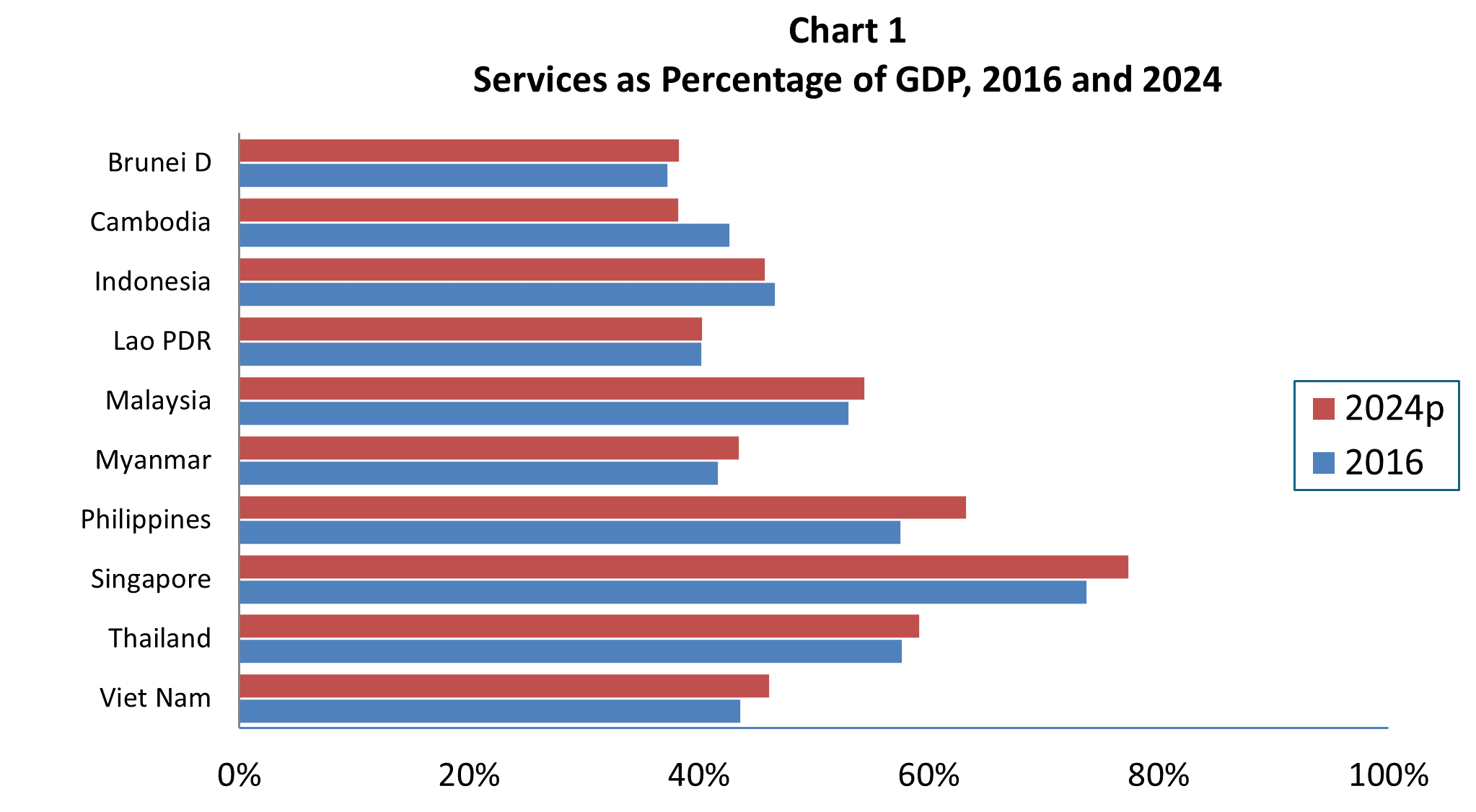
(Source: ASEANStats, 2019 and 2025)
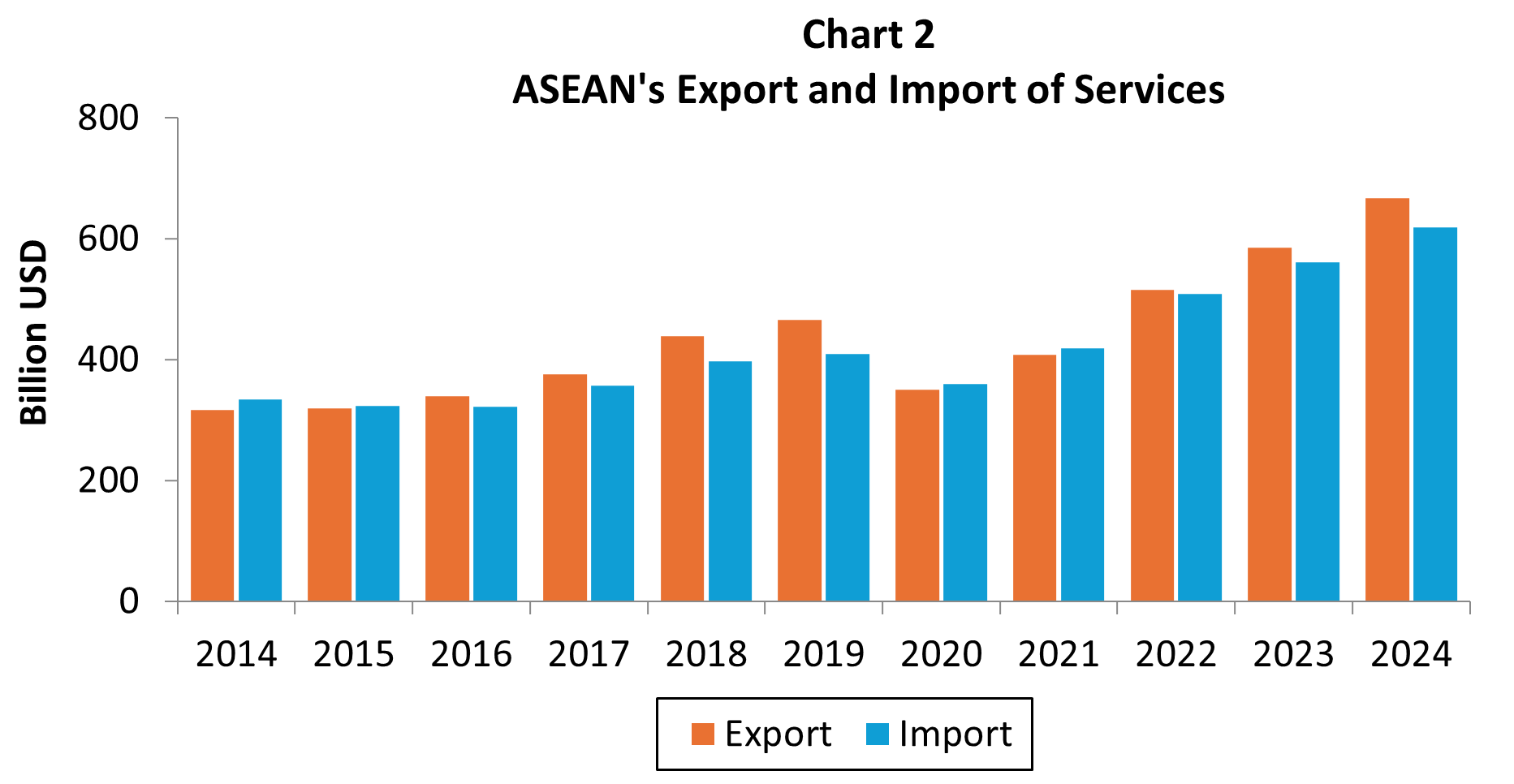
Except for the decrease of trade during the 2020 global COVID-19 pandemic, ASEAN’s services export grew steadily from USD 319.2 billion in 2015 to USD 667.9 billion in 2024, at an annual average growth rate of 7.7%; while ASEAN’s services import also increased from USD 323.0 billion to USD 618.5 billion, at an annual average growth rate of 6.7%. Encouragingly, since 2016, ASEAN has already become a net exporter of services, except for the first two years of the COVID-19 pandemic.
(Source: ASEANStats, 2025)
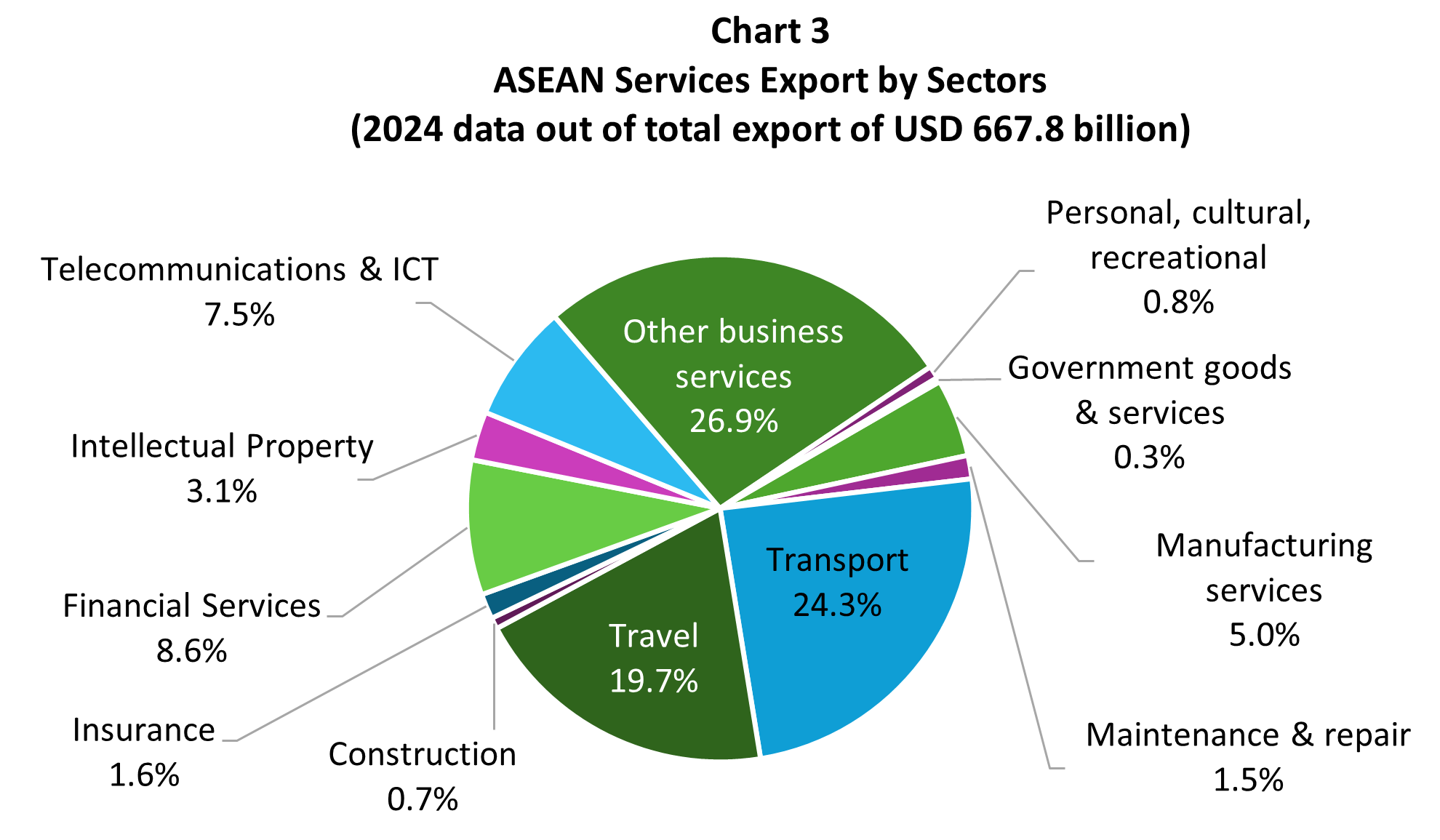
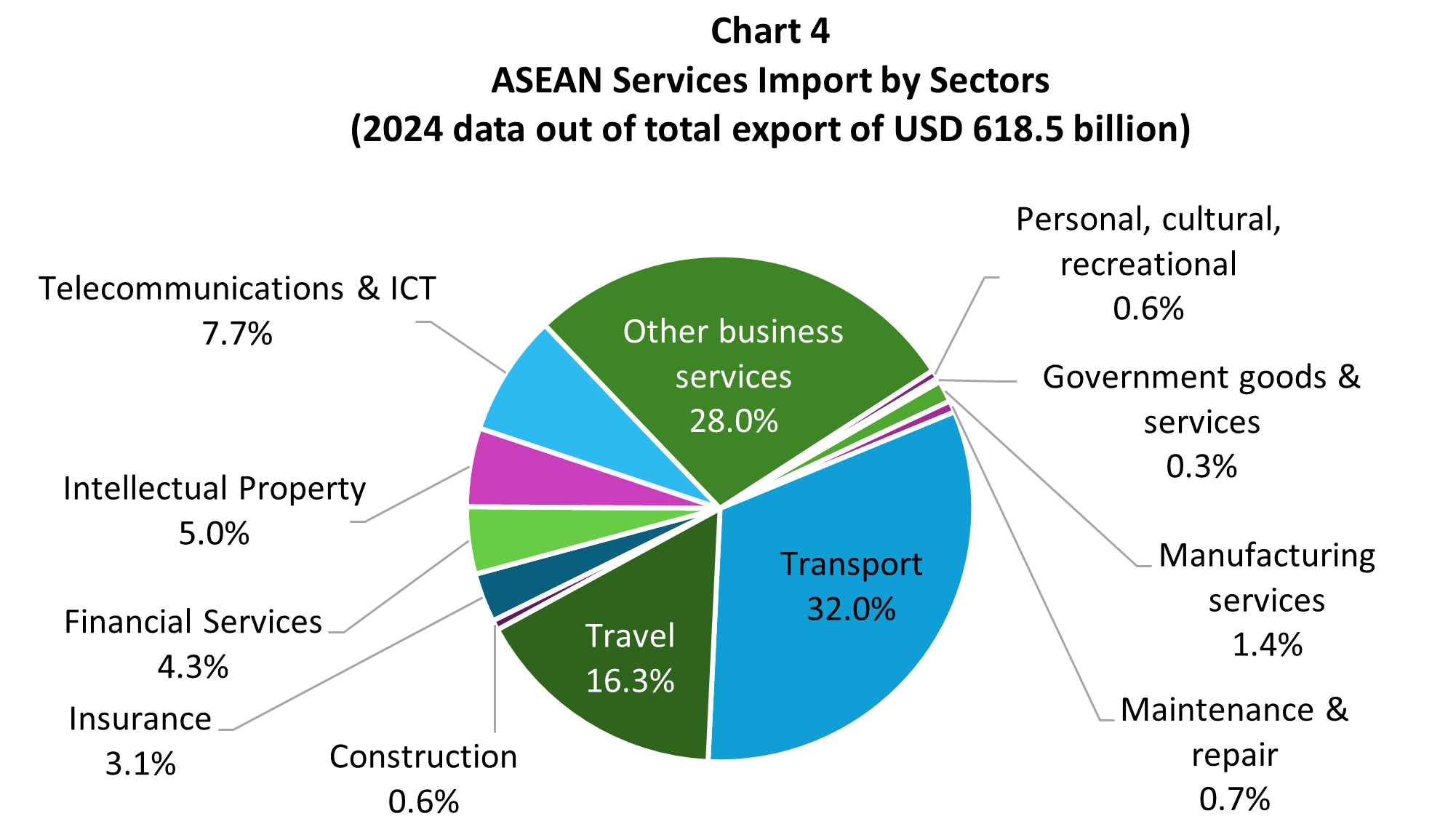
Transport, travel, and other business services have significantly dominated the export and import of services of ASEAN over the past years, followed by financial services at the distant fourth place. However, over the past decade, telecommunications and ICT services have become an increasingly significant component of ASEAN’s services trade, followed by manufacturing services for exports and intellectual property charges for imports. This trend highlights ASEAN’s growing role as one of the world’s key manufacturing hubs. These services sectors are classified based on the IMF Balance of Payments Manual, 6th Edition.
(Source: ASEANStats, 2025)
(Source: ASEANStats, 2025)
Services sectors have also been traditionally the largest recipient of Foreign Direct Investments (FDI) into the region. Throughout the last 15 years, services sectors have attracted about 60 or higher percentage of total FDI flow into ASEAN.
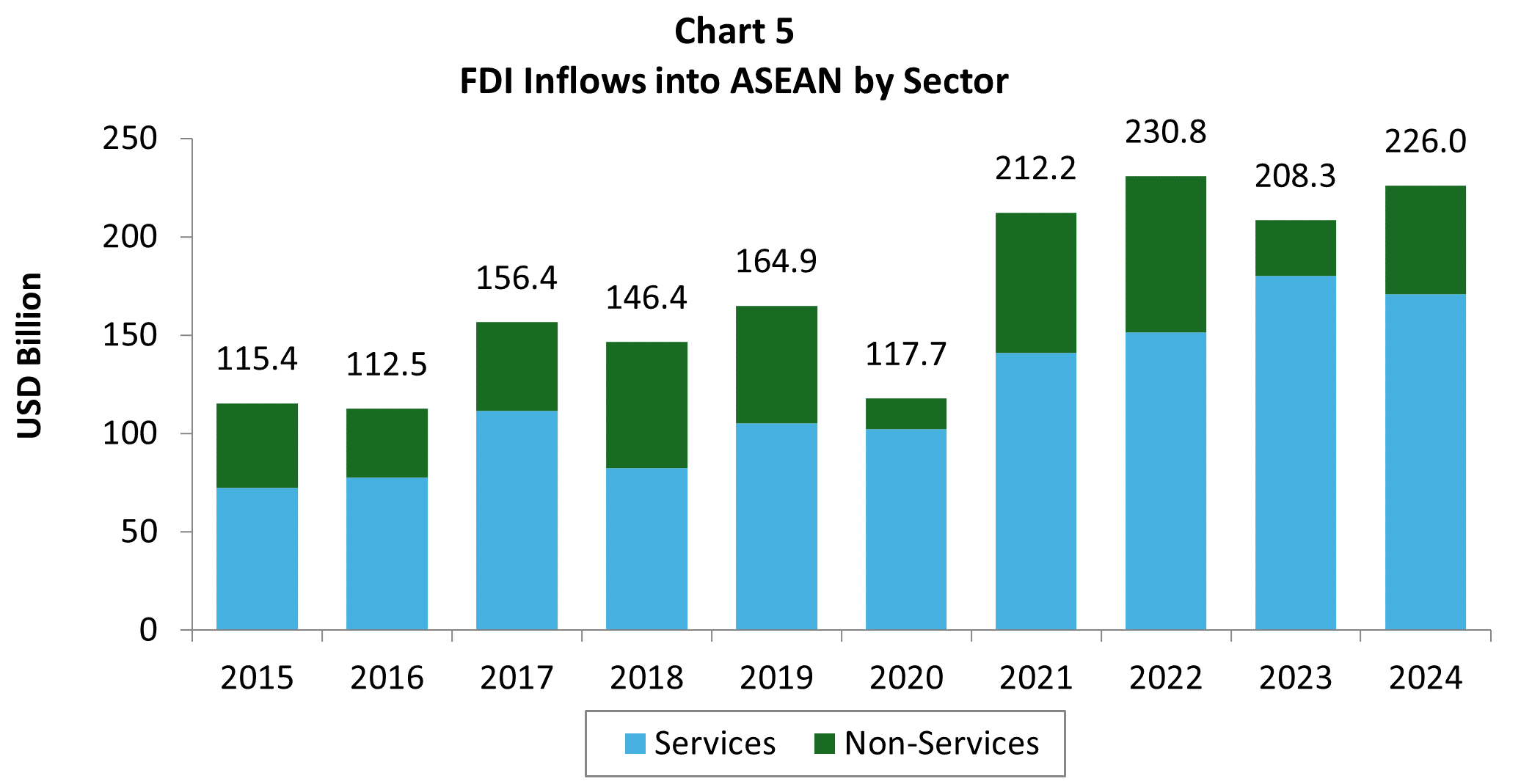 (Source: ASEANStats, 2025)
ASEAN Framework Agreement on Services (AFAS)
Signed by the ASEAN Economic Ministers (AEM) in 1995, AFAS marked ASEAN’s commitment to promoting the free flow of services. It aligns with and builds upon the WTO’s General Agreement on Trade in Services (GATS) and has led to multiple rounds of negotiations to improve the commitments of ASEAN Member States on top of their WTO commitments and aim to deepen regional integration.
Continued efforts in ASEAN have resulted in ten packages of commitments under the AFAS signed by the AEM. These packages provide for details of commitments of each ASEAN Member State in various services sectors and subsectors. In addition, there has also been seven additional packages of commitments in financial services under the AFAS signed by the finance ministers and nine additional packages of commitments in air transport services under the AFAS signed by the ATM.
All of these contribute to progressively deeper level and wider coverage of ASEAN Member States’ commitment to substantially eliminate restrictions to trade in services among them.
Click here for the text of the AFAS
Click here for ASEAN Member States’ AFAS commitments under the ASEAN Economic Ministers (AEM)
Click here for ASEAN Member States’ AFAS commitments in air transport services under the ASEAN Transport Ministers (AEM)
Click here for ASEAN Member States’ AFAS commitments in financial services under the ASEAN Finance Ministers’ and Central Bank Governors’ Meeting (AFMGM)
ASEAN Trade in Services Agreement (ATISA)
Signed in 2020, ATISA represents major milestone in ASEAN’s journey toward deeper regional integration in services. Building on the foundation laid by the AFAS, ATISA strengthens legal commitments among ASEAN Member States and sets a clearer obligation in liberalising trade in services.
ATISA introduces a modern and more business-friendly approach to services commitments by adopting the negative list scheduling method. This means that all services sectors are considered open unless explicitly listed as reservations, providing greater transparency and predictability for businesses.
Under the ATISA, ASEAN Member States are transitioning their AFAS commitments, previously scheduled using the GATS-style positive list, into schedules of Non-Conforming Measures (NCMs). This transition will be done within the timeline stipulated in the Agreement. The transformation will enhance clarity and accessibility of information for service suppliers and investors, supporting a more integrated and competitive ASEAN services market.
Click here for the text of the ATISA along with its annexes
ASEAN Services Facilitation Framework (ASFF)
Adopted in 2024, ASFF is a non-binding framework providing policy guidelines to reduce regulatory barriers and improve the ease of doing business in services. It complements the legally binding ATISA by focusing on practical measures that enhance the business environment for service providers across ASEAN.
ASFF promotes a forward-looking approach to services facilitation through five key pillars:
- Streamlined Regulations: Encouraging objective, transparent, and efficient administrative procedures for service authorisation and licensing
- Digitalisation: Supporting the adoption of digital technologies and the development of single digital platforms to simplify service delivery and regulatory compliance.
- Transparency: Promoting the publication of relevant laws, procedures, and standards, and enabling stakeholder input through public consultations.
- Mobility: Facilitating the temporary movement of service suppliers and enhancing the recognition of professional qualifications.
- Sustainability and Innovation: Advancing policies that support circular economy principles, ESG standards, and innovation in service sectors.
Together, these elements help ASEAN Member States create a more predictable, inclusive, and competitive services ecosystem, one that supports regional integration and benefits businesses of all sizes. Click here for the text of the ASEAN Services Facilitation Framework (ASFF)
Sectoral Cooperations
ASEAN’s services integration is supported by targeted cooperation in key sectors that are vital to regional development and connectivity. These sectors, namely healthcare and logistics, are guided by dedicated roadmaps and working groups that aim to improve service quality, facilitate professional mobility, and enhance infrastructure and regulatory coherence. These sectoral initiatives complement broader ASEAN frameworks by addressing practical challenges and enabling smoother cross-border operations.


What is ASEAN Qualifications Reference Framework?
The ASEAN Qualifications Reference Framework (AQRF) is a common reference framework that enables comparisons of education qualifications across participating ASEAN Member States (AMS).
The objectives of AQRF include:
- Support recognition of qualifications
- Encourage the development of qualifications frameworks that can facilitate lifelong learning
- Encourage the development of national approaches to validating learning gained outside formal education
- Promote and encourage education and learner mobility
- Support worker mobility
- Improve understanding of qualifications systems
- Promote higher quality qualifications systems
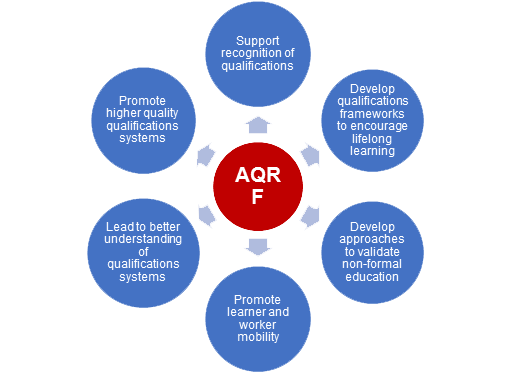
The AQRF developed is based on agreed understanding between AMS. By design, it aims to have a neutral influence on national qualifications frameworks (NQF) of participating AMS. AMS are invited to participate in AQRF on voluntary engagement and implementation. More important, engagement in AQRF does not require changes to national qualifications systems (NQS). AQRF respects the specific structures and processes of participating AMS to maintain their responsiveness to national priorities.
The AQRF was endorsed by the ASEAN Economic Ministers (AEM) in August 2014; the ASEAN Education Ministers (ASED) in September 2014; and the ASEAN Labour Ministers (ALMM) through ad-referendum from November 2014 to May 2015.
Subsequently, the AQRF Governance and Structure document was endorsed by ALMM and ASED in May 2016, and AEM in August 2016, and provided the basis for the establishment of the AQRF Committee to implement the AQRF.
Referencing to AQRF
Referencing is a process that establishes the relationship between the eight-level AQRF and NQF or qualifications system of participating AMS; and the number of levels an NQF may differ, and typically between 8 and 9 levels. AQRF would therefore improve the understanding of the qualification of each level of a NQF or qualifications system of the participating AMS. AQRF also works as an information tool to facilitate the recognition of qualifications and does not replace the decision-making process of the competent authorities in each AMS.
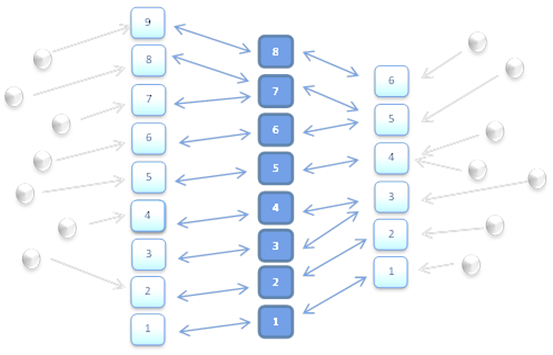
In the long-term, AQRF could potentially serve as a meta-framework to support the recognition of its levels against other Regional Qualifications Framework (RQF) and inter-regional recognition. Interested AMS can choose to begin referencing according to their readiness.
How does AQRF support NQF?
Recognising the difference in development stages – with some AMS having established comprehensive NQF, others with sectoral frameworks, and some do not yet have any – AQRF aimed to support and enhance AMS NQF or NQS by offering a mechanism to facilitate comparison, transparency and higher quality qualifications systems. AQRF is underpinned by a set of agreed quality assurance principles and standards, and requires participating AMS to describe their education and training quality assurance systems.

Complementing MRAs
ASEAN Mutual Recognition Arrangements (MRA) aim to facilitate the mobility of professionals within ASEAN through the recognition of qualifications, experience obtained, requirements met, or licenses or certifications granted by the relevant authorities in an AMS for mutual recognition by other AMS. The AQRF complements and supports this process by enabling a broad comparison of qualifications across AMS.
Role of AQRF in ASEAN Community Building – An ASEAN Cross-sectoral Initiative
The AQRF aimed to support ASEAN Community building and specifically through the process to achieve the following goals:
- free flow of skilled labour (through harmonisation and standardisation) within the region, as indicated in the ASEAN Economic Community (AEC) 2015 Blueprint; and
- ASEAN Socio-Cultural Community (ASCC) 2015 Blueprint which seeks “to establish national skills frameworks as an incremental approach towards an ASEAN skills recognition framework”.
With the launch of the AEC and ASCC Blueprints 2025, AQRF will continue to play an important role in facilitating the seamless movement of skilled labour within ASEAN towards a highly integrated and cohesive economy, and human capacity development respectively.
Above all, AQRF is an initiative in line with the ASEAN Charter’s objective to develop human resources through closer cooperation in education and life-long learning to empower the peoples of ASEAN and to strengthen the ASEAN Community.
In short, AQRF is a unique ASEAN’s cross-sectoral and cross-pillar initiatives and plays an important role in supporting ASEAN Community building.
Latest Developments
The establishment of the AQRF Committee and the inauguration of its first Meeting on 9-10 February 2017 marked a milestone for ASEAN. The AQRF Committee is responsible for considering referencing reports submitted by participating AMS. All interested AMS are invited to express their intent to reference their NQF to AQRF.
Background and Acknowledgement
Recognising the coverage of a RQF and its impact on various sectors, a Task Force on AQRF (TF-AQRF) was created in 2013 under the auspice of ASEAN-Australia-New Zealand Free Trade Area (AANZFTA) Economic Cooperation and Work Programme (ECWP) to take on the task to develop the AQRF. The TF-AQRF comprised representatives from ASEAN ministries of trade, education, and labour or manpower, qualification, accreditation and relevant agencies. As AANZFTA Parties, representatives from Australia and New Zealand formed part of the TF-AQRF as non-voting members.
The TF-AQRF played an important coordinating role between and across the relevant ASEAN sectoral bodies, international organisations, as well as related regional initiatives. This enhances synergy and ensures consistency and alignment with internationally agreed frameworks, principles or standards in the development of the AQRF.
Since 2011, AANZFTA Economic Cooperation Support Programme (AECSP) has rendered continuous support to the AQRF initiative from Education and Training Governance: Capacity Building for National Qualifications Framework (NQF) Phase I to IV. NQF Phase IV will run until June 2019, and aims to support the referencing process of at least two AMS. For more information on AANZFTA AECSP activities, please visit http://aanzfta.asean.org/
More questions?
For any questions on AQRF, please contact Services and Investment Division (SID) of the ASEAN Secretariat at AQRF-ASEC@asean.org
Official Publications on AQRF:
- AQRF Guidelines on Digital Recognition of Qualifications and Credentials
- AQRF: A Practical Guide and All You Need to Know
- AQRF Factsheet
AQRF Referencing Report of ASEAN Member States:
Latest News on AQRF:
- Press Release of the 6th AQRF Committee Meeting, 21-23 May, Luang Prabang, Lao PDR
- Press Release of the 5th AQRF Committee Meeting, 27-29 November, Bandar Seri Begawan, Brunei Darussalam
- Press Release of the 4th AQRF Committee Meeting, 14-16 May 2018, Bangkok, Thailand
- Press Release of the 3rd AQRF Committee Meeting, 14-16 November 2017, Manila, the Phillipines
- Press Release of the 2nd AQRF Committee Meeting, 12-13 July 2017, Manila, the Philippines
- Press Release of the 1st AQRF Committee Meeting, 9-10 February 2017, Jakarta, Indonesia
- Chairman’s Statement of the 28th and 29th ASEAN Summits, 6-7 September 2016, Vientiane, Lao PDR
- Joint Media Statement of the 48th ASEAN Economic Ministers Meeting, 3 August 2016, Vientiane, Lao PDR
- Joint Statement of the 9th ASEAN Education Ministers Meeting, 27 May 2016, Selangor, Malaysia
- Joint Communiqué of the 24th ASEAN Labour Ministers Meeting, 15 May 2016, Vientiane, Lao PDR
Endorsed AQRF Documents:
Documents developed by TF-AQRF and AQRF Committee:
- AQRF Referencing Guideline (August 2020)
- Concept Note 1 on AQRF Non formal and informal learning
- Concept Note 2 on AQRF learning outcomes
- Briefing Paper No. 1 on Qualifications Frameworks and Quality Assurance Systems
Other related ASEAN Documents:
